# The Jackson Wire — Full Text
> Independent reporting on Jackson and Mississippi politics, development, and real estate — and the people who profit from them. Tips welcome, sacred cows not.
# Madison County Approves $48 Million Conference Center in Ridgeland, Despite Lone Dissent Over Taxpayer Risk
> The 3-1 vote authorizes urban renewal bonds for a 1,800-person venue near Sunnybrook Road. A private developer plans a 250-room hotel next door. Critics say taxpayers are on the hook if revenue falls short.
*Commercial Real Estate · By Jackson Wire Staff · July 24, 2026*
Madison County is betting $48 million in urban renewal bonds on a conference center that does not yet exist. The Board of Supervisors voted 3-1 Monday to authorize the financing for a 1,800-person venue near the intersection of Sunnybrook Road and Colony Park Boulevard in Ridgeland. One supervisor was absent.
The project pairs the publicly financed conference center with a privately funded 250-room resort hotel. Gabriel Prado, CEO of Pracon Global Investment Group, is the developer behind the hotel. He says the combined $120 million investment will generate $250 million in economic impact across the county.
Supervisor Casey Brannon cast the lone dissenting vote. He argued the county should not be in the business of financing private development with public debt. “I just don’t think that taxpayers need to be footing the bill for this,” Brannon said, according to WLBT. “We could spend $48 million lighting more roads or fixing more roads, not building a building that we will eventually turn over to a private citizen.”
Brannon also warned about the long-term budget impact. “We are going to be using this money to pay a debt service for the next 15 to 20 years,” he said. “And that will take money off the table for us to be able to lower their taxes.”
Board President Gerald Steen disagreed, saying the county has zero direct investment in the project. “This conference center is something that Madison County has needed for a while, and this is a way that we can make it happen in a positive way,” Steen said.
The financing structure relies on three layers of revenue: conference center operating income, a state tourism tax rebate, and a property levy on the hotel itself. Ridgeland Mayor Gene McGee said the tourism rebate is based on tax revenue that does not exist yet because the project has not been built. Prado has agreed to direct roughly $18.9 million of those rebate proceeds to the county to accelerate debt repayment.
McGee acknowledged the risk but said the structure minimizes it. If conference center revenues fall short, the county can place a first lien tax levy on the hotel property. “Madison County has an additional level of protection,” McGee said.
The conference center has been discussed for two decades. Prado credited Jan Collins, executive director of the Madison County Business League and Foundation, with first proposing the idea 20 years ago. “Many developers have come behind trying to do it until we finally were able to put this structure in place that it works,” Prado said.
When the public hearing opened Monday, not a single resident stood up to speak for or against the plan. One person in the room asked what the discussion was about. A board member noted that not everyone present knew what was being considered.
The City of Ridgeland voted unanimously in March to support the urban renewal plan. The county’s Planning and Zoning Department approved the project in February, finding it consistent with the county’s comprehensive plan.
The board also passed a second resolution Monday to begin assembling a financing package. Prado said he expects to return to the full board in 60 to 90 days to finalize the bond financing.
The question Brannon raised about who bears the risk if the conference center does not generate enough revenue is not new in Mississippi. In 2019, the city of Jackson approved $15 million in bonds for the King Edward Hotel redevelopment, a project that required multiple restructurings. Madison County’s $48 million bet is more than three times that amount, and the county has never operated a conference center before.
---
[The Jackson Wire](https://www.thejacksonwire.com/) · [Read on the web](https://www.thejacksonwire.com/article/madison-county-approves-48-million-conference-center-ridgeland)
---
# Horhn Says No Lake Hico Data Center in the Works as Federal Judge Questions Water Impact
> Mayor John Horhn told WLBT on Monday that talks about a data center at the Lake Hico site are "very premature," walking back records showing his administration quietly planned the hub for months. Separately, a federal judge has raised concerns about what the project could mean for JXN Water.
*Politics · By Jackson Wire Staff · July 21, 2026*
Mayor John Horhn told WLBT on Monday that no data center is currently in the works for the Lake Hico site, calling discussions about the project 'very premature.' The statement marks a sharp reversal from records obtained by The Jackson Wire showing his administration had quietly planned a data center hub at the site for months.
The mayor's comments came the same day a federal judge expressed concern about what a potential data center project could mean for JXN Water, the federally mandated water system that has been under court supervision since 2022. The judge's remarks suggest the project could face legal headwinds beyond the city council's moratorium.
Horhn's characterization of the talks as 'very premature' contradicts internal documents reviewed by The Jackson Wire last week that showed city officials had been in discussions with developers about the Lake Hico site since at least early 2026. Those records indicated the administration had identified the 200-acre parcel as a priority location for data center development.
The city council passed a 120-day moratorium on new data center developments on July 14, voting 5-2 after months of public debate. The moratorium was intended to give the city time to study zoning, infrastructure, and utility impacts before approving any new projects.
Council members who supported the moratorium cited concerns about water usage, energy demands, and the lack of a comprehensive data center policy. The Lake Hico site, located near the Pearl River and within JXN Water's service area, had emerged as a flashpoint in those debates.
The federal judge's concern adds a new dimension. JXN Water has been operating under a federal receivership since U.S. District Judge Henry T. Wingate found the city's water system in contempt of court for failing to address chronic failures. A large data center's water demands could strain a system still struggling to meet basic service obligations.
Records show the Horhn administration had been in contact with at least two data center developers about the Lake Hico site. One proposal envisioned a campus of multiple buildings drawing significant power and water from city utilities. The administration did not brief the council on these discussions before they were made public.
Horhn's Monday statement appears designed to cool the political temperature. But the gap between what the administration's records show and what the mayor now says publicly raises questions about the city's overall approach to data center development and whether the council can trust the information it receives from the executive branch.
The Lake Hico site has been a subject of speculation since at least June, when The Jackson Wire first reported on the administration's quiet planning. The site's proximity to the Pearl River and existing power infrastructure made it attractive to developers, but its location within a floodplain and near residential neighborhoods drew opposition.
The council's moratorium expires in mid-November. By then, the city is supposed to have completed a study of data center impacts and adopted a zoning framework. Whether the administration will share whatever it knows about developer interest in specific sites remains an open question.
For JXN Water, the judge's concern may be the more consequential development. The water system has made halting progress under receivership, and any new large-scale industrial user would require approvals that the court could block. The judge's remarks suggest the court is watching the data center debate closely.
---
[The Jackson Wire](https://www.thejacksonwire.com/) · [Read on the web](https://www.thejacksonwire.com/article/horhn-administration-backtracks-lake-hico-data-center-judge-questions-jxn-water-impact)
---
# Vicksburg Residents Protest $3 Billion AWS Data Center Planned Near Elementary School
> About 50 people gathered Saturday on Dana Road to oppose the Amazon Web Services project, citing concerns over energy costs, water use, and health risks. The protest comes days after Jackson passed its own data center moratorium.
*General News · By Jackson Wire Staff · July 20, 2026*
About 50 Vicksburg residents gathered Saturday morning to protest the $3 billion Amazon Web Services data center planned for Dana Road, less than a mile from Dana Road Elementary School, according to WLBT and the Vicksburg Daily News.
The protest marks the first organized public opposition to the AWS project since the Vicksburg-Warren Economic Development Partnership announced it in November 2025. At the time, officials called the data center the largest capital investment in Warren County history, promising at least 200 high-tech direct jobs and 500 indirect jobs.
Residents carried handmade signs and wore bright colors to be visible from a distance. Their concerns mirror arguments that have surfaced in Jackson, Madison County, and other parts of the state where data center projects are proposed: increased energy and water costs, and potential health risks from the facilities' diesel backup generators and water consumption.
The Dana Road location is particularly contentious. The site sits near an elementary school, and protesters questioned whether the industrial-scale facility belongs in a residential corridor.
The protest came three days after the Jackson City Council passed a five-to-two vote to enact the state's first data center moratorium, halting new data center approvals for 180 days while the city studies infrastructure impacts. Jackson's moratorium does not affect Vicksburg, but the timing underscores a growing regional unease with the rapid pace of data center development.
Mississippi has become a national hotspot for data center construction, driven by cheap power, available land, and state incentives. AWS, Saxum, Prado AI, and other firms have announced or proposed projects across the state. The Mississippi Public Service Commission is currently weighing a docket (2026-AD-10) that could reshape utility rate structures for large industrial power users.
The Vicksburg-Warren EDP has defended the project as an economic engine for a county that has struggled to attract major employers. The $3 billion investment would generate construction work for years and add high-paying jobs to a local economy still recovering from the decline of riverboat gaming and manufacturing.
But Saturday's turnout suggests the sales pitch has not won over everyone. The crowd of 50 is small by the standards of the data center fights playing out in Virginia and Ohio, but it is a signal that Mississippi's data center boom is generating political friction beyond Jackson's city limits.
The question now is whether the Vicksburg protest is a one-day event or the beginning of a sustained opposition campaign. The AWS project has not yet broken ground. The permitting process at the county level has not been made public. And the protest organizers have not announced next steps.
For Jackson residents watching from 45 miles east, the Vicksburg protest offers a preview of what the city's own moratorium debate was trying to get ahead of: the tension between economic development promises and the tangible costs a data center imposes on a community.
---
[The Jackson Wire](https://www.thejacksonwire.com/) · [Read on the web](https://www.thejacksonwire.com/article/vicksburg-residents-protest-aws-data-center-dana-road)
---
# Interim DA McCullouch Asks State Auditor to Review Owens' Office
> Brad McCullouch, appointed to replace Jody Owens after his federal guilty plea, invited Shad White to audit the Hinds County District Attorney's Office. Owens separately moved to surrender his law license.
*Politics · By Jackson Wire Staff · July 19, 2026*
Interim Hinds County District Attorney Brad McCullouch asked State Auditor Shad White on Friday to conduct an independent review of the office's financial practices and internal controls, according to WLBT. The request came four days after McCullouch was appointed to replace Jody Owens, who resigned following a guilty plea to a federal conspiracy charge.
“Accountability begins with our office,” McCullouch said in a statement. “An independent review provides the public with objective assurance. If our practices are sound, the public deserves that. If improvements are identified, we will make them.”
The announcement marks the first major move by McCullouch since Governor Tate Reeves appointed him to fill the remainder of Owens' term. A special election to replace Owens permanently is set for November.
Owens pleaded guilty in federal court to one count of conspiracy to commit bribery. The charge stemmed from a scheme in which Owens, then Hinds County District Attorney, accepted payments in exchange for official actions. His resignation followed days later.
Separately, Owens has moved to surrender his law license, according to a Clarion Ledger report published Saturday. The Mississippi Bar has not yet publicly docketed the petition, but the move is standard for attorneys convicted of felony offenses. If the Mississippi Supreme Court accepts the surrender, Owens will be disbarred and unable to practice law in the state.
The audit request and the license surrender are the first concrete aftershocks of Owens' guilty plea, which sent shockwaves through Jackson's legal and political establishment. Owens had held the office since 2016 and was widely considered one of the most powerful elected officials in Hinds County.
McCullouch, who previously served as a prosecutor in the same office, now inherits a staff, a budget, and a caseload that operated under Owens for nearly a decade. He has not said whether he will request a broader forensic audit or limit the review to financial controls.
The timing is notable. McCullouch's appointment itself has drawn scrutiny: he lives in Madison County, not Hinds County. A University of Mississippi law professor told WLBT this week that the appointment may violate the Mississippi Constitution, which requires district attorneys to reside in the district they serve.
Reeves' office has not responded to the constitutional question. McCullouch has not said whether he plans to relocate.
The special election in November will determine who serves the remainder of Owens' term, which runs through 2027. Candidates have until September to qualify. No major candidates have announced.
For now, McCullouch's invitation to the auditor is a signal: the new administration wants distance from the old one. Whether the audit finds problems or not, the message has already landed.
---
[The Jackson Wire](https://www.thejacksonwire.com/) · [Read on the web](https://www.thejacksonwire.com/article/interim-da-mccullouch-asks-auditor-to-review-owens-office)
---
# Records Show Horhn Administration Quietly Planned Lake Hico Data Center Hub for Months
> Internal documents obtained by WLBT reveal the city eyed a $5 billion to $15 billion hyperscale data center at the former Rex Brown plant site, projecting $9 million to $20 million a year in new revenue. The council passed a moratorium on data centers two days before the records came out.
*General News · By Jackson Wire Staff · July 18, 2026*
Two days after the Jackson City Council voted 5-2 to ban new data centers, records surfaced showing the Horhn administration had spent months quietly planning to build one of the largest in the state at Lake Hico.
The documents, obtained by WLBT through an open records request and reviewed by The Jackson Wire, describe a strategy to turn the 654-acre site of the former Rex Brown Steam Electric Station into a hyperscale data center hub. The briefing document calls it 'Jackson's single best opportunity in 50 years to reverse the structural decline of its tax base.'
The financial projections are striking. A $5 billion to $15 billion facility at the site could generate between $9 million and $20 million a year in direct revenue for the city, and an equal amount for Jackson Public Schools, according to the documents. That revenue stream, the briefing states, 'exceeds Jackson's current $23 million general fund deficit within 1-2 years of full operation.'
The records show Mayor John Horhn's administration met with Entergy Mississippi CEO Haley Fisackerly and former Mayor Kane Ditto on April 30 to discuss data centers. Earlier, on April 10, the mayor's chief of staff Cathy Northington received an email about a meeting with Thomas Consulting Group to discuss 'the economic incentives and legal structures that shape utility decisions about large electricity loads.'
The city had been working with TCG for months on best practices for attracting and evaluating data center proposals, the records show. The documents also list the site's advantages: existing power infrastructure from the Entergy substation already on the property, inactive water line access, pre-clearance from the Mississippi Department of Environmental Quality, a security fence already in place, and proximity to industrial roads, rail lines, and fiber backbone along I-220.
Ward Two Councilwoman Tina Clay, who voted for the moratorium, saw some of the documents for the first time Friday morning. She was not surprised. 'It's been on the street that they were doing that,' she told WLBT, referring to Lake Hico. Clay believes the administration intentionally adopted a $135 million budget that was $23 million too high to make the case for a data center. 'That $135 million, that was to make it look like the city of Jackson needed money, bad,' she said.
Ward One Councilman Ashby Foote, who voted against the moratorium, took the opposite view. He said the records show city leaders doing their due diligence. 'Whether the city has actually been recruiting a data center from day one or not, so what? I mean, they should be trying to recruit all kinds of businesses,' Foote said. He noted that $9 million a year in new revenue would allow the city to resurface 100 miles of roads annually, something it is not close to doing now.
The project would also create 4,000 to 7,000 construction jobs and 500 to 1,200 permanent jobs, according to the briefing. It would mean $5 million to $15 million in workforce development funding for Jackson Public Schools, Jackson State University, Hinds Community College, and the Bean Path.
Joey Deason, executive director of the Madison County Economic Development Authority, told WLBT that behind-the-scenes talks are standard for projects of this scale. He said it took nearly seven years to land Amazon Web Services in Madison County, and premature announcements could have killed the deal. 'Companies don't want the competition to know where they're going, what they're doing, and their plans for the future,' Deason said.
The timing raises a question the council will have to answer: does the moratorium stop a project the administration had already been negotiating? The moratorium ordinance, passed July 14, imposes a temporary ban on new data center permits while the city studies their impact. The Lake Hico documents suggest the administration was further along in its planning than the council debate suggested.
Jackson Director of Communications Nic Lott declined to comment on the records. The council's moratorium is set to expire after a study period, but the Lake Hico documents make clear that the conversation about data centers in Jackson is far from over.
---
[The Jackson Wire](https://www.thejacksonwire.com/) · [Read on the web](https://www.thejacksonwire.com/article/lake-hico-data-center-records-horhn-administration)
---
# Jackson Passes State's First Data Center Moratorium, 5-2, After Months of Debate
> The six-month pause blocks new data center proposals while the city drafts regulations. The vote split the council along familiar lines: economic opportunity versus neighborhood control.
*General News · By Jackson Wire Staff · July 17, 2026*
The Jackson City Council voted Tuesday to become the first municipality in Mississippi to impose a moratorium on new data center development. The 5-2 vote capped three months of public hearings, dueling expert testimony, and a rezoning fight that had turned a quiet stretch of northwest Jackson into a battleground over the city's future.
The ordinance halts the city from accepting, processing, or approving any applications for special use permits, conditional use permits, zoning map amendments, or building permits related to data centers for 183 days. Because the vote was not unanimous, the moratorium takes effect in 30 days rather than immediately, per city rules.
Ward 4 Councilman Brian Grizzell, who first proposed the pause in April, called it a necessary step. 'This council has voted to go in the right direction,' he said after the vote.
Voting in favor were Grizzell, Ward 2's Tina Clay, Ward 3's Kenneth Stokes, Ward 6's Lashia Brown-Thomas, and Ward 7's Kevin Parkinson, who participated remotely. Voting against were Ward 1's Ashby Foote and Ward 5's Vernon Hartley.
The vote came after a rezoning application by New Jersey-based Saxum Investment Group to build a data center on roughly 230 acres near Forest Avenue and Interstate 220 had galvanized opposition in Clay's ward. The company had expanded its original 190-acre request by 40 acres in April, according to filings with the city planning board. The planning board postponed the case at Saxum's request in May and again in June, as the company said it wanted to wait for the city to adopt data center standards.
Foote argued the moratorium would cost Jackson a rare chance to shore up its finances. The city faces a roughly $23 million budget shortfall, and Foote said a data center could generate millions in new tax revenue for city government, Hinds County, and Jackson Public Schools. 'It may not be the perfect economic development, but it's a good economic development,' he said.
Clay pushed back directly. She said the council had knowingly adopted an unrealistic budget and should not use data centers as a rescue plan. 'From day one, we knew we didn't have but $112 million coming in,' she said. 'We have held the budget to the point where we don't have a deficit.'
Hartley, who voted against the moratorium, nevertheless said Jackson was not ready for a data center. 'We're looking at an industry that is still being tested all over the country,' he said. 'Jackson is not ready.' He urged the council to hire engineers and consultants to write permanent regulations rather than rely on a temporary pause.
Before the final vote, the council approved an amendment from Parkinson exempting land adjacent to Jackson-Medgar Wiley Evers International Airport from the moratorium. The city owns roughly 1,100 acres around the airport, much of it undeveloped. Parkinson argued the airport corridor could host data centers without the same risks to nearby neighborhoods. A separate amendment to shorten the moratorium to 60 days failed on a 2-3-2 vote.
The debate in Jackson mirrors a national reckoning. On the same day the council voted, New York became the first state to enact a data center moratorium. In Mississippi, a 2024 state law known as the Data Center Giveaway Act stripped the Public Service Commission of its usual oversight role over large-load energy contracts, allowing utilities like Entergy Mississippi to enter secret agreements with data center operators. A May 2026 report by Synapse Energy Economics found that Entergy's residential customers in Mississippi are already paying an estimated $10.60 more per month on their electric bills due to investments made to serve data centers.
The contrast with Madison County is sharp. There, Amazon Web Services' data center campus has driven a property value surge so large that county officials recently doubled the payment-in-lieu-of-taxes agreement. Madison County projects it will collect $6 million in new property tax revenue from AWS in fiscal year 2026, rising to $54 million annually by 2032. Jackson's moratorium ensures the capital city will not see similar revenue anytime soon.
The council can extend or cancel the moratorium at any time. During the six-month pause, the ordinance directs the city to identify appropriate sites for data centers and study their potential impacts on water, sewer, electrical infrastructure, and nearby neighborhoods. Whether the council can produce a permanent regulatory framework before the clock runs out is the open question.
---
[The Jackson Wire](https://www.thejacksonwire.com/) · [Read on the web](https://www.thejacksonwire.com/article/jackson-data-center-moratorium-passes-5-2)
---
# Morning Brief: Jul 17 · Youth Court Overhaul Heads to Reeves; JTRAN Strike Enters Day 5
> The Mississippi Legislature passed a sweeping youth court reform bill in special session, sending it to Gov. Tate Reeves for signature before a July 24 Supreme Court deadline.
*General News · By Jackson Wire Staff · July 17, 2026*
## 1. Youth court overhaul heads to Reeves
The Mississippi Legislature passed Senate Bill 2001 on Thursday, a sweeping redesign of the state's youth court system that will install full-time judges in all 82 counties, eliminate the part-time referee system by July 2027, and open juvenile proceedings to the public. The bill cleared the House largely along party lines after a late-night Senate vote Wednesday. Only two House Republicans voted no. Democrats argued the 200-page bill was rushed through without adequate review. The legislation also funds two new juvenile detention centers and expands the Oakley Youth Development Center in Hinds County. Gov. Tate Reeves is expected to sign the bill before the Mississippi Supreme Court's July 24 deadline, the Clarion Ledger reported.
## 2. JTRAN strike enters Day 5
JTRAN bus operators represented by ATU Local 1208 remain on strike for a fifth day Friday, leaving thousands of Jackson residents who rely on public transit without regular service. The union walked off the job Monday after failing to reach a contract deal with MV Transportation, the city's contracted operator. Mayor John Horhn has urged both sides to seek federal mediation. MV Transportation has deployed drivers from out of state to maintain limited service, and the city temporarily waived the requirement that JTRAN drivers hold Mississippi driver's licenses for the strike's duration, Mississippi Today reported. Workers last went on strike for 14 days in September 2024.
## 3. JPS Beautification Day underway, school starts July 29
Jackson Public Schools is holding its annual Beautification Day on Friday, with volunteers cleaning up campuses along the Capitol Street Corridor ahead of the first day of school on July 29. The district is partnering with the Jackson Association of Neighborhoods for the cleanup, which runs from 7 a.m. to noon. JPS has warned families that there will be no registration during the first week of school, meaning parents must enroll their children now to avoid delays. The district's Convocation for faculty and staff is scheduled for July 24. Open House schedules for the 2026-27 school year have been posted on the district's website.
## 4. Monument Street Bridge replacement heads to bid
The City of Jackson is accepting bids through July 28 for the complete removal and replacement of the Monument Street Bridge, a federal-aid project that aims to improve transportation safety in Hinds County. A pre-bid conference was held Thursday. The work includes replacing the bridge in its entirety plus related approach work, according to the city's bid management site. Contractors must comply with Mississippi Road and Bridge Construction standards. The project is part of the Jackson Metropolitan Planning Organization's Transportation Improvement Program and is funded through federal aid. Bids must be submitted in triplicate to the City Clerk's office by 10 a.m. on July 28.
## 5. Council enforces 60-person limit after data center crowds
The Jackson Fire Department has begun enforcing a 60-person occupancy limit inside the City Council chambers, a policy that went into effect at Tuesday's meeting where the council voted 5-2 to approve a 183-day data center moratorium. Fire Chief RaSean Thomas told the Clarion Ledger the enforcement followed safety concerns after a large crowd packed a Planning Board meeting in May over the proposed data center. Ward 5 Councilman Vernon Hartley, elected council president Tuesday, said he opposed how the policy was rolled out. Ward 4 Councilman Brian Grizzell defended the enforcement, saying the fire department is simply doing its job after receiving updated occupancy guidance.
---
[The Jackson Wire](https://www.thejacksonwire.com/) · [Read on the web](https://www.thejacksonwire.com/article/morning-brief-2026-07-17)
---
# Banks Rejected a Better Plea Deal. He Would Not Cooperate.
> The former councilman turned down a government offer that required cooperation with prosecutors. His two co-defendants also pleaded guilty without cooperating.
*General News · By Jackson Wire Staff · July 16, 2026*
Aaron Banks had a better offer. He turned it down.
The former Jackson city councilman pleaded guilty July 6 to one count of conspiracy in the federal bribery case that brought down three of the city's most powerful elected officials. But during the hearing in U.S. District Court, Assistant U.S. Attorney Dave Fulcher told Judge Daniel Jordan that the government had offered Banks a deal that required him to cooperate with prosecutors. Banks refused.
"We made an offer that was better, and our best offer included cooperation by the defendant," Fulcher said, according to a transcript of the proceeding reported by WLBT. "He is no longer accepting any cooperating plea agreement."
Judge Jordan paused the hearing to consult with attorneys after Banks's lawyer, Carlos Tanner, began to say his client would never accept a cooperation agreement. When proceedings resumed, Jordan asked Banks directly whether he understood that a better offer had been on the table.
"I think you had a chance to talk with your attorney and discuss the various offers that have come and gone. Is it your understanding that there was an offer at one point that was better than what you're pleading to today?" Jordan asked.
"I did reject that offer," Banks said.
Banks pleaded guilty to the same conspiracy count that former Mayor Chokwe Antar Lumumba entered less than an hour earlier that same morning. Former Hinds County District Attorney Jody Owens had pleaded guilty to the same charge a week earlier, on June 29. All three are scheduled to be sentenced together on October 15.
None of the three defendants agreed to cooperate with the government. That means prosecutors will not file the motions for sentence reductions that typically accompany cooperation agreements. Each man faces up to five years in prison, a $250,000 fine, and restitution the government has requested but not yet specified.
The contrast with earlier defendants in the same investigation is sharp. Former Ward 2 Councilwoman Angelique Lee and local businessman Sherik Marve Smith both pleaded guilty to conspiracy in 2024. Their sentencing dates have been suspended indefinitely, a sign that they are cooperating with the ongoing investigation.
Banks's refusal to cooperate means the government will not learn what he knows about the scheme from the inside. Fulcher laid out the basics in court: Banks demanded $50,000 from undercover FBI agents posing as developers, received an initial $10,000 payment routed through Owens, used the money to pay debt, and assured the agents he would deliver other council members' support for a downtown convention center hotel project.
Lumumba, for his part, told the judge, "I accept the facts that he read," after Fulcher recited the allegations. The former mayor admitted accepting $50,000 in campaign contributions in exchange for official action on the hotel project, including a call to a city employee to move a proposal deadline in the developers' favor.
The trial that was supposed to start July 13 never happened. Jury selection was canceled. The case that consumed Jackson's political class for two years ended not with a verdict but with three men standing before a judge, each saying they would not help the government pursue anyone else.
October 15 will determine what that choice costs them.
---
[The Jackson Wire](https://www.thejacksonwire.com/) · [Read on the web](https://www.thejacksonwire.com/article/banks-rejected-better-plea-deal-cooperation)
---
# Archie Asks Supreme Court to Speed Up Election Appeal as Governor Leaves District 2 in Limbo
> The special election that was supposed to happen July 14 was canceled by Governor Reeves the day before. Now Archie's attorney is asking the Mississippi Supreme Court to fast-track the case, arguing every month of delay extends the harm of a voided election.
*Politics · By Jackson Wire Staff · July 15, 2026*
The special election for Hinds County District 2 supervisor was supposed to happen yesterday. It did not. Governor Tate Reeves canceled it the day before, and he has not set a new date. Now former Supervisor David Archie is asking the Mississippi Supreme Court to force the issue.
In a filing Monday, Archie's attorney Matthew Wilson asked the high court to enter an expedited briefing schedule, requiring Supervisor Tony Smith to file his brief within five days. The goal is a decision at the earliest practicable date.
"Every day this appeal remains pending compounds a harm no later remedy can cure," Wilson wrote, according to the filing reported by WLBT. "The certification of the August 8, 2023, primary has been declared void... and the election itself has been vacated."
The case traces back to the 2023 Democratic primary, when Smith defeated Archie by a vote of 4,687 to 2,810. Archie challenged the results, citing unsealed ballot boxes, missing machine tapes, and missing voter sign-in books across all 26 precincts in District 2. Special Judge Barry Ford spent weeks hearing the challenge and on June 3 voided the results, finding that while there was no indication of fraud, errors in the safekeeping of voter materials and compromised chain of custody made it impossible to ascertain the will of the voters.
Ford initially set the special election for July 14. But he later vacated that order, ruling that under Mississippi law, the governor must call a special election when an election is vacated. Ford said he hoped Reeves would keep the same date. The governor did not. On July 13, one day before the scheduled election, Reeves ordered it canceled.
Smith remains in office. He appealed Ford's ruling to the Mississippi Supreme Court in June, arguing the decision could set a dangerous precedent for future election challenges. As of July 14, Smith had not sought a stay in the case, according to Archie's filing.
Wilson pointed this out in his motion. "The voters of District 2 are presently represented by Mr. Smith, who holds office under a voided election," he wrote. "Each month of delay extends that condition."
The filing also warned that if the contest is not resolved soon, "a contested primary might very well drag on past the general election, thereby disenfranchising the members of a political party." Statewide elections in Mississippi are in 2027, with party primaries scheduled for August 3.
Multiple inquiries to the governor's office about when Reeves will set a new election date have gone unanswered, according to WLBT. The governor's office has set special elections for two state House seats this year but has not acted on the Hinds County supervisor race.
The District 2 seat covers a sprawling stretch of western Hinds County, including Edwards and Bolton, parts of Clinton and Raymond, and sections of Jackson. The winner of the special election will serve the remainder of the term ending December 31, 2027.
For now, the seat hangs in a legal and political void. A judge has declared the last election invalid. The governor has not called a new one. And the state's highest court has not said whether it will speed things up.
---
[The Jackson Wire](https://www.thejacksonwire.com/) · [Read on the web](https://www.thejacksonwire.com/article/archie-asks-supreme-court-expedite-hinds-county-election-appeal)
---
# Morning Brief: Jul 15 · Council Passes Data Center Moratorium; JTRAN Strike Enters Day 3
> The Jackson City Council voted 5-2 to pause new data center development for 183 days, while JTRAN's strike enters its third day with out-of-state operators filling routes.
*General News · By Jackson Wire Staff · July 15, 2026*
## 1. Data center moratorium passes 5-2
The Jackson City Council voted Tuesday to enact a 183-day ban on new data center development, with Ward 4 Councilman Brian Grizzell's ordinance passing 5-2 after nearly three months of debate. Ward 1's Ashby Foote and Ward 5's Vernon Hartley voted against the pause. Because the vote was not unanimous, the moratorium takes effect in 30 days rather than immediately. During that window, the city will not accept or approve special use permits or conditional use permits for data centers. Hartley, who was elected council president in a separate vote Tuesday, said Jackson is "not ready" for the industry. The Clarion Ledger reported the council will use the six-month window to study infrastructure impacts and draft permanent regulations.
## 2. JTRAN strike enters Day 3 with out-of-state drivers
JTRAN bus operators represented by ATU Local 1208 remain on strike for a third day after failing to reach a deal with contractor MV Transportation. Mayor John Horhn has waived the requirement that replacement drivers hold Mississippi driver's licenses, allowing out-of-state operators to keep limited service running. Horhn called on both sides to engage federal mediators. The union, which represents more than 60 workers, says MV Transportation has engaged in unfair labor practices. MV Transportation has accused union leadership of refusing to return to the bargaining table. The strike began at 4 a.m. Monday after a 72-hour notice, following a similar 14-day strike in September 2024.
## 3. Hinds District 2 special election canceled by governor
Governor Tate Reeves canceled Tuesday's scheduled special election for the Hinds County Board of Supervisors District 2 seat between incumbent Anthony Smith and challenger David Archie, WLBT reported. A judge had ordered the do-over election in June after overturning Smith's 2023 Democratic primary victory, citing multiple irregularities. But the judge later vacated his own order, citing state statute. Smith remains in office. The canceled election leaves the District 2 seat in limbo with no new date set. The race has been one of the most contested local elections in Hinds County, with both Smith and Archie previously trading legal victories in circuit court.
## 4. JPS calls for volunteers at Friday beautification day
Jackson Public Schools is hosting its annual "All Hands on Deck" beautification day this Friday, July 17, from 7 a.m. to noon at schools across the district. Superintendent Jeremy Patterson is asking volunteers to help teachers set up classrooms, refresh school entrances, and clean up grounds ahead of the first day of school on July 29. The district also opened registration for the 2026-27 school year and warned families that no registration will be accepted during the first week of classes. JPS reported at its July 7 board meeting that the state has raised accountability thresholds, meaning schools may see lower letter grades even if test scores improve.
## 5. Extreme heat persists as JXN Water reaches compliance milestone
The National Weather Service has Jackson under a heat advisory through midweek, with heat indices expected to reach 105 to 110 degrees. The dangerous conditions come as JXN Water announced it reached full compliance with the federal Lead and Copper Rule for the first time in 2026, according to recent Clarion Ledger testing. Water samples from 16 sites across the city showed no widespread contamination, though results varied depending on the age of household plumbing. JXN Water continues work on long-term improvements under federal receivership, while the proposed Metro Jackson Water Authority remains in legal limbo pending U.S. District Judge Henry Wingate's approval.
---
[The Jackson Wire](https://www.thejacksonwire.com/) · [Read on the web](https://www.thejacksonwire.com/article/morning-brief-2026-07-15)
---
# Jackson Seeks $300 Million From DOJ's New Model Cities Initiative, One of the Largest Federal Grants in City History
> The City Council will vote Tuesday on applying for a competitive federal grant that would award Jackson up to $300 million for public safety, technology, and crime reduction. Only two to four cities nationwide are expected to win.
*General News · By Jackson Wire Staff · July 14, 2026*
The Jackson City Council will vote Tuesday on authorizing the city to apply for a $300 million grant from the U.S. Department of Justice's new Model Cities Initiative. If awarded, it would be one of the largest single federal grants in the city's history.
The agenda item, listed as Order 17 on the July 14 council agenda, authorizes the submission of a grant application to the DOJ for the FY 26 Model Cities Initiative requesting an award of up to $300 million. The item is sponsored by Police Chief RaShall Brackney and Mayor John Horhn.
The Model Cities Initiative is a new Trump-administration program that directs roughly $300 million in federal funding to transform public safety in a small number of American cities. According to the DOJ's official solicitation, the department expects to select only two to four cities after a competitive application process. Awards will be made as cooperative agreements, meaning DOJ will maintain substantial involvement in how the money is spent.
The program is modeled on federal law enforcement surges in Memphis and Washington, D.C., which the DOJ says produced dramatic results. Since September 2025, the department claims, overall violent crime in Memphis fell 42 percent, murders dropped 40 percent, and robberies declined 50 percent. In Washington, homicides fell 54 percent.
Eligible uses of the money are broad. Cities can hire sworn law enforcement officers and non-sworn staff including data analysts, forensic scientists, prosecutors, and behavioral health professionals. The grant also covers equipment and technology: real-time crime centers, drones, artificial intelligence systems, license plate readers, body-worn cameras, and ballistic identification tools. Funds can go toward training, facility construction or renovation, mental health and substance use services, reentry and recidivism reduction programs, victim services, and youth crime prevention.
The program does not require a local match, removing a common barrier for cash-strapped cities. But the application comes with strings. Eligible cities must certify compliance with 8 U.S.C. Section 1373, the federal law governing information-sharing with immigration enforcement. They must also agree to a reimbursement condition covering the costs of any future federal law enforcement intervention in the city.
Jackson's application, if approved by the council, would be due by September 1, 2026. The DOJ expects to make initial award decisions in late 2026. The grant period would run 36 months.
The scale of the ask is notable. Jackson's entire general fund budget for fiscal year 2026 is roughly $280 million. A single $300 million grant would effectively double the city's annual discretionary spending, though the money is restricted to public safety uses and would be disbursed over three years under federal oversight.
Jackson has a history of applying for and winning large federal grants. The city secured a $600 million EPA consent decree for water infrastructure improvements and has received millions in COVID-era relief. But the Model Cities Initiative represents a different kind of federal partnership, one that explicitly ties funding to immigration enforcement cooperation and proactive policing strategies.
The National League of Cities, in a June 2026 analysis, warned local governments that competition will be intense. With only two to four awards expected nationwide, many cities will invest significant time and resources into applications without receiving funding. The league also noted that the cooperative-agreement structure means DOJ will maintain a more active role in project planning and oversight than under traditional grants.
Council members are expected to vote on the application at their 10 a.m. meeting Tuesday, alongside a separate vote on a 183-day moratorium on new data center development. The grant application is on the regular agenda, not the consent agenda, meaning it will receive individual discussion.
Whether Jackson can compete against larger cities for one of the four slots remains an open question. The city's population of roughly 150,000 makes it one of the smaller eligible applicants. But its persistent violent crime rates and recent history of federal intervention in its water system could cut either way with DOJ reviewers.
---
[The Jackson Wire](https://www.thejacksonwire.com/) · [Read on the web](https://www.thejacksonwire.com/article/jackson-seeks-300-million-doj-model-cities-grant)
---
# Morning Brief: Jul 14 · Council Votes on Data Center Moratorium; JTRAN Strike Enters Day 2
> The Jackson City Council votes this morning on a six-month moratorium on data center construction as the JTRAN strike enters its second day and MBI investigates an overnight officer-involved shooting downtown.
*General News · By Jackson Wire Staff · July 14, 2026*
## 1. Data center moratorium vote today
The Jackson City Council meets at 10 a.m. at City Hall to vote on a six-month moratorium on new data center development and expansion. Council President Brian Grizzell introduced the ordinance in late April, citing concerns about strain on the city's water, sewer, and electrical infrastructure. City Attorney Drew Martin presented a draft ordinance at a July 6 committee meeting that includes definitions, zoning rules, and council review provisions. The vote follows weeks of public hearings where residents urged caution. Jackson has no data centers yet, but neighboring cities Clinton and Ridgeland approved projects before passing regulations, a sequence Grizzell called putting "the cart before the horse."
## 2. JTRAN strike enters second day
Bus operators with ATU Local 1208 walked off the job at 4 a.m. Monday after failing to reach a contract deal with MV Transportation, leaving Jackson without public transit. The city urged federal mediation Monday and said MV Transportation is deploying out-of-state drivers to maintain limited service. Mayor John Horhn temporarily waived the requirement that JTRAN drivers hold Mississippi driver's licenses to help keep routes running. Union President Charles Tornes Jr. said MV "continues to bargain in bad faith." Riders should monitor the city's website and social media for route updates.
## 3. Capitol Police shooting downtown
MBI is investigating an officer-involved shooting that happened early Tuesday near Pearl Street and President Street in downtown Jackson. DPS spokeswoman Bailey Martin said a Capitol Police officer was patrolling when a security guard reported someone carrying a weapon near State Street businesses. The officer located the subject, who ran and fired at the officer during a foot pursuit, Martin said. The officer returned fire and struck the subject, who was taken to a hospital with non-life-threatening injuries. No officers were seriously hurt. MBI will share findings with the Attorney General's Office once the investigation is complete.
## 4. Hinds special election canceled by governor
Governor Tate Reeves canceled the special election for the Hinds County Board of Supervisors District 2 seat that had been scheduled for today, WLBT reported. The election between incumbent Anthony Smith and challenger David Archie was ordered in June after Special Judge Barry Ford overturned Smith's 2023 Democratic primary win, citing multiple irregularities. Ford later vacated his own order citing state statute. Smith will remain in office until a new election date is set. Twenty-six precincts across parts of Jackson, Bolton, Clinton, Utica, and Edwards had been prepared to open polls from 7 a.m. to 7 p.m.
## 5. JPS preps for July 29 school start
Jackson Public Schools is calling for volunteers at its annual "All Hands on Deck" Beautification Day this Friday, July 17, from 7 a.m. to noon at schools across the district. The district reported that 68 scholars completed graduation requirements during summer school, according to Superintendent Dr. Errick Greene. The school board also approved updates to the 2026-2027 Scholar Handbook, including a first-time drug policy violation program focused on education and mental health support rather than suspension. The first day of the 2026-2027 school year is July 29. Early registration is open on the JPS website.
---
[The Jackson Wire](https://www.thejacksonwire.com/) · [Read on the web](https://www.thejacksonwire.com/article/morning-brief-2026-07-14)
---
# Morning Brief: Jul 13 · JTRAN Strike Begins; Council to Vote on Data Center Moratorium Tuesday
> Jackson's bus system shuts down at 4 a.m. as more than 60 JTRAN workers walk off the job, and the City Council prepares to vote on a six-month data center moratorium Tuesday.
*General News · By Jackson Wire Staff · July 13, 2026*
## 1. JTRAN strike shuts down city buses
More than 60 JTRAN union workers walked off the job at 4 a.m. Monday after failing to reach a contract deal with MV Transportation, the Texas-based contractor that runs Jackson's public bus system. The Amalgamated Transit Union Local 1208 said the contractor has engaged in unfair labor practices and refused to address wage and working condition concerns. Negotiations have been stalled since the workers' contract expired on Dec. 31, 2025. "MV and JTRAN have left us with no other choice but to walk off the job," Local President Charles Tornes Jr. said in a statement. Jackson's last JTRAN strike, in 2024, lasted 14 days. Riders are left without bus service indefinitely with no announced contingency plan from the city.
## 2. Data center moratorium vote set for Tuesday
The Jackson City Council will consider a six-month moratorium on new data center construction at its regular meeting Tuesday at 10 a.m. at City Hall. Council President Brian Grizzell introduced the proposal in May, saying the city needs time to study and draft regulations before any projects move forward. A draft ordinance change from City Attorney Drew Martin includes definitions, zoning rules, and council review provisions. Neighboring cities Clinton and Ridgeland recently amended their zoning codes to regulate data centers after construction had already begun. No data centers are currently under development in Jackson proper, but cheap vacant land and proximity to active projects make the city a potential target.
## 3. Mayor Horhn appoints Crudup to airport board, names five judges
Mayor John Horhn appointed Bishop Ronnie Crudup to the Jackson Municipal Airport Authority Board of Commissioners and named five judges to the Jackson Municipal Court, city officials announced Thursday. Crudup, founder of New Horizon Church, will serve on the board that oversees Jackson-Medgar Wiley Evers International Airport. Horhn said he wanted someone "who knows this community, who asks the right questions, and who will stand up for the people of Jackson." The appointments come as U.S. District Judge Carlton Reeves weighs a ruling on the city's challenge to a 2016 state law that would replace the current airport board with a regional authority. Lily Bass was named chief municipal judge as the court launches a technology modernization plan.
## 4. JPS beautification day set for Friday as school year nears
Jackson Public Schools is calling for volunteers this Friday, July 17, from 7 a.m. to noon for "All Hands on Deck" Beautification Day at all JPS campuses. The district is asking community members to help teachers set up classrooms, refresh entrances, and clean up school grounds ahead of the first day of school on July 29. Superintendent Errick Greene announced the completion of renovations at Brinkley Middle School, formerly Powell Middle School, with a ribbon-cutting ceremony set for July 27. The district also faces higher state accountability thresholds this year, meaning schools may receive lower letter grades even if test scores improve, Greene told the board earlier this month.
## 5. Jackson home values jump 32%, outpacing metro neighbors
Home values in Jackson surged 32.4% over the past year, the largest increase in the metro area, according to RedFin and Zillow data reported by WLBT in May. Ridgeland posted the second-highest gain at 23%, while Clinton values dropped 2.2% and Madison remained flat. The median sale price in Jackson now sits around $145,000, up nearly 12% from the same period last year, with homes selling in an average of 35 days. The sharp appreciation marks a reversal for a city that has long struggled with population loss and depressed property values, though the median remains well below the national average and keeps Jackson among the most affordable housing markets in Mississippi.
---
[The Jackson Wire](https://www.thejacksonwire.com/) · [Read on the web](https://www.thejacksonwire.com/article/morning-brief-2026-07-13)
---
# Mississippi Youth Court Law Expired July 1. A Temporary Order Expires This Month. No Permanent Fix Has Passed.
> A state law governing how youth court records are shared expired when the Legislature failed to act. The Mississippi Supreme Court issued a temporary order that runs out July 24. The governor has not yet called a special session.
*General News · By Jackson Wire Staff · July 12, 2026*
On July 1, a section of Mississippi law that allows youth court records to be shared with attorneys, state agencies, medical providers, and families quietly expired. The Legislature had included a sunset clause in the statute, Mississippi Code Section 43-21-261, and lawmakers did not pass a bill to extend it before adjourning.
The result is a legal gray zone. The confidentiality of juvenile records themselves remains in place. But the exemptions that let those records move between courts, the Mississippi Department of Child Protection Services, defense attorneys, parents, and foster care providers disappeared with the sunset.
CPS Commissioner Andrea Sanders warned Governor Tate Reeves in an April 30 letter that the expiration could cause legal proceedings involving children to grind to a halt. She also raised concerns about the state's ability to draw down federal foster care funding if it could not demonstrate compliance with disclosure requirements, according to a letter obtained by Mississippi Today.
The state public defender's office went further. On June 24, State Public Defender Andre De Gruy and private attorney Arman Miri filed a federal lawsuit against the Mississippi Administrative Office of Courts, arguing that denying youth court attorneys access to case records violated their clients' due process rights. The suit asked a federal judge to force the AOC to keep providing access.
Without records, De Gruy said, lawyers walk into hearings hearing the allegations for the first time. 'The fundamental fairness of the process would be gone,' he told WLBT.
On June 29, U.S. District Judge Henry Wingate approved an agreed order requiring the AOC to continue its current record-sharing practices through at least July 15. The order can be extended, but both sides have said they intend to use the time to study the full impact of the expired statutes.
The Mississippi Supreme Court also stepped in. At the request of CPS, the court issued a temporary order restoring disclosure rules so youth court operations can continue. That order expires July 24, according to the DeSoto County News, which cited legislative sources. The court could extend it.
The expiration traces back to the 2026 regular session. Lawmakers debated a broad youth court reform bill that included an extension of the repealer, but the bill died when the House walked out before adjournment, Senator Brice Wiggins told WLBT. 'When the House walked out, it was, well, oh my gosh, that's the only bill that was left to address that,' he said.
Four other youth court-related laws also expired with the repealer, including requirements that case details be entered into the state's case management system, a prohibition on sex offenders accessing that database, state funding requirements for local youth courts, and a provision allowing military parents to grant temporary power of attorney.
Governor Reeves has already called a special session for later this month to handle judicial district redistricting after the U.S. Supreme Court's decision in Louisiana v. Callais. Legislative leaders told Mississippi Today they expect Reeves to add youth court reform to that session's agenda. As of July 12, the governor's office had not confirmed the addition.
The temporary federal order expires in three days. The Supreme Court order expires in twelve. Jackson's youth court handles cases involving children from the city's schools, its foster system, and its neighborhoods. If the special session does not produce a fix, the system will be back where it was on July 1: operating on borrowed time.
---
[The Jackson Wire](https://www.thejacksonwire.com/) · [Read on the web](https://www.thejacksonwire.com/article/mississippi-youth-court-confidentiality-law-expires-supreme-court-temporary-order)
---
# Morning Brief: Jul 12 · JTRAN Strike Set for Monday; Data Center Moratorium Vote Looms Tuesday
> More than 60 JTRAN workers will walk off the job at 4 a.m. Monday unless a last-minute deal is reached, leaving Jackson without public transit.
*General News · By Jackson Wire Staff · July 12, 2026*
## 1. JTRAN strike set for Monday morning
More than 60 JTRAN workers represented by Amalgamated Transit Union Local 1208 will go on strike at 4 a.m. Monday unless MV Transportation reaches a deal by Sunday, WAPT reported. The union issued a 72-hour strike notice Friday, citing bad-faith bargaining. The strike would halt all bus service across Jackson, stranding riders who depend on public transit for work, medical appointments, and school. In September 2024, a similar strike lasted 14 days before both sides reached a contract. Union President Charles Tornes Jr. said the union has been operating in good faith and does not want the strike to happen, but accused the contractor of bullying workers at the bargaining table.
## 2. Data center moratorium heads to council vote Tuesday
The Jackson City Council is set to consider a six-month moratorium on new data center development and expansion at its regular meeting Tuesday, Mississippi Today reported. The vote follows two packed meetings on July 6 where residents filled City Hall to oppose data center projects, citing concerns about water consumption, energy bills, noise pollution, and tax breaks for tech companies. Council President Brian Grizzell has said the pause would give the city time to draft a regulatory framework before any construction is approved. The council tabled a similar moratorium on a 4-2 vote in May amid debate over whether it constituted a zoning ordinance.
## 3. Mississippi Bar seeks Lumumba's law license suspended
The Mississippi Bar Association has asked the state Supreme Court to suspend former Jackson Mayor Chokwe Antar Lumumba from practicing law, WAPT reported Friday. The Bar made the same request for former Hinds County District Attorney Jody Owens. The requests come after both men and former City Council President Aaron Banks pleaded guilty to federal conspiracy charges in the FBI bribery sting involving a downtown convention complex hotel project. Their trial had been scheduled to begin Monday, July 13. The Bar's formal complaint is the first step in a process that could lead to indefinite suspension or disbarment under Rule 6.
## 4. Federal receiver says Hinds jail still overcrowded, understaffed
Court-appointed receiver Wendell France told U.S. District Judge Carlton Reeves on Friday that the Hinds County Detention Center in Raymond remains overcrowded and understaffed months into his tenure, WLBT reported. The jail is holding about 500 detainees in pods designed for roughly 400. France said starting pay of $35,000 for detention officers is the lowest in the region and makes recruitment nearly impossible. He is recommending reopening the notorious A-Pod to reduce costs of transporting detainees to Tallahatchie County, though the county's attorney questioned whether that makes sense given the new $250 million jail under construction. The hearing came one week after a detainee was beaten to death inside the facility.
## 5. Sales tax holiday ends today
Mississippi's back-to-school sales tax holiday runs through midnight tonight, offering shoppers a 7% break on eligible clothing, footwear, and school supplies priced under $100 per item, the state Department of Revenue said. The three-day exemption, which began Friday, does not cover accessories, electronics, or furniture. For a family spending $300 on qualifying items, the savings amount to roughly $21. The holiday arrives as Jackson families prepare for the upcoming school year, with community groups like the Magnolia Medical Foundation also hosting back-to-school giveaways this weekend at their new Terry Road resource center.
---
[The Jackson Wire](https://www.thejacksonwire.com/) · [Read on the web](https://www.thejacksonwire.com/article/morning-brief-2026-07-12)
---
# JTRAN Workers to Strike Monday After 72-Hour Notice, Leaving Jackson Without Buses
> More than 60 bus drivers and transit workers will walk off the job at 4 a.m. Monday if no deal is reached with MV Transportation. The strike would strand thousands of riders who depend on Jackson's only public transit system.
*General News · By Jackson Wire Staff · July 11, 2026*
Jackson is about to lose its bus system. Again.
The Amalgamated Transit Union Local 1208 issued a 72-hour strike notice Friday afternoon, telling the public that more than 60 JTRAN workers will walk off the job at 4 a.m. Monday, July 13, if the union and MV Transportation cannot reach a new contract. The Mississippi Free Press first reported the notice Friday.
The union and the Texas-based contractor that runs Jackson's publicly funded bus system have been at an impasse for months. The last contract expired December 31, 2025. A marathon bargaining session on June 27 ran from 10:15 a.m. until 1 a.m. the next morning. It produced nothing.
"Pretty much, they proposed the same contract that they proposed previously on June 9th and 10th, and we countered with what we thought was a fair agreement," ATU Local 1208 President Charles Tornes Jr. said at a Friday press conference. "They turned it down, and we left without a proposal."
MV Transportation disputes that account. In a statement Friday, the company said local union leadership "has refused to return to the table or move in their latest position while continuing to spread wild misinformation about our proposals and the negotiation process." The company said it has "made extensive preparations to provide as much service as possible in the event of a strike."
The city of Jackson declined to comment, according to the Mississippi Free Press.
This would be the second JTRAN strike in less than two years. Workers walked off the job for 14 days in September 2024 before ratifying a tentative agreement mediated by the Federal Mediation and Conciliation Service. That strike stranded riders across the city and drew attention to the fragile arrangement at the core of Jackson's transit system: a publicly funded service run by a private contractor.
JTRAN operates 11 fixed routes with about 540 stops, serving a city where a large share of residents do not own cars. The system carried roughly 395,000 riders in 2024, according to FMCS records. A strike would affect not just commuters but people who rely on the bus for medical appointments, grocery shopping, and getting to school.
"We care about our riders whom we transport each day and do not want this strike to happen," Tornes said in the union's statement. "The Union does not tolerate companies that try to bully workers by bad faith bargaining at the table."
The core dispute goes beyond wages. The union has objected to MV Transportation's proposal to eliminate two bus routes, cut Saturday service, and replace some fixed-route service with an on-demand microtransit system. The city has said it has not approved any service changes and that the proposals remain under review. But the union sees the microtransit plan as a threat to driver jobs and rider access.
JTRAN driver Marquie Johnson spoke at Friday's press conference alongside Tornes. "We hate how the city is being impacted because we have a connection with a lot of people that we pick up," Johnson said. "It hurts us just as much as it hurts them." He said many riders have told drivers they support the strike.
The Communication Workers of America, whose local chapter led its own strike in 2024, has pledged to join the picket line. "They have until Sunday to present a new proposal or counter," Tornes said. "If they do not, we'll be proceeding with a strike 4 o'clock a.m. Monday morning."
The clock runs out at 4 a.m. Monday. After that, Jackson's bus system goes silent until someone blinks.
---
[The Jackson Wire](https://www.thejacksonwire.com/) · [Read on the web](https://www.thejacksonwire.com/article/jtran-strike-monday-july-14-2026)
---
# Morning Brief: Jul 11 · Data Center Moratorium Heads to Tuesday Vote; Hinds Election in Limbo
> The Jackson City Council on Tuesday will consider a six-month moratorium on data center projects, while the Hinds County District 2 special election remains in legal limbo three days before its scheduled date.
*General News · By Jackson Wire Staff · July 11, 2026*
## 1. Data center moratorium heads to Tuesday vote
The Jackson City Council will consider a six-month moratorium on new data center development and expansion at its regular meeting Tuesday at 6 p.m., following two packed public meetings July 6 where residents demanded a halt. Council President Brian Grizzell introduced the ordinance, which would pause projects for 183 days while the city drafts permanent zoning rules. The draft ordinance, first introduced in April but tabled on a 4-2 vote in May, includes definitions, zoning requirements, and council review provisions. Ward 7 Councilman Kevin Parkinson pressed Hinds County economic developers on whether a moratorium would kill potential projects. The meeting is at Jackson City Hall, 219 S. President St.
## 2. Hinds County special election in legal limbo
The July 14 special election for the Hinds County Board of Supervisors District 2 seat between incumbent Anthony Smith and challenger David Archie is in doubt after Special Judge Barry Ford voided the date and ordered Gov. Tate Reeves to set a new one under state law. The Hinds County Election Commission's meeting calendar now lists July 14 as cancelled. Ford ruled in June that significant errors in handling and safekeeping of election materials made it impossible to determine the will of voters in the 2023 Democratic primary, which Smith won by a roughly 2-to-1 margin. Smith has said he plans to appeal. Reeves has not yet set a new date.
## 3. Mayor Horhn appoints Crudup to airport board, names five judges
Mayor John Horhn announced Thursday the appointment of Bishop Ronnie Crudup, founder of New Horizon Church, to the Jackson Municipal Airport Authority Board of Commissioners. The appointment comes about a week after a 10-day federal bench trial over control of Jackson-Medgar Wiley Evers International Airport concluded before U.S. District Judge Carlton Reeves. Horhn also named five municipal court judges, though the city has not released their names. 'I wanted someone on the board who knows this community, who asks the right questions, and who will stand up for the people of Jackson,' Horhn said in a statement. The airport authority oversees operations at the city's main commercial airport.
## 4. JPS faces higher bar as state raises accountability thresholds
Jackson Public Schools will need stronger test scores to earn the same letter grades this year after the Mississippi Department of Education raised performance thresholds. Superintendent Errick Greene told the school board July 7 that even if test performance improves, the district could receive a lower accountability rating in 2026. The new law requires MDE to raise standards when 75% of students are proficient or when 65% of schools or districts earn a B or higher. The board also approved updates to the 2026-2027 Scholar Handbook, including a first-time drug policy violation program focused on education and mental health support rather than suspension alone. The school year starts July 29.
## 5. Jackson Zoo Ice Cream Safari and community events fill Saturday
The Jackson Zoo hosts its annual Ice Cream Safari fundraiser Saturday from 9 a.m. to noon, presented by Blue Bell, with admission at $15 for adults and $10 for ages 2 through 17. The JXN LemonDrop Festival runs at M Bar North on Ridgewood Court Drive. The Pupa Project holds its 2nd Annual Back to Flow Bash at the Jackson Medical Mall from 9 a.m. to noon, providing free menstrual and hygiene supplies, kit bookbags, and teacher prep kits. Fondren Guitars Student Rock Band performs at Cultivate Coffee Project in Belhaven. The events cap a week dominated by data center debates and city appointments.
---
[The Jackson Wire](https://www.thejacksonwire.com/) · [Read on the web](https://www.thejacksonwire.com/article/morning-brief-2026-07-11)
---
# Data Center Moratorium Heads to a Vote. The Council Is Split.
> After two meetings on July 6 and months of debate, the Jackson City Council will vote Tuesday on a six-month pause on new data center construction. The margin is uncertain.
*General News · By Jackson Wire Staff · July 10, 2026*
The Jackson City Council will vote Tuesday on a six-month moratorium on new data center construction, the first test of whether two days of public hearings in July shifted the council's math. The vote is scheduled for the council's regular meeting at 10 a.m. on July 14, according to the city clerk's office.
The moratorium would temporarily ban the construction, expansion, permitting, and site plan approval for data centers exceeding five megawatts of projected electrical load. That threshold covers the kind of large-scale AI and cloud-computing facilities that have drawn billions in investment to neighboring cities like Clinton, Ridgeland, and Madison County.
Council President Brian Grizzell introduced the measure. He has been its most vocal advocate. At the July 6 special council meeting, Grizzell said the city needs time to study the issue before developers rush in. 'We know that Mississippi, the Southeast actually has a lot of cheap land and also offers a lot of cheaper labor, so you have these big entities that want to rush in and make these things happen,' Grizzell said, according to WAPT. 'But there's a lot of groundwork that needs to happen before we allow these developments to come in.'
The vote is not a sure thing. In May, the council tabled an identical moratorium on a 4-2 vote. Ward 6 Councilwoman LaShia Brown-Thomas made the motion to table. Ward 7's Kevin Parkinson seconded it. Ward 1's Ashby Foote and Vice President Vernon Hartley joined them. Voting no (against tabling, meaning they wanted to pass the moratorium) were Grizzell and Ward 3's Kenneth Stokes.
The procedural question that sank the May vote was whether the moratorium counted as a zoning action. If it does, state law requires a 15-day public notice and a public hearing before a vote. The city attorney advised the council that the moratorium likely constituted a zoning change. 'If we're hearing from the city attorney that this is zoning action, then even if you support the moratorium, you should be opposed to doing it now,' Parkinson said at the time, according to WLBT.
Since May, the council has held two public meetings on the issue: a Planning and Economic Development Committee meeting on the afternoon of July 6, followed by a special council meeting that evening. Both were packed. Residents from Southaven, where an xAI data center has drawn noise complaints, traveled to Jackson to urge the council not to repeat their city's mistakes. 'No one who had the power to protect the community did,' Southaven resident Shannon Samsa told the council, according to WLBT. 'Every single guardrail and guideline that was meant to protect us has failed.'
The public pressure appears to have changed the conversation. A Facebook post from the activist group Make It Make Sense JXN, published the morning of July 6, noted that 'a process that was moving forward was forced to slow down' and that 'the people demanded transparency.' The group credited public engagement with forcing the special meeting.
But the council also heard from developers and their attorneys. Robert Ireland, an attorney with Watkins and Eager, told the council he represents a client interested in locating a data center in Jackson. He warned that a moratorium would signal the city does not want the projects that its neighbors are competing for. Ireland cited the potential tax revenue: a project the size of Clinton's $1 billion Amazon Web Services data center would generate an estimated $62.3 million for the city in its first decade, plus $85.3 million for the school district, according to his presentation to the council.
The vote count is unclear. Brown-Thomas and Parkinson voted to table in May but have since participated in the July 6 discussions. Foote and Hartley also voted to table. Grizzell and Stokes voted against tabling. Ward 2 Councilwoman Angelique Lee is no longer on the council after pleading guilty in the federal bribery case. Ward 4's Brian Grizzell (the council president) and Ward 5's Charles Tillman have not taken public positions on the record. The council has seven voting members.
The same day as the council vote, the Mississippi Department of Environmental Quality will hold a public hearing on a draft air permit for Entergy's proposed Traceview Advanced Power Station, a 754-megawatt gas-fired plant in Madison County. That hearing is scheduled for 5:30 p.m. at Greater Pearlie Grove Missionary Baptist Church on West County Line Road, just outside the Jackson city limits. The two events, four miles apart, will bookend a day that will shape the region's energy and development future.
Tuesday's vote will answer whether the council's May majority has held or shifted. If the moratorium passes, Jackson will join a growing list of Mississippi cities that have paused data center development to write rules first. If it fails, the city will have no data center regulations on the books, and the next developer to come calling will find an open door.
---
[The Jackson Wire](https://www.thejacksonwire.com/) · [Read on the web](https://www.thejacksonwire.com/article/data-center-moratorium-vote-july-14-council)
---
# Morning Brief: Jul 10 · Data Center Moratorium Heads to Council Vote; Hinds Special Election Tuesday
> The Jackson City Council will consider a six-month moratorium on data center projects at its next regular meeting on Tuesday, as Hinds County voters in District 2 head to the polls the same day for a supervisor special election.
*General News · By Jackson Wire Staff · July 10, 2026*
## 1. Data center moratorium heads to council vote
The Jackson City Council will consider a six-month moratorium on new data center development and expansion at its next regular meeting Tuesday, July 14, at 10 a.m. Council President Brian Grizzell said the pause would give the city time to pass zoning regulations before any construction is approved, telling Mississippi Today that neighboring cities “put the cart before the horse” by approving projects first and regulating later. The draft ordinance includes definitions, zoning rules, and council review provisions. The Monday Planning and Economic Development Committee meeting and a special public hearing drew packed crowds, with residents pressing for a ban rather than a temporary pause. Clinton and Ridgeland recently amended zoning codes after data center construction had already begun within those cities.
## 2. Hinds District 2 special election set for Tuesday
Voters in Hinds County’s District 2 will head to the polls July 14 for a special election between incumbent Supervisor Tony Smith and former Supervisor David Archie. Judge Barry Ford ordered the new election after voiding the 2023 Democratic primary results, citing missing election materials that made it impossible to determine the will of voters. Twenty-six precincts across parts of Jackson, Bolton, Clinton, Utica, and Edwards will be open from 7 a.m. to 7 p.m. The race is the only item on the ballot. The Hinds County Election Commission’s July 14 meeting was canceled, according to the county website, as staff focus on election operations.
## 3. JPS board approves teacher raises, new drug policy
The Jackson Public School Board of Trustees approved Mississippi’s state-mandated teacher pay raise and a revised salary schedule including a $2,000 increase during its July 7 meeting, the Clarion Ledger reported. The board also raised the minimum salary for assistant teachers to $19,000 per year and approved a first-time drug policy violation program that offers substance abuse education and mental health support instead of automatic suspension. Superintendent Errick Greene warned that even if test scores improve, schools may receive lower accountability ratings this year because the Mississippi Department of Education raised the performance thresholds required for each letter grade. The first day of school is July 29.
## 4. New water tests show improvement, lingering concerns
The Clarion Ledger tested tap water from 16 sites across Jackson nearly four years after the 2022 water crisis and found no widespread contamination, but results showed what comes out of the tap still depends on the pipes inside each home. Unlike the 2022 testing, one sample tested positive for total coliform bacteria, though a follow-up sample came back clean. E. coli was not detected in any sample. JXN Water, the court-appointed interim utility manager, continues to issue localized boil-water notices for small areas; the most recent, for Highland Circle and surrounding streets, affected about 22 connections and was issued July 7. JXN Water reported it has reduced system water demand by more than 30 percent through leak repairs and conservation efforts.
## 5. Smart Start Wellness Bash kicks off today in south Jackson
The Magnolia Medical Foundation is hosting the Smart Start Wellness Bash today from 9 a.m. to 3 p.m. at 3311 Terry Road, offering free health screenings, back-to-school bookbags and supplies, teacher resources, school uniforms, fresh produce, and games. The event is one of several community back-to-school efforts ahead of JPS’s July 29 start date. The district’s annual Beautification Day is set for July 17, and a ribbon-cutting for the newly renovated Brinkley Middle School (formerly Powell Middle School) is scheduled for July 27. The National Weather Service forecasts a high near 95 today with a heat index up to 105, so organizers advised attendees to bring water and plan for the heat.
---
[The Jackson Wire](https://www.thejacksonwire.com/) · [Read on the web](https://www.thejacksonwire.com/article/morning-brief-2026-07-10)
---
# What Lumumba Gave Up: Plea Agreement Shows Full Scope of Waivers as Probation Work Begins
> The former mayor's signed plea agreement, filed in federal court July 6, surrenders his rights to appeal, to FOIA records, and to control his assets. A probation officer has now been assigned to build the pre-sentence report that will shape all three sentencings on October 15.
*Politics · By Jackson Wire Staff · July 9, 2026*
The plea agreement Chokwe Antar Lumumba signed on July 1 and filed in federal court five days later is a document of surrender, page by page. It runs five pages. It gives away nearly everything a criminal defendant can give away.
Lumumba pleaded guilty to a single count of conspiracy under 18 U.S.C. Section 371, which carries a maximum of five years in prison, a $250,000 fine, and three years of supervised release. But the agreement, docket entry 211 in case 3:24-cr-00103, goes far beyond the charge.
He waived his right to appeal the conviction and sentence on any ground. He waived his right to contest the sentence in any post-conviction proceeding, including a motion under 28 U.S.C. Section 2255. He waived his right to seek attorney fees under the Hyde Amendment. He waived his right to request any records from any federal agency under the Freedom of Information Act or the Privacy Act.
The agreement also freezes his assets. Lumumba is prohibited from transferring or liquidating any asset he owned as of the date he signed. Any unapproved transfer or liquidation, the agreement states, 'shall be deemed a fraudulent transfer or liquidation.' He must also complete a Department of Justice financial statement within seven days of his guilty plea and provide updated statements before sentencing.
The only right Lumumba preserved is the right to pursue a claim of ineffective assistance of counsel based on information not known to him at the time of sentencing, and which could not have been known through reasonable diligence.
On July 7, one day after the plea was entered, the court assigned a probation officer to Lumumba's case, docket entry 215 shows. That officer will now conduct a pre-sentence investigation and produce a report that will guide Judge Daniel P. Jordan III when he sentences all three defendants on the same day: October 15.
The joint sentencing date is unusual. Owens, Lumumba, and Banks each pleaded guilty to the same charge, conspiracy, and each faces the same statutory maximum. But the pre-sentence reports will differ. The probation officer will weigh each defendant's role, their cooperation, their criminal history, and the amount of loss or benefit they received.
For Lumumba, the government has alleged he accepted $50,000 in bribes disguised as five $10,000 campaign contribution checks. The indictment described a meeting on a yacht where Owens handed Lumumba cash, and a night at a club where Owens directed undercover agents to make cash available for the then-mayor to use. Lumumba's only quoted word in the indictment was 'Yeah.'
The plea agreement does not specify a recommended sentence. It notes that the U.S. Sentencing Guidelines are advisory only and that the court may impose a sentence outside the guideline range. The government has requested restitution but has not specified an amount.
A digital audio recording of Lumumba's change-of-plea hearing was filed on July 8, docket entry 217. That recording, along with the plea agreement and the forthcoming pre-sentence report, will form the record Judge Jordan reviews before October 15.
The three men who once ran Jackson's city government and its criminal justice system will stand before the same judge on the same morning, three months from now, to learn how many years they will spend in federal prison.
---
[The Jackson Wire](https://www.thejacksonwire.com/) · [Read on the web](https://www.thejacksonwire.com/article/lumumba-plea-agreement-public-probation-assigned)
---
# Morning Brief: Jul 9 · Data Center Moratorium Heads to Council Vote; CAO Resigns
> The Jackson City Council will consider a six-month moratorium on data center projects at its next regular meeting after residents packed City Hall on Monday demanding a full ban.
*General News · By Jackson Wire Staff · July 9, 2026*
## 1. Data center moratorium heads to council vote
The Jackson City Council will consider a six-month moratorium on new data center projects at its next regular meeting, Council President Brian Grizzell announced after two marathon meetings Monday. Residents packed City Hall for a public hearing, with speaker after speaker calling not for a pause but for a permanent ban on data center development in the city. Concerns ranged from water consumption and noise to power grid strain and property values. The council’s Planning and Economic Development Committee met first at 4 p.m., followed by a special council hearing at 6 p.m. No vote was taken Monday; the moratorium ordinance will appear on a future regular agenda. Ward 7 Councilman Kevin Parkinson asked Hinds County Economic Development Authority Executive Director Hunter Gardner whether a moratorium would kill potential projects, Mississippi Today reported. Gardner said it could complicate negotiations.
## 2. City’s top administrator resigns
Jackson Chief Administrative Officer Pieter Teeuwissen submitted his resignation Monday, citing the death of his law partner, Anthony Simon, and the resulting demands on his time. Teeuwissen, who served as Mayor John Horhn’s CAO for nearly a year, will stay on through the end of the fiscal year on September 30, the city confirmed. Before becoming CAO, Teeuwissen spent more than nine years as city attorney and six years as board attorney for Hinds County. He also led efforts to balance Jackson’s budget this year, including eliminating the parks and recreation department without layoffs or program cancellations, the Mississippi Free Press reported. Horhn thanked Teeuwissen in a press release, calling him “an essential part of our team.” The resignation leaves a gap in the mayor’s senior leadership as the city enters budget season.
## 3. JPS first day set for July 29 as enrollment opens
Jackson Public Schools will welcome students back for the 2026-2027 school year on July 29, with enrollment now open online. The district is urging families to register early to help schools finalize class schedules, staffing assignments, and bus routes. There will be no registration during the first week of school, JPS said on its website. The earlier start date, now standard under the district’s modified calendar, allows for a full week of fall break later in the semester. The district is also running its “Meet Up and Eat Up” summer meal program through multiple sites across the city, offering free breakfast and lunch to children 18 and under. A Smart Start Wellness Bash on Friday at 3311 Terry Road will offer health screenings, book bags, and school supplies ahead of the first bell.
## 4. Broadway in Jackson announces 2026-27 season lineup
Thalia Mara Hall will host a six-show Broadway series for the 2026-2027 season, including “Jersey Boys” (September 30), “The Outsiders” (January 27-February 1), “Hell’s Kitchen” (February 10-15), “Suffs” (February 24-March 1), “The Great Gatsby” (March 31-April 5), and “The Notebook” (June 9-14), according to the venue’s Facebook page. The lineup marks the first full Broadway season at Thalia Mara since 2024, signaling a rebound for downtown Jackson’s performing arts calendar. Single tickets and subscription packages are available through the Ardenland box office. The season opens with “Jersey Boys,” the Tony-winning jukebox musical about Frankie Valli and the Four Seasons, at the end of September.
## 5. Clarion Ledger water tests show improvement, lingering pipe concerns
Four years after Jackson’s water crisis, the Clarion Ledger retested tap water at 16 sites across the city and found no E. coli in any sample, a marked improvement from 2022. One sample tested positive for total coliform bacteria, though a follow-up test at the same location came back clean, the newspaper reported. The results suggest the system managed by court-appointed JXN Water has stabilized since the 2022 crisis, when a plant failure left thousands without pressure. But the tests also showed that water quality can still depend on the pipes inside a home, not just the treatment plant. JXN Water recently implemented a 12 percent rate increase, pushing the average monthly bill to about $88, to fund long-term maintenance and repairs.
---
[The Jackson Wire](https://www.thejacksonwire.com/) · [Read on the web](https://www.thejacksonwire.com/article/morning-brief-2026-07-09)
---
# Residents Packed Two Meetings Monday. They Did Not Ask for a Moratorium. They Asked for a Ban.
> The Jackson City Council held a Planning Committee meeting and a special public hearing on data centers July 6. Speaker after speaker told council members a temporary pause is not enough.
*General News · By Jackson Wire Staff · July 8, 2026*
The Jackson City Council held two meetings about data centers on Monday, July 6. A Planning and Economic Development Committee session at 4 p.m. followed by a special public hearing at 6 p.m. The question on the agenda was whether to pass a six-month moratorium on data center construction while the city drafts regulations.
Residents who packed City Hall had a different answer. They do not want a pause. They want a ban.
According to WLBT, one speaker told council members: 'Ideally, the council would ban development expansion of data centers, but in lieu of that, a temporary moratorium and regulatory framework is vital.' Another resident said: 'We don't need more big business interests coming into our city and taking out value without really contributing anything.'
A third speaker described what they called a statewide pattern: 'We're witnessing a wave of irresponsible development across our state driven by big tech giants rushing to build without regard for the long-term consequences on our communities and our infrastructure.'
The meetings came six weeks after the council first tabled a moratorium proposal in May over legal questions about whether it would violate state zoning law. Since then, the public pressure has only intensified.
At the center of the fight is a 190-acre site along Forest Avenue near Interstate 220. Saxum Investment Group, an out-of-state firm represented by attorney Robert Ireland of Watkins and Eager, wants to rezone the property from residential and commercial to heavy industrial for a data center. The Planning Board postponed the rezoning hearing in May at Saxum's own request, and again in June, as the city works on data center-specific standards.
Council President Brian Grizzell, who introduced the moratorium in April, told WAPT after Monday's meetings that the city still has unanswered questions. 'We still need to talk to engineers and environmentalists,' Grizzell said. 'It's just really important for us to get all of this done before we make a decision in terms of where or if even these data centers will be here in the city of Jackson.'
Grizzell also acknowledged a tension that ran beneath the entire evening. Data centers may bring revenue, he said, but Jackson still needs basics: better schools, more grocery stores in underserved neighborhoods. The city cannot afford to chase one kind of development at the expense of everything else.
Ward 7 Council Member Kevin Parkinson asked Hinds County Economic Development Authority Executive Director Hunter Gardner whether a moratorium would kill any potential project. Gardner's answer was not reported, but the question itself captured the council's dilemma: how to regulate an industry that has not yet arrived, without scaring it away before it does.
The draft ordinance the council is working on includes definitions, zoning standards, and opportunities for council review of future projects. Grizzell said it will take time for the body to vote on any new ordinances. At least one more public hearing is expected before a final vote.
The Mississippi Department of Environmental Quality has scheduled a separate public hearing for July 14 on an air permit application related to a proposed data center project. That hearing will give residents another chance to weigh in on the environmental impacts of a technology that, in Jackson, does not yet exist but is already reshaping the city's politics.
Ridgeland, which approved a data center in 2024 and passed regulations this April, is the cautionary tale council members keep citing. Grizzell said he does not want Jackson to be the city that put the cart before the horse. After Monday night, it is clear that a significant portion of Jackson's residents do not want the horse at all.
---
[The Jackson Wire](https://www.thejacksonwire.com/) · [Read on the web](https://www.thejacksonwire.com/article/jackson-data-center-meetings-july-6-residents-demand-ban)
---
# Jackson Edges Closer to a Data Center Moratorium After Two Meetings in One Day
> The Planning and Economic Development Committee reviewed a draft regulatory framework Monday afternoon. The full council took up a six-month moratorium that night. No vote was taken, but the path forward is clearer than it was.
*Politics · By Jackson Wire Staff · July 7, 2026*
Jackson city leaders spent Monday in back-to-back meetings on data centers, advancing a six-month moratorium proposal and a parallel regulatory framework that together would give the city its first set of controls over the industry. No final vote was taken. But the shape of what is coming is now visible.
The Jackson Planning and Economic Development Committee met at 4 p.m. Monday to review a draft regulatory framework for data centers. The draft includes definitions, zoning standards, and opportunities for council review, according to News From The States. Two hours later, the full City Council held a special meeting to take up a six-month moratorium on data center development and expansion.
Council President Brian Grizzell proposed the moratorium in May, just as the city Planning Board was considering a rezoning application from Saxum Investment Group LLC for roughly 190 acres along Forest Avenue in Northwest Jackson. The Planning Board postponed that vote first to June 24 and then indefinitely, pending the city’s completion of data center regulations.
Grizzell made clear Monday that the council is not ready to approve anything yet. “We know that Mississippi, the Southeast actually has a lot of cheap land and also offers a lot of cheaper labor, so you have these big entities that want to rush in and make these things happen,” Grizzell told WAPT. “But there’s a lot of groundwork that needs to happen before we allow these developments to come in.”
The council president listed unanswered questions about engineering, environmental impact, and the city’s broader needs. “We still need to talk to engineers and environmentalists,” he said. “Jackson still needs basics like better schools and more grocery stores in neighborhoods.”
The Monday meetings follow a June 22 public hearing where more than 20 residents spoke against data centers and only one spoke in favor. Residents packed City Hall, carrying signs that read “No Data Centers” and “Can’t Drink Data.” The council had tabled Grizzell’s original moratorium on a 4-2 vote in May after a debate over whether the ordinance followed proper zoning procedure.
The difference this time: the council has a draft regulatory framework to work from. The Planning and Economic Development Committee reviewed it Monday afternoon. Once the full council approves a final version, an additional public hearing is expected before any vote, according to the Jackson Association of Neighborhoods.
Ward 7 Councilman Kevin Parkinson asked Hinds County Economic Development Authority Executive Director Hunter Gardner whether a moratorium would kill potential projects, according to News From The States. The question underscored the tension the council faces: residents are overwhelmingly opposed, but the city has not formally rejected the possibility of data center development.
The next milestone is July 14, when the Mississippi Department of Environmental Quality holds a public hearing on an air permit application for the Entergy Mississippi Traceview Advanced Power Station. The hearing is scheduled for 5:30 p.m. at Greater Pearlie Grove Missionary Baptist Church on West County Line Road. The power station is tied to data center infrastructure in the region.
Jackson has no data centers within city limits today. Clinton has an Amazon data center under construction. Ridgeland has one operating. Southaven’s xAI facility has become a cautionary tale that residents and council members cite repeatedly. “Every single guardrail and guideline that was meant to protect us has failed,” Southaven resident Shannon Samsa told Jackson leaders in March.
The council is expected to take up the moratorium ordinance again at its next regular meeting. The draft regulations will go through additional revisions. The question no one on the council has answered yet: whether “temporary” means six months, or something longer.
---
[The Jackson Wire](https://www.thejacksonwire.com/) · [Read on the web](https://www.thejacksonwire.com/article/jackson-data-center-moratorium-july-6-2026)
---
# Five Guilty Pleas, Five Sentences Coming. What Each Person Faces, and When.
> The Jackson bribery case now moves to the only courtroom fight left: punishment. A person-by-person guide to the exposure, the guidelines math, the cooperation credit, and the order in which the bills come due.
*General News · By Jackson Wire Staff · July 6, 2026*
The case is over. The punishment phase is not, and it now becomes the whole story. Five people stand convicted by their own word in the FBI's Jackson operation, and one judge, Daniel P. Jordan III, will decide all five sentences, likely across a fall calendar that begins October 15. Here is what each person faces, based on the public record, the federal sentencing guidelines, and the parts of the plea agreements that have reached the docket. Where terms are not yet public, this guide says so.
First, the rules of the game. Federal sentences are driven by advisory guidelines: public corruption cases start from Section 2C1.1, which adds levels for the value involved, for holding a high-level or elected position, and for leading the scheme. Pleading guilty earns a three-level reduction for acceptance of responsibility. Cooperation can earn a substantial-assistance motion, the 5K1.1, which lets the judge sentence below the guidelines entirely. There is no parole in the federal system; defendants serve at least 85 percent of whatever they get. Conspiracy under 18 U.S.C. 371, the count most of these defendants chose, caps the sentence at five years no matter what the guidelines say.
Jody Owens, former district attorney. Pleaded June 29 to one conspiracy count: five-year cap, $250,000 maximum fine, restitution owed, forfeiture waived. Sentencing October 15. The guidelines treat him harshly in every direction: an elected official at the top of the trust hierarchy, described by prosecutors as the scheme's broker, tied to at least $115,000 for himself and more than $80,000 he moved to others. Without cooperation, the Wire's read of the guidelines points to a range around 30 to 46 months. The wildcard is his sealed plea supplement. If the government files a 5K1.1 before October 15, the floor drops, and there is an argument his plea earned it already: eight days after he folded, everyone folded. Prosecutors got five convictions without calling a witness. Estimate: 18 to 36 months, lower with a strong government motion.
Chokwe Antar Lumumba, former mayor. Pleaded July 6. The terms had not reached the public docket at publication, and they matter enormously. If he pleaded to a single conspiracy count on the Owens model, the five-year cap governs everything. If he pleaded to a substantive bribery or fraud count, the ceiling is far higher. The conduct the guidelines will price: five $10,000 checks accepted on a recorded yacht, and a call placed while aboard directing a city employee to move a deadline. As the elected chief executive, he takes the same high-official enhancement as Owens, but he was not the organizer; that role belonged to the man who recruited him. His problem is timing. A plea seven days before trial, on the day final filings were due, buys the acceptance reduction but none of the goodwill an early plea earns, and with no trial left, he has little cooperation to sell. Estimate, if capped at the conspiracy count: 30 to 48 months, with real risk of the top of that range.
Aaron Banks, former council president. Pleaded July 6, hours after Lumumba; terms likewise not yet public. His conduct is the smallest on the board: $10,000 in cash plus the alleged job and driver, tied to a vote that never took place. His guidelines value calculation is the lowest of the five, and his lawyers spent months building an actual-innocence record that may now serve as sentencing mitigation: the argument that whatever he agreed to, the city was never actually injured. He pleaded last, which costs him, but his exposure was always the shortest. Estimate: 12 to 24 months, and he has the best argument on this list for a sentence at or near the bottom of it.
Angelique Lee, former councilwoman. Pleaded in August 2024 to conspiracy to commit bribery, the same five-year cap, and has now sat unsentenced for nearly two years, the signature posture of a cooperating witness kept on ice until her testimony was no longer needed. It never was. Under the guidelines she benefits from everything the others lack: the earliest acceptance, the longest cooperation, a lower-level role, and the near-certainty of a government motion crediting two years of assistance. First-in pleas in cooperator-driven cases routinely land at probation, home confinement, or months rather than years. Estimate: zero to 12 months, with probation a live possibility.
Sherik Marve Smith, the insurance agent and Owens associate described as a conduit for payments. Pleaded in 2024 to the same conspiracy count and has waited unsentenced just as long. He holds no public office, which spares him the trust enhancements that drive the others' math, and his cooperation clock matches Lee's. Estimate: zero to 12 months, and as the only non-official in the group, he has the strongest claim to the bottom of everyone's range.
Notice the shape of that list, because it is the quiet lesson of the whole affair. The likely order of severity runs roughly inverse to the order of pleading. The two who admitted it first, in 2024, may walk away with little or no prison. The broker who flipped in June bought himself a fighting chance at the low end. The two who held out until the courthouse steps face the longest realistic terms. In the federal system, the discount for honesty is real, it is priced daily, and it expires.
What happens between now and the hearings follows a fixed sequence. The probation office prepares a presentence report on each defendant: interviews, financial disclosures, guidelines calculations, victim and community impact. Both sides file sentencing memoranda, the defense arguing mitigation, the government stating what cooperation, if any, it will credit. Watch three specific filings: a 5K1.1 motion for Owens before October 15, and the setting of sentencing dates for Lumumba and Banks, which will signal whether Judge Jordan intends one climactic week or a staggered fall. Restitution amounts, reserved in every public agreement, arrive at sentencing too, and they will finally put a dollar figure on what the government says Jackson lost.
Two caveats belong on every number above. These are the Wire's estimates from public guidelines and public facts, not predictions from inside any camp; the sealed supplements and unpublished terms could move any of them, in either direction. And Judge Jordan is not a calculator. The guidelines advise; the sentence is his. He has watched this case for twenty months, watched five public servants and associates admit that the government's tape was true, and he will be the first official voice to say, with numbers, what that conduct costs in Mississippi. By Thanksgiving, Jackson will know the price of everything.
---
_Sentencing estimates reflect the Wire's analysis of the U.S. Sentencing Guidelines and the public record; they are not legal advice and could change materially once the Lumumba and Banks plea terms become public. Sources: court records in United States v. Owens, No. 3:24-cr-103 (S.D. Miss.), Magnolia Tribune, Mississippi Free Press, WLBT, AP, and prior Wire reporting._
---
[The Jackson Wire](https://www.thejacksonwire.com/) · [Read on the web](https://www.thejacksonwire.com/article/sentencing-guide-five-guilty-pleas)
---
# The Bar Moves on Owens's License. Now Every Conviction He Won Is a Question.
> The Mississippi Bar asked the state Supreme Court on July 6 to suspend Jody Owens from practicing law, the near-automatic consequence of his felony plea. The harder problem arrives later: six years of Hinds County convictions won by an office whose leader was committing federal crimes while running it.
*General News · By Jackson Wire Staff · July 6, 2026*
The Mississippi Bar filed a formal complaint with the state Supreme Court on July 6 asking that Jody Owens be suspended from the practice of law, WLBT reported. It landed the same day Chokwe Antar Lumumba and Aaron Banks pleaded guilty in the case Owens's cooperation helped close. While the federal side of his reckoning waits for an October 15 sentencing, the professional side is already moving, and it moves on rails.
The mechanism is Rule 6 of the Rules of Discipline for the Mississippi Bar, and there is very little suspense in it. When an attorney pleads guilty to a felony, the plea itself is the proof; there is no separate Bar trial about whether the conduct occurred. The standard sequence is an interim suspension pending sentencing, followed by the attorney's name being stricken from the rolls once the sentence lands and any appeals run out. Owens waived his appeal rights in his plea agreement, which removes the usual source of delay. The arc from suspension to disbarment is, at this point, mostly a matter of paperwork and calendar.
In practical terms, the license was already gone. Owens resigned as district attorney effective July 1, two days after standing before Judge Daniel Jordan and admitting a conspiracy to bribe the city officials he worked alongside. No client could hire him; no court would want him appearing before it. The Bar complaint formalizes a professional death that the plea colloquy had already pronounced.
The far harder question is what his plea does to the work his office produced, because a district attorney is not one lawyer. He is the signature on six years of prosecutions. From January 2020 until this month, every felony case in Mississippi's largest county moved through an office Owens led, and the government's own timeline says that for at least part of that period, October 2023 through May 2024, he was committing federal crimes while running it.
Defense lawyers in Hinds County can do that arithmetic as well as anyone. Expect post-conviction challenges arguing that defendants prosecuted under Owens deserve new scrutiny: that plea offers were extended or withheld by a compromised office, that charging decisions carried conflicts nobody disclosed, that the man demanding accountability in courtrooms was for sale outside them. The Clarion Ledger raised the question days after his plea, and it is the right one.
The honest legal answer is that most of those challenges will fail, and should. Courts require a defendant to show that specific misconduct infected their specific case, not merely that the elected DA turned out to be a criminal. Line prosecutors, not Owens personally, tried the overwhelming majority of the office's cases. A murder conviction won by an assistant DA on solid evidence does not evaporate because the boss took bribes in an unrelated scheme.
But most is not all, and volume is the problem. A six-year DA's office touches thousands of felony dispositions. Even if only a narrow class of cases presents a colorable claim, cases Owens personally handled, cases involving the developers' orbit, cases where charging decisions look different with the timeline of his crimes overlaid, the review burden lands on a court system and an interim DA's office that are already stretched. Hinds County's new district attorney, whoever emerges from the special election, inherits not just a caseload but an audit.
There is precedent for this kind of reckoning, and it is not comforting about the speed. When prosecutors or forensic officials fall elsewhere, conviction-integrity reviews have taken years and produced fights over every file. Mississippi has no standing conviction-integrity unit in Hinds County, which means the review, if it happens, will be adversarial: motion by motion, defendant by defendant, in front of judges applying a demanding standard.
The Bar's July 6 filing, then, is the easy part, the system working exactly as designed against one man who confessed. The test that matters is the one with no rule number: whether anyone systematically asks which of the office's six years of judgments deserve a second look, or whether Hinds County simply changes the name on the letterhead and moves on. The suspension will be granted. The audit is optional. Watch which one this county chooses.
---
_Sources: WLBT, the Clarion Ledger via Yahoo News, Rules of Discipline for the Mississippi State Bar (Rule 6), court records in United States v. Owens, No. 3:24-cr-103, and prior Wire reporting._
---
[The Jackson Wire](https://www.thejacksonwire.com/) · [Read on the web](https://www.thejacksonwire.com/article/owens-bar-suspension-conviction-integrity)
---
# Banks Pleads Guilty. The Jackson Bribery Case Ends Five for Five, With No Trial.
> Hours after Lumumba folded, the last defendant did too. The biggest corruption case in the city's modern history is over: one mayor, one district attorney, one council president, one councilwoman, one associate, all guilty by their own word. What remains is the sentencing calendar, and the questions no jury will ever answer.
*General News · By Jackson Wire Staff · July 6, 2026*
Aaron Banks pleaded guilty Monday, hours after Chokwe Antar Lumumba did the same, and with that the federal bribery case that has gripped Jackson for twenty months ended the way almost no one predicted: completely, and without a trial. The courtroom reserved for July 13 will sit empty. Full terms of both Monday pleas had not reached the public docket by publication.
The arithmetic of the collapse is worth writing down plainly, because it will be recited in this city for a generation. Five public figures were charged in the FBI's undercover operation: District Attorney Jody Owens, Mayor Chokwe Antar Lumumba, Council President Aaron Banks, Councilwoman Angelique Lee, and Sherik Smith. Five pleaded guilty. Zero went to trial. Lee and Smith folded in 2024. Owens held out twenty months and folded on June 29. Lumumba and Banks held out one week longer and folded within hours of each other, on the same Monday the court had set as the deadline for the final pretrial filings.
Banks was the last, and until Monday afternoon he had the most plausible path to a verdict. His charging package was the smallest, two counts against Lumumba's five and Owens's eight. His defense was the simplest: the council vote he was allegedly paid to deliver never took place. His lawyers were still litigating, with a pending motion to force prosecutors to pick a single bribery theory on his indictment. That motion, like Lumumba's McDonnell argument and Owens's entrapment defense, now dies unanswered. Every legal question this case raised will stay a question.
It is not hard to reconstruct Banks's Monday. At noon he was one of two defendants, splitting the government's attention, with a jury pool arriving in a week. By early afternoon he was alone: the sole target of four prosecutors, facing a witness list that now potentially included every other participant in the scheme, each of them carrying a sentencing date and a reason to perform. A trial of United States versus Aaron Banks, alone, with the mayor and the district attorney available to testify against him, was a different case than the one he had prepared to fight. He declined to fight it. The dominoes did not fall toward him so much as onto him.
What happens now happens on the sentencing calendar, and it stretches into the fall. Owens is set for October 15, and the substantial-assistance motion the government may file before that date will reveal how much his cooperation mattered, and to whom. Lumumba and Banks will receive sentencing dates in the coming weeks, likely in the same October window. Lee and Smith, who have sat unsentenced for two years in classic cooperator posture, may finally learn their fates too; with no trial left to testify at, the government has no further reason to keep them waiting. Judge Daniel Jordan, who was to spend his summer refereeing the state's biggest trial, will instead spend his fall deciding, five times, what public corruption costs in Mississippi.
Each sentencing will answer a piece of what the trial cannot. The guidelines math for a mayor and a DA differs from a councilman's, but the live variables are the same ones the Wire has tracked since the first plea: acceptance of responsibility, cooperation credit, and restitution, which the government reserved in every agreement made public so far. Watch for whether Lumumba's and Banks's agreements carry sealed supplements like Owens's did. With nobody left to testify against, a cooperation clause in Monday's pleas would point at something beyond this case, and that is the single most interesting open thread the collapse leaves behind.
Because the operation, by every indication, did not begin and end with five people. The indictment referenced other public officials in its narrative. The undercover agents worked Jackson for the better part of two years, and stings that convert five for five without a trial tend to embolden the offices that ran them. The U.S. Attorney's Office has never said the investigation is closed. Every person in Jackson public life who ever took a meeting with two friendly developers from Nashville has spent this week doing arithmetic of their own.
The questions that die with the trial deserve their own accounting, because both halves of this city will feel their absence differently. No jury will ever say whether moving a proposal deadline is an official act under McDonnell, a question that mattered to every mayor in America. No jury will ever weigh whether the FBI manufactured a crime or uncovered one, the question at the center of the political-prosecution narrative half of Jackson holds. No agent will ever be cross-examined about the yacht, the jet, the alcohol, or the choice of this city as a target. The government proved everything by proving nothing; the defendants conceded everything by contesting nothing. History gets the convictions without the record.
For Jackson's government, the practical ledger on this single Monday reads almost like satire: the city's former mayor and former council president pleaded guilty to federal crimes, its chief administrative officer announced his resignation, and its council spent the evening in a public hearing on the data center moratorium. The DA's office is run by an interim appointee awaiting a special election. The District 2 supervisor seat goes to a court-ordered do-over vote next week, maybe. The July 14 council meeting, which was supposed to share a news cycle with opening statements, now has the stage to itself.
How does it end? Like this: no verdict, no vindication, no reckoning in a jury room. Five plea colloquies, a fall of sentencing hearings, restitution schedules, and a city left to metabolize the fact that every official it trusted in that room took the money, said so under oath, and never made the government prove it. The Thad Cochran courthouse opens Monday morning as usual. Courtroom 5A will be dark. That darkness is the verdict Jackson gets.
---
_The Wire confirmed both pleas Monday. Full terms of the Lumumba and Banks agreements had not reached the public docket at publication; this story will be updated. Sources: court records in United States v. Owens, No. 3:24-cr-103 (S.D. Miss.), and prior Wire reporting._
---
[The Jackson Wire](https://www.thejacksonwire.com/) · [Read on the web](https://www.thejacksonwire.com/article/banks-pleads-guilty-case-ends-no-trial)
---
# Chokwe Antar Lumumba Pleads Guilty. The Trial Jackson Braced For Dies a Week Early.
> The former mayor, twice elected and the heir to a movement, has changed his plea in the federal bribery case. Seven days before opening statements, only Aaron Banks still says he is innocent.
*General News · By Jackson Wire Staff · July 6, 2026*
Chokwe Antar Lumumba pleaded guilty Monday in the federal bribery case that ended his political career before a jury ever weighed it. The former two-term mayor of Jackson, who spent twenty months calling the charges a political prosecution designed to destroy him, stood in the same courthouse where his trial was set to open in seven days and admitted a federal crime. The full terms of his plea agreement were not immediately available and had not yet reached the public docket Monday.
The collapse took eight days. On June 29, Jody Owens, the former district attorney prosecutors cast as the scheme's broker, pleaded guilty to conspiracy and signed an agreement whose sealed supplement pointed toward cooperation. On July 6, Lumumba followed. Of the five public figures charged in the government's undercover operation, four have now pleaded guilty: former Councilwoman Angelique Lee, Sherik Smith, Owens, and the former mayor himself. One defendant remains: former Councilman Aaron Banks, whose trial is scheduled to begin Monday, July 13.
The timing carries its own message. July 6 was the court's deadline for the final machinery of trial: bench briefs, proposed voir dire questions, and jury instructions, including instructions related to seating an anonymous jury, a measure courts reserve for their most charged cases. Lumumba's lawyers were due to file their war plans Monday. He filed a plea instead.
What ended Monday was not just a case but an argument. Lumumba's defense was never entrapment; that was Owens's play, abandoned with his plea. Lumumba's fight was McDonnell v. United States, the unanimous 2016 Supreme Court decision narrowing what counts as an official act under federal bribery law. His lawyers argued that the conduct at the center of his indictment, a phone call from a Fort Lauderdale yacht directing a city employee to move a proposal deadline, was routine scheduling, not the sale of an office. Judge Daniel Jordan let the question live for trial. It will now never be answered. The legal argument that might have acquitted him dies unargued, which is what makes a plea this close to trial so telling.
The evidence he would have faced is by now familiar to anyone in Jackson who reads. Two FBI agents posing as developers named the fake hotel project, chartered the jet, rented the yacht, and recorded it all. On the tape prosecutors described, Lumumba accepts five $10,000 campaign checks and, while still aboard, places the call moving the deadline. After June 29, the government also had Owens: the man who allegedly arranged those checks, prepared to narrate them from the witness stand with a sentencing date hanging over his performance.
For half of Jackson, Monday's plea will read as surrender under siege rather than confession, and that reading has history behind it. This is a city that watched the state move on its airport, its courts, and its water, and a family that carried the memory of federal surveillance of Black political movements. The Wire examined that narrative in full this weekend. But the theory that the case was manufactured now has to survive the sworn admissions of four participants, including the man the theory existed to defend. A political prosecution that ends in the defendant's own guilty plea is a theory that must adapt or break.
There is a generational weight here that the charging documents do not capture. Lumumba was not merely a mayor. He was the son of Chokwe Lumumba Sr., the movement lawyer who became mayor himself before dying eight months into the job, and the inheritor of a project that treated Jackson as the proving ground for Black self-governance in the Deep South. The son was elected at 34 with 93 percent of the vote. The radical experiment did not end with a federal takeover or a state law. It ended Monday, in a plea colloquy.
Now the question is Banks. He is, as of Monday, the last defendant standing, the only one of five still saying he is innocent, and his July 13 trial date is unchanged on the docket. His defense has always been structurally different: not entrapment, not McDonnell, but the flat factual claim that the council vote he was allegedly bribed to deliver never happened. His motion to force prosecutors to choose a single bribery theory on his two-count indictment remains pending. A trial that was going to be a month of tapes and cooperators now becomes, if he holds, a shorter and stranger thing: the United States versus one former councilman, with every other participant available to testify against him.
The pressure on Banks to fold is now maximal, and the math is unforgiving. The government no longer needs a sprawling conspiracy presentation; it needs one defendant's intent on one payment. But the value of a Banks plea shrinks by the day. The government has its cooperators. Whatever discount was available in May is not available now. If Banks believes his innocence argument, this week is when that belief gets priced.
The practical aftermath spreads out from the courthouse. Owens will be sentenced October 15. Lumumba's sentencing will be set in the coming weeks, and what he faces depends on terms not yet public: whether he pleaded to the conspiracy count alone, as Owens did, or to more. Whether his agreement contains its own sealed supplement will say whether the government expects anything further from him, including at a Banks trial. The Hinds County DA's seat sits with an interim appointee awaiting a special election. And Jackson's government, already absorbing the resignation of its chief administrative officer this same morning, keeps operating.
Step back far enough and the ledger of the FBI's Jackson operation reads like this: one district attorney, one mayor, one councilwoman, and one associate, all guilty by their own word, without a single trial. Whatever else the operation was, whatever a jury might have made of its methods, no jury will now be asked. That fact will be cited for decades by both halves of this city, as proof the corruption was real, and as proof the game was rigged so thoroughly that even fighting it became irrational.
The trial Jackson braced for is not quite dead; one chair is still occupied. But the city that elected Chokwe Antar Lumumba twice, that heard him promise to make Jackson the most radical city on the planet, will never get the verdict it was promised, in either sense of the word. It got an admission instead. The courtroom opens Monday either way.
---
_Update, July 6: Hours after this story published, Aaron Banks also pleaded guilty, ending the case with no trial. See the Wire's full report, 'Banks Pleads Guilty. The Jackson Bribery Case Ends Five for Five, With No Trial.' Full terms of the plea agreements had not reached the public docket at publication. Sources: court records in United States v. Owens, No. 3:24-cr-103 (S.D. Miss.), and prior Wire reporting._
---
[The Jackson Wire](https://www.thejacksonwire.com/) · [Read on the web](https://www.thejacksonwire.com/article/lumumba-pleads-guilty)
---
# Jackson's Top Administrator Resigns, Leaving a Gap at City Hall
> Chief Administrative Officer Pieter Teeuwissen is stepping down after less than a year on the job, citing personal obligations. His departure comes as the city faces a budget shortfall, a data center fight, and the fallout from Jody Owens's guilty plea.
*Politics · By Jackson Wire Staff · July 6, 2026*
Jackson's chief administrative officer is resigning. Pieter Teeuwissen confirmed Monday that he will step down from the role he has held for less than a year, according to WLBT. He will likely stay on through the end of the budget year on September 30.
Teeuwissen told WLBT he no longer has enough time for the job. The death of his law partner, Anthony Simon, in April and his recent appointment as a trustee to the National Conference of Bar Examiners both factored into the decision.
The CAO is the second-highest-ranking official in Jackson city government, responsible for day-to-day operations and representing the mayor's office at council meetings. Teeuwissen has been the public face of the administration on several major issues, including a $23 million budget shortfall and the city's plans to close it.
He also served on the 1% Infrastructure Sales Tax Commission, a body that oversees how the city spends its dedicated infrastructure revenue.
The timing is notable. Teeuwissen's resignation comes one week after former Hinds County District Attorney Jody Owens left office following his guilty plea to federal bribery charges. Owens's last day was July 1. Teeuwissen told WLBT he is not running for the vacant DA seat and that the timing is coincidental, though he said he is honored people have asked.
The departure leaves Mayor John Horhn without his top administrator at a moment when City Hall is juggling multiple high-stakes fights. The council is holding a public hearing Monday evening on a proposed moratorium on data center development. The city is also awaiting a federal judge's ruling on who controls Jackson's airport. And the budget Teeuwissen helped navigate is still under pressure.
Teeuwissen was appointed by Horhn in mid-2025, replacing a previous CAO. He came into the role with a background in private law practice rather than municipal government, which made him an unconventional pick for a city with Jackson's fiscal and operational challenges.
His resignation means Horhn will need to find a replacement quickly, or the city will operate without a permanent CAO during the final quarter of the budget year. The mayor's office had not issued a statement as of Monday morning.
The CAO position has been a revolving door in recent administrations. Teeuwissen's predecessor also served less than two years. The pattern raises a question that no council member has asked publicly: whether the job itself is structured in a way that makes it difficult to keep anyone in it for long.
For now, the city's day-to-day management falls to a staff that is already stretched. Monday's council meetings will proceed as scheduled. But the person who has been standing at the podium explaining the administration's positions will not be there much longer.
---
[The Jackson Wire](https://www.thejacksonwire.com/) · [Read on the web](https://www.thejacksonwire.com/article/jackson-cao-pieter-teeuwissen-resigns)
---
# Morning Brief: Jul 6 · Data Center Double-Header Tonight; Fourth Arrest in Triple Homicide
> The City Council holds a Planning Committee meeting at 4 p.m. and a public hearing at 6 p.m., both on data centers, as the fourth suspect in the Queen Alexandria Lane triple homicide is extradited from Texas.
*General News · By Jackson Wire Staff · July 6, 2026*
## 1. Data center double-header tonight
The Jackson City Council holds two meetings today on data centers, starting with the Planning and Economic Development Committee at 4 p.m. and a special public hearing at 6 p.m., both in Council Chambers at City Hall. The committee agenda, obtained by The Jackson Wire, lists a single item: "DISCUSSION: DATA CENTERS." The public hearing follows at 6 p.m., where the council is expected to take up the proposed six-month moratorium on new data center development that has drawn packed crowds and impassioned testimony since May. Council President Brian Grizzell has said the pause would give the city time to draft regulations before any construction is approved, as residents continue to raise concerns about water use, noise, and environmental impacts.
## 2. Fourth suspect extradited in triple homicide
Devone Modacure was arrested in Forney, Texas, by U.S. Marshals and faces a capital murder charge in the June 27 triple homicide on Queen Alexandria Lane that killed Keyana Weathersby, 25, her 2-year-old son Camari Givens, and her sister Erica Weathersby, court records show. Jackson Police Chief RaShall Brackney announced the arrest July 2, saying Modacure will be extradited to Mississippi. Three others Mikala Keyon Young, Cornelius Carter, and Jordan Carter were previously arrested. Brackney has called the killings a "targeted attack" and confirmed that a stolen JPD SWAT rifle was used in the shooting, a detail that has intensified scrutiny of department protocols.
## 3. JXN Water hits federal lead standard for first time
The court-appointed utility reached full compliance with the federal Lead and Copper Rule in 2026, the first time Jackson's water system has met that standard in recent history, according to JXN Water's quarterly report. Independent testing by the Clarion Ledger at 16 sites across the city found no E. coli in any sample and only one isolated total coliform detection that cleared on follow-up. Low-level lead was detected at four of 16 taps, which experts attributed to aging home plumbing rather than the treated water leaving the system. The results mark a significant improvement from the 2022 water crisis, though JXN Water remains exempt from Mississippi public records laws, drawing criticism from transparency advocates.
## 4. Flats at Fondren breaks ground in $55M project
Arlington Development has broken ground on the Flats at Fondren, a 234-unit apartment complex in Jackson's Fondren neighborhood, the company announced. The project spans roughly 293,800 square feet with one-, two-, and three-bedroom floor plans, a saltwater pool, fitness center, and coworking lounge, with initial units expected by fall 2027. It is Arlington's fourth investment in Jackson and the third Fondren groundbreaking in 2026 alone, according to WLBT. Parking will be supported by a new deck owned by Hinds County. The development sits near the Mississippi hospital district and within walking distance of Fondren's restaurants and retail, signaling continued private investment in the corridor despite broader city fiscal challenges.
## 5. National Folk Festival returns to Jackson in November
The 83rd National Folk Festival will take over downtown Jackson from Nov. 13 to 15, marking the second year of the city's three-year residency hosting the free Smithsonian-affiliated event. Organizers expect more than 300 tradition bearers across seven stages, with performances spanning blues, gospel, hip-hop, Cajun, mariachi, and HBCU culture, plus craft demonstrations and regional cuisine. The festival coincides with America's 250th anniversary celebration. Jackson beat out 41 other cities for the 2025-2027 hosting rights, and the city is expected to launch its own continuing festival once the National moves on. Vendor applications and volunteer sign-ups are open now.
---
[The Jackson Wire](https://www.thejacksonwire.com/) · [Read on the web](https://www.thejacksonwire.com/article/morning-brief-2026-07-06)
---
# Jackson Council to Vote on Data Center Moratorium at Monday Hearing
> The council will consider a temporary ban on new data center development at a 6 p.m. public hearing Monday, following a committee discussion at 4 p.m. Both meetings are at City Hall.
*Politics · By Jackson Wire Staff · July 5, 2026*
The Jackson City Council will hold two data center meetings Monday, July 6, starting with a Planning and Economic Development Committee discussion at 4 p.m. and followed by a public hearing at 6 p.m. on a proposed moratorium that would halt new data center development until the city passes a regulatory framework.
The public hearing agenda, posted June 25, lists a single item: an ordinance establishing a temporary moratorium on the development and expansion of data centers until a regulatory framework is approved by the governing authority. The Planning Committee agenda, posted July 2, lists one item for discussion as well: data centers.
The meetings come two weeks after the council's June 22 public hearing on data center zoning, where more than 20 people spoke and only one speaker voiced support for data centers, according to the Clarion Ledger. The Jackson Fire Department limited capacity to about 65 people in the council chambers that night, turning away roughly two dozen residents who stood in the hallway and listened through the building's speaker system.
Ward 2 Councilwoman Tina Clay questioned why capacity limits were enforced that night and not at previous meetings. You don't arbitrarily pick a meeting to enforce it, she said, according to WLBT.
The moratorium ordinance was first introduced by Council President Brian Grizzell in April. He proposed a 183-day pause to give the city time to study data center impacts on water, sewer, and electrical infrastructure. The council tabled the measure in May on the advice of City Attorney Drew Martin, who said the city needed to advertise and hold a public hearing before voting on a zoning ordinance.
Since then, the debate has accelerated. A company called Saxum Investment Group is seeking to rezone roughly 190 acres near Forest Avenue and Interstate 220 to I-1 light industrial, making the site data center-ready. The proposal later expanded to 230 acres, according to testimony at the June 22 hearing. The Planning Board postponed Saxum's rezoning request in May and again in June, with Zoning Administrator Ester Ainsworth saying it would not be fair to vote without new regulations in place.
Deputy City Attorney Carrie Johnson told the council at a June committee meeting that the city attorney's office was in the early stages of drafting a data center ordinance. She said the draft would address location, noise, utility usage, water, and storm drainage. Council Vice President Vernon Hartley submitted a list of about 20 environmental concerns he wants included, telling the city attorney he was not sure a template off the internet is going to give us everything we need.
The public opposition has been sustained and organized. At the May 27 Planning Board meeting, dozens of residents packed the Warren Hood Building carrying signs reading No Data Centers and Can't Drink Data. At the June 22 hearing, Ashley Acres resident Thomas Cheatham told the council he can stand at his front door and see the top of the data system if the rezoning passes. Southaven resident Shannon Samsa traveled to Jackson to warn the council that every single guardrail and guideline that was meant to protect us has failed in her city, where xAI operates natural gas turbines to power its data center.
The council's decision Monday will test whether the political will matches the public sentiment. A yes vote on the moratorium buys time for the city to write rules from scratch. A no vote or another delay leaves Jackson without any data center regulations on the books, with Saxum's rezoning request still pending and the Planning Board waiting for the council to act first.
The Planning Committee meeting starts at 4 p.m. in council chambers at Jackson City Hall, 219 South President Street. The public hearing follows at 6 p.m.
---
[The Jackson Wire](https://www.thejacksonwire.com/) · [Read on the web](https://www.thejacksonwire.com/article/jackson-council-data-center-moratorium-hearing-july-6)
---
# New York Spent the Week Rationing Electricity. Jackson Is About to Decide How Much of Its Grid to Sell.
> Con Edison cut power to thousands and reduced voltage for 400,000 customers during the heat wave, a preview of what a grid without slack looks like. Jackson votes on its data center rules July 14. The two stories are the same story.
*General News · By Jackson Wire Staff · July 5, 2026*
Last week, the largest city in America started turning off the lights on purpose. As a heat wave pushed demand toward the grid's ceiling, Con Edison cut power entirely to roughly 9,800 customers in southwest Queens to protect failing equipment, reduced voltage by 8 percent for nearly 400,000 customers across Brooklyn and Queens, and watched more than 80,000 customers lose power to weather-related equipment failures. A new Canadian transmission line meant to shore up the city during exactly this kind of week went down for a day in the middle of it.
None of that was caused by a data center. It is what happens to any grid running without slack, and it is worth studying in Jackson this week for one reason: on July 14, the City Council takes up the ordinance that will decide how much of central Mississippi's slack gets sold to the fastest-growing electricity consumers on earth.
The margin is the whole story. New York's grid operator warned this spring that the state faced a historically thin safety margin heading into summer, and that the city could face reliability violations beginning next year. When the heat arrived, the margin was gone, and the choices left were the bad ones: cut voltage, cut neighborhoods, and ask everyone else to conserve. A grid does not fail all at once. It fails at the edges first, in the neighborhoods where the equipment is oldest.
What is eating grid margin nationally is not air conditioning. It is compute. Data centers are on track to consume roughly 1,000 terawatt-hours globally this year, which would rank them among the largest electricity consumers on earth if they were a country. A single AI campus can draw 100 megawatts or more, the load of a small city that never sleeps, never conserves, and never turns down. In the PJM region, the 13-state grid serving the mid-Atlantic, capacity prices for the 2026-2027 year cleared at $329 per megawatt-day, more than ten times the price two years earlier, with data center growth identified as a major driver. Those costs flow to 65 million ratepayers.
Mississippi is not in PJM. It sits in a different regional grid, and Entergy Mississippi insists the math here is different: the company says its deals with Amazon, Meta and others will save existing customers roughly $2 billion over 20 years by spreading fixed costs across enormous new loads. Critics answer that the 2024 state law fast-tracking these projects gutted Public Service Commission oversight, and Earthjustice has estimated Mississippi ratepayers may already be paying about $11 more a month. Amazon's actual rate terms with Entergy are confidential, which means the public argument is being conducted between one side's promise and the other side's estimate.
This is the context for what Jackson decides next week. The council's draft data center ordinance, the product of a June 22 public hearing where 25 of 26 speakers opposed the projects, is expected back before the body on July 14. Saxum Investment Company's request to rezone 230 acres in northwest Jackson waits on those rules. And developer Gabriel Prado is pursuing something the New York story makes newly interesting: a data center powered by its own private plant, off the grid entirely, a structure that avoids straining the shared system and also avoids nearly every form of public oversight that exists.
The New York comparison is imperfect in ways that cut both directions. Jackson is not Queens. Central Mississippi has land, and its grid is not running at a coastal megacity's razor margin. That is precisely the pitch: come here, we have room. It is also how a region with room becomes a region without it. Capacity margin disappears one approved interconnection at a time, and the customers who feel it first are never the ones who signed the confidential rate agreements.
Jackson also carries a memory New York does not. This is a city where the water system failed in 2022 because decades of deferred maintenance met one bad week of weather. Residents at the June 22 hearing made the connection themselves, telling the council they do not yet trust the drinking water and asking why the city would add industrial-scale demands to infrastructure that has already failed them once. The specific fear is water-hungry cooling. The general fear is arithmetic: systems run near their limits break at their limits.
There is a version of this that works for Jackson. Data centers pay taxes on a scale a shrinking city cannot ignore, and firm long-term loads can genuinely stabilize a utility's finances if the contracts are priced honestly. The ordinance the council is writing is where honesty gets enforced or waived: water consumption limits, noise, emissions, restrictions on temporary power generation, and, above all, who bears the cost of the transmission and generation these projects require. Every one of those questions has a New York answer now, visible from Howard Beach to Ozone Park, about what happens when the answer is nobody thought about it.
The heat wave that broke New York's week will reach Mississippi eventually; it is July, and it always does. When it comes, Entergy will ask customers to conserve, the way it does most summers. The difference between a conservation request and a voltage reduction is margin. The difference between a voltage reduction and a neighborhood going dark is also margin. On July 14, Jackson starts deciding, in zoning language that will read as dry as dust, exactly how much of its margin is for sale, and at what price, and to whom.
---
_Sources: amNewYork, ABC7 New York, Utility Dive, The City Reporter, Spectrum News, Consumer Reports, Goldman Sachs analysis via public reporting, Mississippi Today, and prior Wire reporting on the Saxum rezoning, the Prado proposal, and the June 22 public hearing._
---
[The Jackson Wire](https://www.thejacksonwire.com/) · [Read on the web](https://www.thejacksonwire.com/article/nyc-blackouts-jackson-data-center-lesson)
---
# Morning Brief: Jul 5 · Stolen JPD Rifle Used in Triple Homicide; Data Center Hearing Set for Monday
> Jackson police confirm a department-issued SWAT rifle stolen eight weeks ago was used in the Queen Alexandria Lane triple homicide that killed two women and a toddler.
*General News · By Jackson Wire Staff · July 5, 2026*
## 1. Stolen JPD rifle tied to triple homicide
Mayor John Horhn and Police Chief RaShall Brackney confirmed Friday that a semi-automatic short-barrel rifle stolen from a marked JPD vehicle eight weeks ago was used in the June 27 triple homicide on Queen Alexandria Lane that killed two women and a 2-year-old child. Brackney said the rifle was taken during a series of vehicle burglaries at Jackson apartment complexes that also hit two other law enforcement agencies. Four suspects have been arrested, including a fourth suspect extradited from Texas. The revelation raises questions about how a department-issued weapon remained unaccounted for and whether JPD has tightened vehicle security protocols since the burglaries.
## 2. Data center public hearing set for Monday
The City Council will hold a special public hearing Monday at 6 p.m. in City Hall chambers, the next step in crafting regulations for future data center development. The hearing follows a June 22 session where more than 20 residents spoke and only one — an attorney for Saxum Investment Company — voiced support. Council President Brian Grizzell has pushed for a 183-day moratorium, but the council tabled it in May over legal questions about state zoning law. Monday’s Planning and Economic Development Committee meeting at 4 p.m. precedes the hearing. A draft ordinance is expected before a final vote, likely at the July 14 regular council meeting.
## 3. Hinds County supervisor election heads to July 14
Incumbent Tony Smith and former supervisor David Archie are set for a do-over election in Hinds County’s District 2 after Judge Barry Ford voided the 2023 Democratic primary results, citing missing voting machines and registration books. Smith has appealed the ruling to the Mississippi Supreme Court, but Hinds County election officials say they are preparing for the July 14 vote unless told otherwise. The race stems from Archie’s challenge after 25 of 26 voting machines could not be located. The winner serves the remainder of the term through December 2027.
## 4. Jackson just had its wettest June in over a century
The city recorded 9.52 inches of rain in June 2026, making it the second-wettest June on record and the wettest in more than 100 years, according to National Weather Service data. Only June 1909 was wetter, at 9.69 inches. The heavy rainfall contributed to multiple boil-water notices in early July, including advisories on Tiki Lane, Dalton Street, Old Canton Road and Linden Place affecting roughly 100 connections combined. JXN Water has lifted those notices, but the pattern underscores the strain on Jackson’s aging water infrastructure during extreme weather events.
## 5. Fondren development boom continues with 234-unit complex
Arlington Development broke ground in late April on Flats at Fondren, a $55 million apartment complex behind the Fondren Garage that will add 234 units to the neighborhood. It is the third major groundbreaking in Fondren in 2026, joining Prado Lofts and a 111-room Hampton Inn on State Street. First unit deliveries are expected in fall 2027. The project signals continued private investment in Jackson despite the city’s water and infrastructure challenges, with nearly $120 million in new luxury housing expected in Fondren alone by the end of 2027.
---
[The Jackson Wire](https://www.thejacksonwire.com/) · [Read on the web](https://www.thejacksonwire.com/article/morning-brief-2026-07-05)
---
# Half of Jackson Believes the Mayor Was Set Up. Here Is the Strongest Version of That Argument.
> Lumumba has called his indictment a political prosecution timed to destroy him. In a city that watched the state take its airport, its courts, and its water, that theory did not come from nowhere. An examination of the case his defenders make, and where it collides with the record.
*Politics · By Jackson Wire Staff · July 5, 2026*
When the indictment against Chokwe Antar Lumumba was unsealed in November 2024, the mayor did not equivocate about what he believed was happening. We believe this to be a political prosecution against me, he said, primarily designed to destroy my credibility and reputation within the community. He noted the timing, months before a mayoral race he was fighting to survive. In much of Jackson, that framing did not read as spin. It read as pattern recognition.
The Wire has covered this case through its filings, its tapes, and now its guilty pleas. This piece covers something else: the theory of the case held by a substantial share of the city the case is about. That theory deserves to be laid out at full strength, not as a strawman, because the history it draws on is real even where its conclusions outrun the evidence.
The theory goes like this. Jackson is the Blackest large city in America, roughly 80 percent, in a state government run by the opposite party and, in the view of many residents, hostile to the city's self-governance. The FBI did not discover a crime in Jackson. It built one. Two undercover agents invented a development company, invented a hotel project, chartered a jet, rented a yacht, stocked it with alcohol, and spent months pursuing the city's leadership with money nobody in Jackson had asked for. No developer was defrauded. No public money was lost. The crime, such as it is, could not have existed without the government that prosecuted it.
And the timing, the theory continues, was surgical. The indictment landed months before the 2025 mayoral election, ending the political career of a two-term mayor at the ballot box before any jury weighed the evidence. Whatever the verdict this month, that part already worked. Lumumba lost re-election with the charges hanging over him, unconvicted of anything.
What gives the theory its force in Jackson is not the case itself. It is everything around it. In 2016, the state legislature moved to take control of the city's airport from Jackson's appointed board, litigation that is only now reaching a ruling. In 2023, House Bill 1020 created a state-appointed court system inside the capital, legislation the Justice Department and the NAACP said intentionally discriminated against Black residents by undermining the power of their elected officials to self-govern. Lumumba called it an attack on Black leadership, and he was not alone. The water system that failed in 2022 went into the hands of a federally appointed manager, not the city's. A resident who concludes that every lever of power Jackson holds eventually gets pried away by someone else is not inventing a pattern. The pattern exists.
There is older history underneath. Lumumba's father, Chokwe Lumumba Sr., came to Mississippi as an organizer with the Republic of New Afrika, a movement the FBI surveilled for years in the era when the bureau's programs against Black political organizations were policy, not paranoia. The son grew up in a household that did not have to theorize about federal attention. For Jacksonians who carry that memory, an FBI operation targeting the movement's heir lands differently than it does in a courtroom.
That is the strongest version of the argument, and it is stronger than outsiders tend to credit. Now the collision with the record.
The tapes exist. The yacht meeting was recorded on audio and video, and on it, according to prosecutors, Lumumba accepts five $10,000 campaign checks and places a call directing a city employee to move a proposal deadline. Entrapment law asks whether the government induced a crime the defendant was not predisposed to commit, and the answer is for a jury. But the political prosecution theory has to explain not just why the FBI came to Jackson, but why the people it approached said yes. Three of them have now admitted they did. Angelique Lee pleaded guilty. Sherik Smith pleaded guilty. And on June 29, Jody Owens, the man the theory casts as a fellow target, stood in front of a federal judge and sworn under oath that the conspiracy was real and he was in it.
The theory also has to account for who is prosecuting. This case was built and charged by the Justice Department across two administrations of different parties, and the trial judge, Daniel Jordan, has ruled against the government on nothing that suggests coordination. The defense's own strongest argument, the McDonnell official-act question, is a legal argument about the reach of a statute, not a claim of persecution. Lumumba's lawyers, notably, have not argued entrapment. That was Owens's defense, and he abandoned it for a plea.
And the selective-timing claim cuts both ways. The indictment did land before the election. It also landed when the investigation ended. Prosecutors who charge before an election are accused of interference, and prosecutors who wait are accused of concealment. The timing argument is unfalsifiable, which is precisely why it persists.
Here is what an honest observer can hold at once. The state of Mississippi has, within one decade, moved on Jackson's airport, Jackson's courts, and Jackson's water, and the racial dimension of those fights is documented, not imagined. And separately: two FBI agents recorded the city's leadership accepting money, and three participants have sworn the scheme was real. Both of those things are true. The tragedy of this case, for Jackson, is that the second truth will be read by half the city through the lens of the first, no matter what twelve jurors decide.
The trial opens July 13. If Lumumba is acquitted, the theory will harden into civic memory as vindication. If he is convicted, it will not die. It will adapt, because the history that feeds it did not start with this case and will not end with it. The verdict will settle the legal question. It will not settle Jackson's oldest question, which is whether the city is ever allowed to govern itself.
---
_This is an analysis of a narrative held by many in Jackson, presented alongside the documented record. It does not assert claims beyond that record. Sources: NBC News, Mississippi Today, WJTV, Justice Department and NAACP statements on HB 1020, court filings in United States v. Owens, No. 3:24-cr-103, and prior Wire reporting._
---
[The Jackson Wire](https://www.thejacksonwire.com/) · [Read on the web](https://www.thejacksonwire.com/article/lumumba-political-prosecution-theory-examined)
---
# One Defense Got Harder and One Got Cleaner. Lumumba and Banks After the Owens Plea.
> The former mayor loses the cover of a co-defendant's entrapment fight and gains a star witness against him. Banks loses the same cover and may be better off without it. A strategic map of the trial that opens July 13.
*General News · By Jackson Wire Staff · July 4, 2026*
In nine days, Chokwe Antar Lumumba and Aaron Banks will walk into a courtroom that was built for three defendants. The third man, the one prosecutors say introduced everyone and moved the money, will not be at the defense table. Jody Owens pleaded guilty to conspiracy on June 29, and legal observers told WLBT they expect him to surface as the government's main witness. His plea agreement references a sealed supplement, the standard vehicle for cooperation terms, and his sentencing is set for October 15, safely after the trial where his testimony would be most valuable.
That sequencing is not an accident, and it defines the problem both remaining defendants now face. A cooperator sentenced after trial has every incentive to perform. The defense gets to say that to the jury. The government gets to put him on the stand anyway.
Start with what the plea did to the case itself. For twenty months, all three defendants maintained that no criminal conspiracy existed, that the FBI invented a crime and recruited participants. That argument is now structurally broken. The man prosecutors describe as the hub of the conspiracy has admitted under oath that it existed and that he was in it. Lumumba and Banks can still argue they were not knowing participants. They can no longer argue the thing itself was fiction without contradicting the sworn admission of the man who allegedly ran it.
Lumumba's position is the more complicated one. He faces five counts: conspiracy, bribery, honest services wire fraud, a Travel Act count, and money laundering, with exposure prosecutors have pegged as high as 75 years. His core defense has never been entrapment. It is McDonnell v. United States, the 2016 Supreme Court decision that unanimously narrowed what counts as an official act in federal bribery law. His lawyers argue that the conduct at the center of his case, a phone call from a Fort Lauderdale yacht instructing a city employee to move a proposal deadline, is the kind of routine scheduling matter McDonnell says cannot support a bribery conviction. Judge Jordan declined to dismiss the charges on that theory but left the question alive for jury instructions, which is where it will now be fought.
The Owens plea damages Lumumba in a way the recordings alone could not. Tape shows what happened. A cooperator explains what it meant. Owens can testify about what was said before the cameras rolled, what the five $10,000 campaign checks handed over on that yacht were understood to buy, and what Lumumba knew about where the money originated. The defense theory that the checks were ordinary campaign contributions, lawful on their face, must now survive cross-examination by the man who allegedly arranged them.
What Lumumba retains is real. The campaign checks are still checks made to a campaign, not cash in a pocket, and the government must still prove a specific quid pro quo beyond a reasonable doubt. McDonnell is still good law, and the jury instruction fight matters: if the judge charges the jury narrowly on what an official act requires, the deadline call may not clear the bar. And Owens is now a confessed felon testifying for leniency, which is the first sentence of every cross-examination his lawyers will write.
Expect Lumumba's trial strategy to make Owens the defendant in absentia: a broker who deceived everyone around him, including his friends, and who now has five years of prison exposure riding on how useful his testimony proves. That is a real argument. It has also been tried against cooperators in nearly every federal corruption trial in memory, and juries who watch tape tend to believe tape.
Lumumba's calculus on a late plea is different from what Owens's ever was. Owens was a prosecutor whose career was finished the day the indictment was unsealed. Lumumba is 43, twice elected mayor of the state's capital, with a political base that did not evaporate at indictment. A plea ends that story permanently. A trial, even a losing one, preserves the narrative of a man who fought the federal government to the end. Every incentive that pushed Owens toward the plea table pushes Lumumba away from it.
Banks is the stranger case, because the plea that hurt his co-defendant may have helped him. His charging package is the smallest: conspiracy and a single federal program bribery count, roughly 10 years of maximum exposure. His defense is actual innocence, anchored to a concrete fact: the city council vote he was allegedly paid to influence never took place. And his lawyers have a live motion, filed June 26, arguing that his bribery count is duplicitous because it bundles the alleged $10,000 cash payment with unspecified other things of value into a single charge. If Judge Jordan grants it, prosecutors must pick one theory before trial, simplifying exactly the count Banks most needs simplified.
Here is the part that cuts in Banks's favor: his own attorneys filed months ago that Owens's entrapment defense clashed with Banks's innocence defense, warning that Owens's lawyers would flood the trial with claims Banks could not rebut. That contamination risk left the courtroom with Owens. Banks now gets the cleaner two-defendant trial his severance motion asked for and was denied. Sitting next to a five-count former mayor, his two-count charge sheet looks smaller by comparison, and defense lawyers know juries make comparisons they are instructed not to make.
The plea still costs Banks something significant. The government alleges Owens personally handled the money that reached him. An alleged bag man who has admitted the scheme can now testify about the handoff from the witness stand. And the window where a Banks plea could have bought real value is closing: the government already has its cooperator. A defendant who pleads ninth in line gets a discount. The one who pleads after the star witness signs gets a receipt.
One docket detail shows how late Owens's turn came. On June 25, Judge Jordan ordered the parties to call his courtroom deputy on June 29 to schedule a hearing on Owens's expert witness, and ordered the expert's report filed under seal by June 30. June 29 arrived, and instead of scheduling the hearing that would have advanced his entrapment defense, Owens pleaded guilty. The infrastructure of his defense was still being assembled the week he abandoned it.
What to watch between now and July 13: whether Owens's name appears on the government's final witness list, how Judge Jordan rules on the Banks duplicity motion, and the wording of the official-act jury instruction, which is the whole ballgame for Lumumba. The trial will turn on a simple question that took twenty months to sharpen: whether twelve jurors believe a man who spent two years telling Jackson he was innocent, and now says none of them were.
---
_Sources: WLBT, Mississippi Today, court filings in United States v. Owens, No. 3:24-cr-103 (S.D. Miss.), including Documents 201, 202, and 205, and prior Wire reporting._
---
[The Jackson Wire](https://www.thejacksonwire.com/) · [Read on the web](https://www.thejacksonwire.com/article/lumumba-banks-strategy-after-owens-plea)
---
# The World Cup Is Within a Day's Drive of Jackson. Here Is What's Left, and Who Is Carrying Africa's Hopes.
> For the first time in a generation, the world's biggest sporting event is being played within driving distance of Mississippi. Two African teams remain. One plays in Houston today. The other faces Argentina in Atlanta on Tuesday.
*General News · By Jackson Wire Staff · July 4, 2026*
The largest sporting event on earth is unfolding right now in American stadiums, and for once, geography favors Mississippi. Three of the tournament's host cities sit within a day's drive of Jackson: Atlanta, about 380 miles east; Houston, about 440 miles southwest; and Arlington, Texas, roughly 400 miles west. No World Cup has ever been played this close to the state, and none will be again for decades. The knockout rounds began Saturday, on the Fourth of July.
For Mississippians who have never had a rooting interest in international soccer, this tournament offers several. The first is proximity. The Round of 16 is underway, and the matches within driving distance are not filler games. Houston's NRG Stadium hosts Canada against Morocco. Arlington's AT&T Stadium gets Portugal against Spain on Monday, an Iberian derby that would headline any tournament in history. And on Tuesday, Mercedes-Benz Stadium in Atlanta hosts the defending champion, Argentina, against Egypt.
The second reason is what comes later. When the tournament narrows to four teams, the semifinals will be played on July 14 in Arlington and July 15 in Atlanta. A Mississippian willing to drive six hours could watch a World Cup semifinal, a sentence that has never before been true in the state's history.
Then there is the story of the African teams, which resonates in a state where nearly 38 percent of residents trace their ancestry to the continent. This World Cup, expanded to 48 teams, brought a record African contingent: ten nations. Nine of them survived the group stage and reached the Round of 32, a performance no previous tournament came close to producing. The knockout rounds have been less kind.
Eight African sides fell in the Round of 32, several by the narrowest margins the sport allows. Senegal lost a 3-2 fight with Belgium. Ghana fell 1-0 to Colombia. Ivory Coast lost 2-1 to Norway, DR Congo 2-1 to England, and South Africa 1-0 to Canada. Cape Verde, an island nation of about half a million people playing in its first World Cup, took Argentina to extra time before losing 3-2, one of the tournament's great overachievements regardless of the result.
Two remain, and both carry weight beyond their borders. Morocco, the team that captivated the world by reaching the semifinals in 2022, eliminated the Netherlands on penalties after a 1-1 draw, and faces co-host Canada in Houston. Egypt, built around Mohamed Salah, one of the greatest players of his generation, drew the hardest assignment left on the board: Argentina, in Atlanta, on Tuesday at 11 a.m. Central time.
That Atlanta match deserves particular attention from anyone in Jackson weighing a road trip. It is the closest venue, the earliest kickoff, and arguably the most consequential fixture available: the reigning champions against the last standard-bearer of the most successful African World Cup ever played. Tickets on FIFA's official resale platform fluctuate daily, and knockout-round prices are not modest. But a five-and-a-half-hour drive puts a Mississippian in the building for a match the rest of the world will set alarms to watch.
For those staying home, the economics of fandom are more forgiving. Every match airs on national television, and the tournament's schedule, built for North American time zones, means kickoffs land in the late morning and afternoon rather than the pre-dawn hours that defined World Cups in Qatar and Russia. Watching this tournament requires no sacrifice beyond a lunch break.
There is also a longer arc worth noting. Mississippi has no professional soccer team, and the nearest MLS club is Atlanta United. But youth soccer participation in the state has grown steadily, and the sport's demographics skew young in a state that struggles to keep young people. A World Cup on American soil, within driving distance, is the kind of event that creates fans for life. The children watching Morocco and Egypt this week are the adults who will decide whether soccer takes root here.
The tournament runs through July 19, when the final will be played outside New York. Between now and then, the road east on I-20 leads to Atlanta and the road west leads to Arlington, and both lead to games that will be replayed for decades. Mississippians spend their summers driving farther for less.
---
_Match details and results per FIFA, ESPN, and Al Jazeera as of July 4. Kickoff times and ticket availability subject to change; check FIFA's official channels before traveling._
---
[The Jackson Wire](https://www.thejacksonwire.com/) · [Read on the web](https://www.thejacksonwire.com/article/world-cup-2026-jackson-drivable-games-african-teams)
---
# Jackson's Data Center Fight Moves to July 14. Here Is What the Council Is Writing.
> After a standing-room-only public hearing where 25 of 26 speakers opposed data centers, the Jackson City Council is drafting regulations that will determine whether Saxum's 230-acre rezoning moves forward. The next vote is July 14.
*Politics · By Jackson Wire Staff · July 4, 2026*
On June 22, more than 80 people packed Jackson City Hall for a public hearing on data centers. The Jackson Fire Department turned away about two dozen more, citing capacity limits that some council members said had never been enforced before. Of the 26 people who spoke, exactly one supported bringing a data center to Jackson. He was the lawyer for the company trying to build one.
That company is Saxum Investment Group. It wants to rezone 230 acres near Forest Avenue and Interstate 220, land currently zoned residential, commercial, and light industrial. The site sits within two miles of half a dozen neighborhoods, two schools, a clinic, and a cluster of local businesses. Saxum's attorney, Robert Ireland of Watkins & Eager, told the council his client is not asking officials to ignore residents' concerns. He said the council can write rules that address noise, emissions, water use, and utility burdens.
The council is now doing exactly that. Deputy City Attorney Carrie Johnson told the Planning and Economic Development Committee that her office is drafting a data center ordinance covering location, noise, utility usage, water, and storm drainage. She said she has been using an online database of template ordinances created by Georgia Tech. Council Vice President Vernon Hartley pushed back, submitting a list of about 20 environmental concerns he wants included. He told Johnson he is not sure a template off the internet will give Jackson everything it needs.
The next milestone is July 14. That is the date of the next regular City Council meeting, and Council President Brian Grizzell has said mid-July is tentatively set for another public hearing on the draft ordinance. The council will not vote on the Saxum rezoning until the new regulations are in place. Zoning Administrator Ester Ainsworth said it would not be fair to the applicant or the community to vote without a definitive set of rules.
The path to July 14 has been winding. Grizzell first proposed a six-month moratorium on data centers in April. The council tabled it in May after City Attorney Drew Martin advised that a moratorium is a zoning ordinance and requires a public hearing and proper advertisement. That procedural snag opened the door for Saxum to file its rezoning application. The Planning Board was set to hear it May 27, then June 24. Both times it was postponed at Saxum's request, as the company said it wanted to wait for the city to write its rules.
The June 22 hearing made clear what residents want. Candace Abdul-Tawwab, executive director of Mississippi for a Just World, told the council that data centers are taking advantage of poor, predominantly Black communities across the South. She asked for not just a moratorium but a ban. Wade Brown, president of the Presidential Hills-Natchez Trace Homeowners Association, kept his comments short. He said his neighborhood is not interested in the data center being processed in that area. He acknowledged the money it could bring. 'But money is not always good,' he said.
Residents pointed to Southaven, where xAI built a data center powered by 41 temporary natural gas turbines. Two Southaven residents traveled to Jackson earlier this year to warn the council. One said she would give anything to have had regulations in place before xAI arrived. Another said people in Southaven cannot give their houses away, with prices dropped by $20,000, $40,000, even $50,000.
Ireland told the council that Jackson can avoid Southaven's mistakes. He said the council can simply restrict the use of temporary power sources until a permanent facility has gone through the MDEQ permitting process. He said the council can require noise impact studies during site-plan review and after operations begin. He said the council can set standards ensuring a project's utility demands do not raise costs for residents and small businesses.
The council has not yet released a draft of the ordinance. Grizzell said the process does not end with the June 22 hearing. Another public hearing will be held once a draft is published. The July 14 meeting is the next opportunity for the council to show what it has written.
Jackson now faces a question that cities across Mississippi are wrestling with. Amazon is investing $25 billion in data centers across the state, including in Madison, Warren, and Hinds counties. The PSC has cleared the way for private power plants to serve AI data centers. Developers are circling. The council can write rules that protect the city's water system, its neighborhoods, and its tax base. Or it can let the developers write them first.
---
[The Jackson Wire](https://www.thejacksonwire.com/) · [Read on the web](https://www.thejacksonwire.com/article/jacksons-data-center-fight-moves-to-july-14)
---
# Morning Brief: Jul 4 · Airport Trial Lands With Judge; Data Center Fight Heats Up
> Closing arguments are done in the decade-long airport control trial, and Judge Carlton Reeves now holds the fate of Jackson-Medgar Wiley Evers International Airport.
*General News · By Jackson Wire Staff · July 4, 2026*
## 1. Airport control now rests with Judge Reeves
Closing arguments wrapped Wednesday in the decade-long federal bench trial over who controls Jackson-Medgar Wiley Evers International Airport, WJTV and the Clarion Ledger reported. U.S. District Judge Carlton Reeves heard four hours of final arguments from the city and the state on July 1, nearly 10 years to the day after the 2016 state law creating a regional airport board was set to take effect. Airport attorneys pointed to Mayor John Horhn's testimony that state leaders told him they pushed the bill 'because we can.' The state argued the city failed to prove the law is unconstitutional. Reeves has not said when he will rule, and whichever side loses is expected to appeal.
## 2. Saxum data center rezoning remains in limbo
The Jackson Planning Board was set to vote June 24 on Saxum Investment Company's bid to rezone 230 acres along Forest Avenue Extension for a data center, but the item was delayed again, the Mississippi Free Press reported. The proposal has drawn packed protest crowds and organized opposition from groups like Mississippi for a Just World, which is hosting a community training July 16 at Kirksey Middle School. Meanwhile, Council President Brian Grizzell's proposed six-month data center moratorium has not yet received a hearing date. The next regular City Council meeting is July 14, and the PSC is separately pushing lawmakers for stronger data center oversight.
## 3. Hinds County Board meets Monday with full agenda expected
The Hinds County Board of Supervisors holds its first regular meeting of July on Monday, July 6, at 9 a.m. in the Chancery Court Building on South President Street, according to the county's published schedule. The agenda had not been posted as of Friday evening, but the board typically considers road projects, budget amendments, and contract awards at its first-Monday sessions. The board also has a work session scheduled for July 28. Residents can watch past meetings online through the county's video archive.
## 4. Jackson home values jumped 32% in the past year
Home values in the capital city surged 32.4% over the last 12 months, the largest increase in the metro area, according to a May WLBT report citing RedFin and Zillow data. Ridgeland posted the second-highest gain at 23%, while Clinton values actually dropped 2.2% and Madison stayed flat. The Federal Reserve Bank of St. Louis's all-transactions house price index for the Jackson metro area hit 254.51 in Q1 2026, up from 241.86 a year earlier. The question worth watching is whether rising values will boost the city's property tax base enough to meaningfully fund infrastructure repairs.
## 5. Stars, Stripes & Symphony kicks off America 250 tonight
The Mississippi Symphony Orchestra performs a free patriotic concert tonight from 5 to 9 p.m. on the grounds of the Two Mississippi Museums, capping with a fireworks finale, Visit Jackson announced. The event is part of the Levitt AMP Downtown Jackson Music Series and the America 250 Mississippi celebration. The city held its own Fireworks Extravaganza at Smith-Wills Stadium on July 1, featuring a Kidz Zone, food vendors, and live entertainment. JPS students return to class July 29, with teachers reporting July 23, meaning summer break is entering its final stretch.
---
[The Jackson Wire](https://www.thejacksonwire.com/) · [Read on the web](https://www.thejacksonwire.com/article/morning-brief-2026-07-04)
---
# The Airport Trial Is Over. Judge Reeves Will Decide Who Controls Jackson's Airport.
> After seven days of testimony and nearly four hours of closing arguments, the decade-old fight over Jackson-Medgar Wiley Evers International Airport now rests with one man. A ruling could take months.
*Politics · By Jackson Wire Staff · July 4, 2026*
On July 1, after seven days of testimony and nearly four hours of closing arguments, the federal trial over control of Jackson-Medgar Wiley Evers International Airport ended. The next move belongs to U.S. District Judge Carlton Reeves, and he is not expected to rush.
The case, first filed in 2016, challenges Senate Bill 2162, the state law that would replace the Jackson Municipal Airport Authority with a nine-member regional board appointed by the governor, lieutenant governor, and supervisors from Rankin and Madison Counties. Jackson argues the law was racially motivated, passed after the election of Mayor Chokwe Lumumba and the appointment of an all-Black JMAA board. The state says it was about poor management and the loss of Southwest Airlines.
In her closing argument, JMAA attorney LaToya Merritt told the court the takeover was always about money and race. She pointed to testimony from Joey Songy, former chief of staff to Governor Phil Bryant, who began drafting the takeover plan in May 2015, months before the bill was introduced. Songy testified that he spoke with stakeholders as he developed the idea but could not name anyone beyond the executive director of the Mississippi Development Authority. He did not meet with the JMAA board, the airport CEO, or the Jackson City Council, Merritt said.
City Attorney Drew Martin went further. He noted that Hinds County Circuit Judge Adrienne Wooten, then a state representative, testified that the bill was manipulated on the legislative calendar when members known to oppose it were absent. Martin said no lawmaker who supported the bill took the stand. 'We don't know what the other legislators said under oath, because they didn't show up and say,' he told the court.
Assistant Attorney General Justin Matheny countered that the lawmakers who backed 2162 did not need to testify because their floor statements were already in the record. He argued that Senator Josh Harkins made clear during debate that the bill responded to Southwest's departure, high airfares, and downgraded bonds. 'There is so much in this case that are not facts,' Matheny said, calling claims about a potential airport name change 'speculation, innuendo, and frankly, fear mongering.'
The trial produced one detail that has received less attention than it deserves. Records introduced in court show that while then-CEO Carl Newman opposed 2162, he told Harkins that Hawkins Field, the smaller airport in west Jackson, should also be included in the legislation because it would not survive on its own. The state cited this as evidence that the city was consulted. The city saw it differently: one concession does not make a partnership.
Closing arguments lasted nearly four hours. Attorneys for JMAA, the city, the state, and Rankin County each made their case. Reeves asked questions throughout, but gave no indication of which way he is leaning.
The timeline is now clear. Both sides have until September 4 to submit post-trial findings of fact and conclusions of law. After that, Reeves will issue a ruling. Attorneys on both sides have signaled that whatever he decides will likely be appealed. Any transfer of control would also require approval from the Federal Aviation Administration, which, according to testimony, is unlikely to sign off unless all parties agree.
Ten years after the bill was signed into law, the airport still operates under the same city-controlled board. The same terminal, the same name, the same management. The state has not taken over. The city has not prevailed. The case has survived four trips to the Fifth Circuit Court of Appeals, outlasted two governors and two mayors, and now sits with one judge in one courtroom.
Reeves has already ruled once that the city presented enough evidence to proceed to trial on allegations that SB 2162 targeted Jackson and transferred control of a city-owned asset to a board largely appointed by officials from majority-white jurisdictions. That was in 2023. Now he must decide whether the evidence at trial proved it.
The question Reeves will answer is not just about an airport. It is about whether Mississippi can restructure control of a majority-Black city's assets over that city's objections, and whether the Constitution stops it. That is why this case has lasted a decade. That is why it will not end with one ruling.
---
[The Jackson Wire](https://www.thejacksonwire.com/) · [Read on the web](https://www.thejacksonwire.com/article/airport-takeover-trial-closing-arguments-judge-carlton-reeves)
---
# Jackson's Data Center Fight Comes to a Head on July 14
> After a standing-room-only public hearing where 25 of 26 speakers opposed data centers, the City Council is expected to release a draft ordinance and hold another hearing before any vote. The Saxum rezoning remains in limbo.
*General News · By Jackson Wire Staff · July 3, 2026*
On June 22, more than 80 people packed Jackson City Hall for a public hearing on data center regulations. Twenty-six people spoke. Twenty-five opposed data centers coming to the capital city. The one supporter was a lawyer for the company trying to build one.
That ratio, 25 to 1, tells you everything about where Jackson stands on the AI data center boom sweeping Mississippi. The question now is whether the City Council will listen.
The next regular council meeting is July 14 at 10 a.m. at City Hall. The July 1 meeting was canceled for a municipal conference. According to the Jackson Association of Neighborhoods' summary of the June 23 council meeting, a future public hearing on data center regulations is expected in early July, with an additional work session anticipated before the July 14 meeting.
Council members are reviewing public feedback and proposed amendments before presenting a draft ordinance. Once a draft is released, another public hearing will be held before any final vote. City leaders have stressed that no data center projects will be approved until the regulatory framework is complete.
The fight has been building for months. In April, Council President Brian Grizzell introduced a 183-day moratorium on new data center development. The council tabled it on a 4-2 vote in May after the city attorney raised legal questions about whether a moratorium counts as a zoning ordinance, which requires a public hearing and proper advertisement.
While the council works on citywide rules, a specific project is waiting in the wings. Saxum Investment Company wants to rezone roughly 230 acres along Forest Avenue in Northwest Jackson, expanded from an initial 190-acre request, from residential, commercial, and light industrial to I-2 heavy industrial. The site is near the Ashley Acres neighborhood, where residents say they can see the property from their front doors.
Saxum's rezoning request has been postponed three times. The Planning Board was set to hear it May 27, but Saxum asked for a delay. The board pushed it to June 24. Then Saxum asked for another postponement, and the matter is now on hold until the city adopts its new data center zoning rules.
The June 22 hearing was standing room only. The Jackson Fire Department turned away roughly two dozen people once the chamber hit capacity of about 60. Overflow rooms filled up. Speakers raised concerns about water usage, noise, emissions, infrastructure strain, and environmental impacts on a city still recovering from a water crisis.
One resident, identified as Lawson, told the council: 'We've seen already that Jackson has a drinking water crisis, a clean water crisis, and our infrastructure is in a very tenuous spot. None of the residents still feel quite safe with the drinking water here.'
Only one voice broke the pattern. Robert Ireland, an attorney with Watkins and Eager representing Saxum, told the council the company supports the city's effort to write data center-specific standards and wants to pursue a project that meets residents' concerns. He pointed to temporary turbine emissions at a Southaven data center as a problem the council could address by restricting temporary power sources.
The July 14 meeting will be the first test of whether the council can turn public outrage into a regulatory framework. The draft ordinance, once released, will show how the city plans to handle water consumption, noise limits, emissions, and temporary power sources. If the council moves too slowly, the Saxum rezoning could resurface before the rules are in place. If it moves too fast, residents may accuse it of rubber-stamping a project they don't want.
---
[The Jackson Wire](https://www.thejacksonwire.com/) · [Read on the web](https://www.thejacksonwire.com/article/jacksons-data-center-fight-comes-to-a-head-july-14)
---
# Four Days in July Will Decide Who Runs Jackson
> Between July 11 and July 14, the capital city faces a new district attorney, a federal corruption trial, a court-ordered election do-over, and a possible transit strike. None of these deadlines was planned. All of them are about the same thing.
*General News · By Jackson Wire Staff · July 2, 2026*
Cities usually decide who holds power on a schedule. Elections come in November. Budgets pass in September. Terms run four years. Over the next two weeks, Jackson will decide who prosecutes its crimes, who judges its former leaders, who sits on its county board, and whether its buses keep running, and almost none of it will happen on anyone's schedule. Four deadlines, four days, all of them forced.
Start with the courthouse math. By roughly July 11, Governor Tate Reeves must name an emergency district attorney for Hinds County, the 10-day clock that started when Jody Owens's resignation took effect July 1. On July 13, the federal bribery trial of former Mayor Chokwe Antar Lumumba and former Council President Aaron Banks opens at the Thad Cochran courthouse. On July 14, Hinds County is scheduled to rerun the District 2 supervisor election a judge threw out. And somewhere in that same window, the 30-day strike clock that JTRAN's drivers started on June 12 runs out.
The district attorney decision is the quietest of the four and may matter longest. Reeves, a Republican, gets to place his choice at the top of the prosecution apparatus for the most Democratic county in Mississippi. First Assistant DA Brad McCullouch is running the office in the meantime. Whoever Reeves names holds the job until a special election that state law also requires him to call. Felony prosecution in a county with some of the state's highest crime numbers will be led, at least for months, by someone no Hinds County voter chose.
Two days later and two blocks away, the trial. Twelve jurors drawn from eighteen counties will spend roughly a month deciding whether Jackson's former mayor sold his office to two FBI agents posing as developers. The government arrives with recorded audio and video, more than $80,000 in documented payments, and now a cooperating co-conspirator: Owens, the man prosecutors say brokered the whole arrangement, pleaded guilty on June 29 and signed an agreement whose sealed supplement almost certainly obligates him to help the people he once sat beside at the defense table.
The trial is formally about three men and a fake hotel deal. Practically, it is a referendum on how Jackson was governed, and the verdict will be read that way. An acquittal validates the defense argument that Washington manufactured a crime and shipped it south. A conviction confirms that the city's top elected official took envelopes on a yacht. There is no verdict that leaves Jackson's self-image intact.
One day after opening statements begin, the county is supposed to vote. Special Judge Barry Ford ordered the District 2 do-over in June after finding mishandled ballots and a broken chain of custody made the 2023 result unverifiable. He said it plainly: he could not determine the will of the voters. Supervisor Anthony Smith has appealed to the Mississippi Supreme Court, a move that could freeze the July 14 rematch with David Archie days before it happens. Either way, a fifth of the county's governing board is in limbo, decided by courts rather than precincts.
And beneath all of it, the buses. Amalgamated Transit Union Local 1208 voted 32 to 6 to authorize a strike, starting a 30-day countdown that expires in the middle of trial week. The dispute reads like a wage fight, but the engine is the city's roughly $23 million budget shortfall. The contractor's cost-saving proposals would cut routes, end Saturday service, and shift riders to on-demand vans. Roughly a thousand daily riders, disproportionately the people least able to buy a car, would absorb the savings. The last strike, in 2024, lasted fourteen days and ended only after national union leadership flew to Jackson.
Four stories, and the same story. The DA vacancy exists because a prosecutor committed federal crimes. The trial exists because the FBI decided Jackson's government was purchasable and tested the theory. The election do-over exists because the county could not securely count its own ballots. The strike clock exists because the city cannot fund the services it operates. Each deadline is a different institution failing to do its ordinary work on ordinary time, and the extraordinary machinery of courts, federal agents, and governors stepping in to do it instead.
Consider what an ordinary resident of south Jackson faces in the span of a single week: a new chief prosecutor she did not vote for, a former mayor she may have voted for on trial two blocks from her supervisor's contested seat, and a real possibility the bus she rides to work stops running. None of this required her input. Most of it happened in courtrooms and conference rooms she will never enter.
By August 1, the shape of the answers will be visible. A DA will be seated. The trial will be past jury selection and into the government's tapes. The District 2 seat will be decided, delayed, or in the Supreme Court's hands. The buses will be running or they will not. What Jackson will know by then is not just who won each fight, but whether the institutions that are supposed to make these decisions in the ordinary way can be trusted to take them back.
The Wire will cover all four clocks as they run out. The trial gavel falls July 13 at 9:00 a.m.
---
_Sources: prior Wire reporting; court filings in United States v. Owens, No. 3:24-cr-103 (S.D. Miss.); WLBT; Mississippi Today; WJTV. Dates for the DA appointment window and strike deadline are computed from the statutory clocks and may shift with court action._
---
[The Jackson Wire](https://www.thejacksonwire.com/) · [Read on the web](https://www.thejacksonwire.com/article/four-days-in-july-jackson-power)
---
# Jody Owens Is Out. Who Runs the Hinds County DA's Office Now?
> First Assistant DA Brad McCullouch is holding the office while Governor Tate Reeves decides who gets it. Under state law, Reeves has 10 days to make an emergency appointment and must call a special election. The politics here are not simple.
*General News · By Jackson Wire Staff · July 1, 2026*
Jody Owens resigned as Hinds County District Attorney on July 1, effective immediately following his guilty plea to a federal conspiracy charge. The office he left behind prosecutes felony crimes for Mississippi's most populated county, the seat of state government, and the city at the center of one of the most significant public corruption cases in Mississippi history. Someone has to run it.
That person, for now, is Brad McCullouch. McCullouch is the First Assistant District Attorney for Hinds County, the second-ranking position in the office, and he assumes the interim leadership role automatically when the top post goes vacant. His background is in criminal prosecution. He has worked as an assistant district attorney in Mississippi, handling felony cases including crimes against persons, theft offenses, white-collar crime, and organized criminal activity. He has also served as a Special General Assistant Attorney in the Medicaid Fraud Control Unit and earlier in his career worked as an assistant district attorney in Texas.
McCullouch is a placeholder, not a permanent appointment. Under Mississippi law, Governor Tate Reeves has 10 days from the date the vacancy occurs to make an emergency appointment to fill the seat. Because Owens's term does not expire until January 2028, more than six months remain on the clock. That means Reeves is also required to call a special election to let voters fill the seat permanently.
The political dimension is significant. Hinds County is the largest Democratic stronghold in Mississippi. Owens was a Democrat. Tate Reeves is a Republican. The governor's emergency appointment power gives him the ability to install a Republican at the top of the criminal prosecution apparatus for Hinds County, at least temporarily, in a county and city that have voted Democratic in every major election in recent memory. Whether Reeves appoints a Republican, a non-partisan legal official, or reaches across the aisle to install someone more aligned with Hinds County's political character will be one of the first signals of how he intends to handle this vacancy.
The DA's office does not touch the federal bribery case against Lumumba and Banks. That is a federal prosecution brought by the U.S. Attorney's Office for the Southern District of Mississippi, and it proceeds regardless of what happens in the county DA's seat. But the Hinds County DA handles thousands of state-level felony cases each year. The office manages prosecutions for violent crime, drug offenses, property crime, and public corruption under state law. Hinds County's crime numbers are among the highest in the state. This is not a ceremonial vacancy.
Whoever Reeves appoints will serve until the special election resolves the seat. The timing of that election has not been announced. Mississippi law requires the election be held on the next regular special election day in the district after the vacancy occurs, unless that date falls within a certain window of the vacancy itself. Reeves has set special elections for other vacancies in recent weeks. The Hinds County DA's seat will require the same process.
McCullouch's name has not been floated publicly as a candidate for the seat itself, nor has any other name emerged as a clear frontrunner for Reeves's appointment. The office will continue operating under his day-to-day management while Reeves makes his decision. The 10-day clock started running July 1.
---
_Sources: WAPT, WLBT, Mississippi Today. Wire reporting._
---
[The Jackson Wire](https://www.thejacksonwire.com/) · [Read on the web](https://www.thejacksonwire.com/article/brad-mccullouch-hinds-da-vacancy)
---
# The Owens Plea Agreement Is Public. Here Is What It Actually Says.
> Document 205, filed June 29, reveals an asset freeze, a full waiver of all appeal rights, and a sealed supplement that almost certainly contains the cooperation terms. The fine print tells a story the courtroom summary did not.
*General News · By Jackson Wire Staff · June 30, 2026*
The public version of Jody Owens's plea agreement runs five pages and was filed in federal court the same day he entered his guilty plea. Document 205 in United States v. Owens fills in details that the courtroom summary left out, and some of what is in there has real consequences for what comes next.
The plea covers Count One of the indictment only, charging Owens with conspiracy under Title 18, United States Code, Section 371. Maximum exposure is five years in prison, three years of supervised release, and a fine of up to $250,000. A $100 special assessment is also required. The government will seek restitution, and the agreement makes clear that restitution is not capped at the count of conviction. The judge can consider relevant conduct across the entire scheme when calculating how much Owens owes.
The most consequential line in the document is one it does not explain: the agreement repeatedly references a "plea supplement" signed alongside it. That supplement is not in the public filing. In federal practice, a sealed plea supplement almost always contains the cooperation terms, including what Owens agreed to do, what information he agreed to provide, and under what conditions the government will file a substantial assistance motion before sentencing. The public can see that a supplement exists. Its contents remain sealed.
The asset freeze is immediate and broad. From the moment Owens signed the agreement, he is prohibited from transferring or liquidating any asset without prior written approval from the U.S. Attorney's Financial Litigation Unit. Any unapproved transfer is deemed a fraudulent conveyance. He must submit a complete Department of Justice Financial Statement within seven days of entering his plea, and he must provide updated statements whenever prosecutors ask, up through sentencing. If incarcerated, he is enrolled in the Bureau of Prisons Inmate Financial Responsibility Program and the Treasury Offset Program until every dollar owed is paid.
The waivers Owens signed are sweeping. He gave up the right to appeal his conviction and sentence on any ground whatsoever, including grounds established under Title 18, United States Code, Section 3742. He gave up the right to challenge his conviction in any post-conviction proceeding, including a habeas corpus petition under 28 U.S.C. Section 2255, double jeopardy claims, and excessive penalty arguments. He waived his FOIA and Privacy Act rights to seek records from any federal agency about the investigation or prosecution of his case. And he signed a specific acknowledgment that the government's prosecution was not vexatious, frivolous, or conducted in bad faith, which closes off any future claim for attorney's fees under the Hyde Amendment.
One clause addresses what happens if the deal falls apart. Should Owens fail to fulfill any part of the agreement, fail to plead guilty before the court, or commit any further crimes, the government regains the right to prosecute him on any charges it has agreed to forego, including charges that would otherwise be barred by the statute of limitations. By signing, Owens tolled the limitations clock. If he walks away from this deal for any reason, prosecutors can pursue charges they otherwise could not.
The prosecution team is also now fully named on the document. U.S. Attorney J.E. Baxter Kruger's office is represented by four AUSAs: David H. Fulcher, who presented the case in court Monday; Herbert S. Carraway; Kabah S. Ealy; and Charles W. Kirkham. That is a four-prosecutor team on a single defendant's plea, which reflects the scale and complexity of the underlying investigation.
On the defense side, the full roster is likewise confirmed. Thomas Gerry Bufkin led the Carroll Bufkin firm attorneys, alongside Joel J. Averitt and Luke E. Whitaker. Warren Gary Kohlman signed separately under his own name. All four signed the agreement on June 29. Owens also signed on June 29, the day of his court appearance.
What the document does not contain is any specifics about what Owens told prosecutors, what he agreed to testify about, or whether the government has made any sentencing recommendation. All of that is in the sealed supplement. The existence of the supplement, the asset freeze, and the impossibility of walking away from the deal without reopening all dismissed charges together suggest that Owens's cooperation with the government is ongoing, structured, and legally enforceable. Sentencing is October 15. The sealed supplement will likely never become public unless Owens breaches the agreement or a court orders otherwise.
---
_Source: Document 205, United States v. Owens, Case No. 3:24-cr-103DPJ-LGI, filed June 29, 2026, United States District Court for the Southern District of Mississippi._
---
[The Jackson Wire](https://www.thejacksonwire.com/) · [Read on the web](https://www.thejacksonwire.com/article/owens-plea-agreement-terms)
---
# The Best Lawyer in the Room Just Pled Out. Now Lumumba and Banks Are on Their Own.
> Jody Owens brought Gary Kohlman, one of Washington's most decorated trial lawyers, to lead the defense. Legal observers expected the other two defendants to ride in his wake. Owens is gone. The question is what his departure leaves behind.
*General News · By Jackson Wire Staff · June 30, 2026*
When Jody Owens assembled his legal team, he did not go local. He went to Washington and hired W. Gary Kohlman, a trial attorney whose career spans five decades of high-stakes federal criminal work. Kohlman trained at the Public Defender Service in Washington, argued before the United States Supreme Court, trained Harvard Law Professor Charles Ogletree, and built one of the most respected white-collar defense practices in the capital. He represented figures from the ABSCAM-era political scandals, defended a CIA translator convicted of selling classified documents to China, and spent years as general counsel to the National Basketball Players Association. D.C. Attorney General Karl Racine described him plainly: "Gary Kohlman is one of the country's best trial lawyers."
Alongside Kohlman, Owens retained local attorneys Gerry Bufkin and Rob McDuff. The three formed a formidable team, and among those watching the Jackson bribery case closely, the expectation was that Kohlman would set the tempo in the courtroom, and that the attorneys representing Chokwe Antar Lumumba and Aaron Banks would, to varying degrees, benefit from the arguments Kohlman built. When you go to trial with the most aggressive and credentialed lawyer in the room, the others sometimes move in your orbit.
That calculus collapsed Monday when Owens pleaded guilty and walked out of the case entirely.
Lumumba's defense is now led by Jackson attorney Thomas Bellinder alongside Detroit lawyers Gerald Evelyn and Jeffrey Edison. Edison is a Super Lawyers-rated criminal defense attorney in Michigan with a national practice background. A committee formed in early 2025 to help fund Lumumba's legal bills estimated the cost of a high-quality defense at up to $750,000. Lumumba attended a fundraiser in Detroit organized by the Committee to Defend Chokwe Antar Lumumba. Asked in April how much the committee had raised, Lumumba declined to say. The fundraising itself signals that the financial burden of a six-week federal trial is real.
Banks is represented by Jackson attorney E. Carlos Tanner III of Tanner and Associates and S. Thomas Rich of Savant and Rich in Madison. Tanner has been aggressive in pretrial filings, including the motion filed last week arguing that Count Three of the indictment is duplicitous and must be corrected before trial. That motion reveals something about Banks's core posture: he is not arguing entrapment. He is arguing actual innocence.
That distinction matters more now than it did three weeks ago. Owens's defense was built on entrapment. His lawyers argued that federal agents plied him with alcohol and manipulated him into conduct he would not otherwise have engaged in. Banks's own attorneys saw that strategy as a liability. In a filing seeking a separate trial, Banks's counsel wrote that Owens's intent to pursue entrapment "to an unduly fair degree clashes with Mr. Banks' defense of actual innocence," warning that Owens's lawyers would be permitted to introduce "otherwise patently irrelevant factual claims" that Banks would have no evidentiary recourse to counter. The three defendants were not operating as a unified front. They had different theories of the case.
Now there is no entrapment argument in the courtroom. Owens dropped it when he pleaded guilty. What replaces it is the question both remaining defendants have to answer without the cover of the most prepared legal team in the group.
Lumumba's clearest pretrial argument has been a motion to dismiss claiming his conduct does not constitute an "official act" as defined by the Supreme Court's McDonnell v. United States decision. He argues that a phone call he made to a city employee while on a yacht in Fort Lauderdale, instructing that person to adjust a proposal deadline, was not sufficient to prove he wielded government power in exchange for a bribe. The motion was not granted, and the case is proceeding to trial, but the "official act" argument is likely to remain central to how his attorneys frame his conduct to the jury.
What Kohlman's departure actually removes is harder to quantify than it looks. The entrapment defense he was presumably building required years of high-level federal defense work to execute well. It required understanding how undercover operations are structured, where to find the seams in FBI procedure, and how to make a jury uncomfortable with the government's conduct rather than the defendant's. Lumumba and Banks were never going to run that play. But they were going to benefit if it created doubt in the jury box.
Now they build their own defense, from scratch, against a prosecution that opens its case two weeks from Monday with recorded audio and video, $80,000 in documented payments, and a cooperating witness who knows every conversation that happened along the way. Whether Owens testifies is not confirmed, but he has admitted the facts of the scheme under oath. His plea agreement requires him to cooperate with investigators. Every lawyer in that courtroom on July 13 is going to be working in his shadow.
---
_Sources: WLBT, Mississippi Today, Magnolia Tribune, DC Office of the Attorney General, Super Lawyers, Neighborhood Defender Service. Wire reporting._
---
[The Jackson Wire](https://www.thejacksonwire.com/) · [Read on the web](https://www.thejacksonwire.com/article/lumumba-banks-defense-owens-out)
---
# The DA Who Brokered the Bribes Just Pleaded Guilty. Trial Starts in Two Weeks Without Him.
> Jody Owens admitted Monday he funneled more than $80,000 in FBI cash to the mayor and a city councilman. He resigned as Hinds County DA effective Wednesday. Lumumba and Banks go to trial July 13.
*General News · By Jackson Wire Staff · June 30, 2026*
Jody Owens walked into federal court on Monday as the Hinds County District Attorney. He left as a convicted felon who had just handed federal prosecutors the most powerful witness they could ask for two weeks before trial.
Owens pleaded guilty before U.S. District Judge Daniel P. Jordan III to a single count of conspiracy to commit bribery. He admitted that beginning in 2023, he used his relationships with some of Jackson's most powerful officials to route more than $80,000 in cash to former Mayor Chokwe Antar Lumumba, former City Council President Aaron Banks, and former Councilwoman Angelique Lee. The money came from what Owens believed were Nashville-area real estate developers. It was FBI agents.
The operation was an undercover sting. Two federal agents posed as developers seeking to build a convention center hotel on city-owned land near the Jackson Convention Complex. The land had been purchased with a federal loan. Owens, according to prosecutors, was the connector who introduced the agents to city hall and then served as the bag man, ferrying cash and checks to officials in exchange for their votes and influence. He solicited and accepted at least $115,000 for himself in cash and promises of future payments from the developers for brokering the deal.
The sting produced recorded evidence. In April 2024, Owens, Lumumba, and others boarded a private jet paid for by the FBI and flew to Fort Lauderdale. On a yacht, recorded on both audio and video, Lumumba received five $10,000 campaign checks from the developers while on the call instructing a city employee to move a deadline for project proposals. Banks allegedly received $10,000 in cash.
Owens had spent months trying to fight his way out. In January, his legal team alleged he had been plied with alcohol by federal agents and argued entrapment. He eventually dropped that fight. On Monday he stood at the podium with his attorney Gary Bufkin and admitted the facts prosecutors laid out were true. He told the court he has been treated for anxiety and depression since his indictment and has never been treated for addiction.
The terms of the plea: no forfeiture, but restitution will be sought. Conspiracy carries a maximum of five years in prison and a $250,000 fine, plus three years of supervised release and a $100 special assessment. Sentencing is scheduled for October 15 at 9:00 a.m. Owens resigned from office effective Wednesday, July 1.
What he gets on October 15 will depend heavily on one factor that is not yet public. Federal law allows prosecutors to file a substantial assistance motion before sentencing if a defendant has cooperated meaningfully, helping build the case against co-defendants. That motion, known as a 5K1.1, allows the judge to go below the sentencing guidelines range entirely. The government's decision not to seek forfeiture already suggests Owens gave something up to get something. If a 5K1.1 appears on the docket before October 15, it will signal he has been actively cooperating against Lumumba and Banks.
Without cooperation credit, the federal guidelines for a public official in Owens's position point to a range of roughly 30 to 46 months, reduced from potentially higher for his guilty plea and lack of criminal record. With substantial assistance, the floor drops to whatever the judge decides. Similar public corruption cases in federal court have resolved anywhere from 18 months to four years depending on the cooperation picture.
What comes next is a trial, starting July 13 at the Thad Cochran United States Courthouse in Jackson. Lumumba and Banks have both pleaded not guilty and are going before a jury. The case is expected to run six weeks. With Owens now a convicted co-conspirator who has admitted to the core facts of the scheme, prosecutors enter that trial with a witness who can describe the operation from the inside. Whether he actually testifies, and what a 5K1.1 motion signals about the scope of his cooperation, will define how dangerous a witness he is.
The question Lumumba and Banks now face is straightforward: how much did Jody Owens tell them, and how much of it is on tape.
---
_Sources: WLBT, Mississippi Today, Mississippi Free Press, WJTV, NBC News. Wire reporting._
---
[The Jackson Wire](https://www.thejacksonwire.com/) · [Read on the web](https://www.thejacksonwire.com/article/owens-pleads-guilty-resigns-da)
---
# Jody Owens Pleaded Guilty. What October 15 Looks Like.
> The former Hinds County DA faces conspiracy, money laundering, and honest services fraud. Federal guidelines point to 2 to 3.5 years. One question will determine whether he gets less.
*General News · By Jackson Wire Staff · June 29, 2026*
Jody Owens stood before U.S. District Judge Daniel P. Jordan III, flanked by his attorney Gary Bufkin, and pleaded guilty to three federal charges: conspiracy to commit bribery, money laundering, and honest services fraud. Judge Jordan accepted the plea. Sentencing is set for October 15 at 9:00 a.m. Owens has since resigned as Hinds County District Attorney.
Assistant U.S. Attorney David Fulcher laid out the terms in court. The government will not seek forfeiture. It will seek restitution. Those two facts already tell you something about the shape of the deal: prosecutors gave something up, and defendants usually do not get that kind of concession for free.
On paper, the charges carry enormous exposure. Conspiracy tops out at five years and a $250,000 fine. Money laundering under federal law carries up to 20 years. Honest services fraud carries up to 20 years as well. If sentences ran consecutively, Owens could theoretically face decades. In a negotiated plea, that almost never happens. What matters is what the federal sentencing guidelines produce and what the parties agreed to recommend.
Owens told the court he has been treated for anxiety and depression since his indictment. He said he has never been treated for addiction. Both facts will appear in the pre-sentence investigation report the probation office prepares before October 15. Mental health treatment since indictment is a standard mitigating argument at sentencing, and federal judges take it seriously when it is documented and ongoing.
The guidelines calculation is where the real number comes from. Public corruption cases are sentenced under Section 2C1.1 of the U.S. Sentencing Guidelines, which starts with a base offense level of 12 and layers on enhancements. Because Owens held high-level decision-making authority as the elected district attorney, the guidelines add four levels. The amount of money involved adds more. His role as an organizer or leader in a scheme that involved multiple co-defendants adds two to four more levels. Abuse of a position of public trust is already built into the calculation for officials at his level.
Working against him: he was the architect. Jody Owens was not a middleman or a bystander. The indictment describes him as central to the scheme, soliciting payments from developers in exchange for influence over city decisions. That is the profile of a defendant who earns the upper end of the range, not the lower.
Working for him: the guilty plea, which earns a three-level reduction for acceptance of responsibility. His resignation, which judges read as a genuine reckoning rather than a legal maneuver. His lack of any prior criminal record, which puts him in the most favorable criminal history category. And his mental health history, which his lawyers will argue in a sentencing memorandum.
Accounting for those factors, the guidelines likely produce a range somewhere around 30 to 46 months before any further adjustments. At the low end of that range, with good behavior, Owens would serve roughly two years and one month in federal custody. Federal prisoners serve at least 85 percent of their sentence. There is no parole in the federal system.
The cooperation wildcard is the single biggest variable. If Owens has been providing substantial assistance to prosecutors, helping build the case against co-defendants Aaron Banks and former Mayor Chokwe Antar Lumumba, the government can file what is called a 5K1.1 motion before sentencing. That motion asks the judge to go below the guidelines entirely, and judges almost always grant it. A 5K1.1 could cut Owens's actual time to 18 months or less. The fact that the government agreed to waive forfeiture is consistent with a deal that involved cooperation, though it does not confirm it.
Watch the docket between now and October 15. If a 5K1.1 motion appears, Owens is likely looking at under two years. If no motion is filed, the guidelines range holds and the number lands closer to 30 months. The sentencing memoranda from both sides, due in the weeks before October 15, will signal where each party thinks the number should land.
---
_The sentencing analysis in this article reflects the Wire's read of public federal guidelines and case precedent. It is not legal advice and does not represent the views of any party in the case. Source: plea hearing in United States v. Owens, Case No. 3:24-cr-103DPJ-LGI, Southern District of Mississippi._
---
[The Jackson Wire](https://www.thejacksonwire.com/) · [Read on the web](https://www.thejacksonwire.com/article/owens-plea-sentencing-analysis)
---
# Aaron Banks to Feds: You Can't Bundle My Bribes. Pick ONE.
> The former Jackson City Council president just dropped a legal bombshell on prosecutors, arguing they illegally crammed multiple separate crimes into a single count. His lawyers want the judge to make the government show its hand before trial.
*General News · By Jackson Wire Staff · June 27, 2026*
Aaron Banks is not going quietly.
The former president of the Jackson City Council just had his lawyers file a motion Thursday that could FORCE federal prosecutors to tip their hand before his bribery trial even starts. The filing, dropped in federal court June 26, targets Count Three of the indictment and makes a bold argument: the government has been cheating.
Here is the deal. Count Three says Banks took "$10,000.00 in cash AND OTHER THINGS OF VALUE" in exchange for his vote on a development deal. One count. Multiple alleged bribes bundled together like a combo meal. Banks's lawyers say you cannot do that. Under federal bribery law, each separate bribe is its own individual crime. You do not get to lump them all together and let a jury pick whichever story they like.
What are the "other things of value" the feds keep referencing but never name in Count Three? The indictment drops hints elsewhere. We are talking about an alleged job for Banks's DAUGHTER and a DRIVER for his campaign. Banks says none of it happened. He has pleaded not guilty to everything and is fighting every single allegation.
But here is why this matters legally. If the charge stands as written, you could end up with six jurors believing the $10,000 story and six believing the daughter's job story, and the judge calls that a conviction. Banks's team says that is NOT a unanimous verdict. And without knowing which bribe the jury actually bought, Banks cannot even claim double jeopardy if prosecutors ever try to come at him again.
The lawyers pulled up a nearly identical case from the Virgin Islands, United States v. Tutein, where a judge threw out a bribery count for this exact reason. The ruling said it plainly: "every corrupt offer warrants a separate charge." Banks is asking Judge Daniel Jordan to do the same thing here.
Banks's team is not asking for the count to be dismissed. They want something cleaner. Option A: make prosecutors PICK ONE bribery theory and stick with it all the way to the jury. Option B: at minimum, tell the jury it must unanimously agree on WHICH alleged bribe they are convicting him of before they can check the guilty box.
The lawyers say Option A is better for everyone. Cleaner instructions. Fewer fights over what evidence comes in. Less chance of the government throwing spaghetti at the wall and seeing what sticks.
Banks is one of three defendants in the case. Co-defendant Jody Owens and former Mayor Chokwe Antar Lumumba are also charged. The feds have not responded to the motion yet. Trial is later this year in the Southern District of Mississippi. Stay tuned.
---
_Source: Document 202, United States v. Banks, Case No. 3:24-cr-103DPJ-LGI-3, filed June 26, 2026, in the United States District Court for the Southern District of Mississippi._
---
[The Jackson Wire](https://www.thejacksonwire.com/) · [Read on the web](https://www.thejacksonwire.com/article/banks-motion-duplicitous-bribery-count)
---
# Jackson Wants Volunteers to Hunt Blight. Finding It Was Never the Problem.
> A Ward 7 councilman's pilot would deputize residents to document derelict properties. The city already has a list. What it lacks is anyone with the money and staff to clear it.
*Residential Real Estate · By Jackson Wire Staff · June 20, 2026*
On June 2, the Jackson City Council declared more than 200 properties a menace to public health, safety and welfare. Two weeks later, a Ward 7 councilman was asking the same body to recruit volunteers to go find more. The distance between those two actions is where Jackson's blight problem actually lives.
Ward 7 Councilman Kevin Parkinson wants to create a community code enforcement volunteer pilot program in which residents, neighborhood associations and community groups would identify, document and report vacant homes, overgrown lots and dilapidated properties. The program would run for a full year, and Parkinson believes it would help the city clean up eyesores. The ordinance was introduced June 2 and, per the council's standard procedure, was set for a vote at the next meeting. City leaders were expected to take it up the week of June 15.
The June 2 menace vote shows what the volunteer corps would be feeding into. The council voted to declare more than 200 properties a menace, a designation that allows the city to pursue enforcement actions and assess penalties against the responsible owners. By the city's own framing, the vote does not mean action will occur on every property; officials called it a step that creates a pathway for remediation as resources become available. That last clause is doing heavy lifting.
Consider the scale. There are 2,032 tax-forfeited abandoned properties inside the city, according to Elizabeth Johnson, communications director for the Secretary of State, all forfeited to the state because the owners stopped paying taxes. Against that backlog, the city's enforcement arm is thin. Only three code-enforcement officers are currently employed, with two more in training; back in 2015 there were 15 to 20, according to Jackson code official Robert Brunson.
The deeper bottleneck sits in Mississippi's own basement. Tax-forfeited land is held by the Public Lands Division inside the Secretary of State's office, which currently has two employees. There has been no money in the fund used to clean those properties since legislative changes in 2016 stopped the funding. So the single largest owner of blighted property in Jackson is a two-person state office with no maintenance budget, and the people most able to spot a collapsing house already know exactly where it is.
Jackson has started spending its own money to compensate. As part of the 2026 fiscal year budget, the city set aside money to bring blight work in-house, and Council Vice President Vernon Hartley said about $1.4 million has been spent on equipment such as skid steers, forest mulchers and pole-saw extensions. Separately, Hartley said the city received $250,000 from the state to demolish the old Coca-Cola bottling plant and the old Gipson Discount Foods along Highway 80. The arithmetic is unforgiving: a quarter-million dollars clears two commercial eyesores, and the inventory runs into the thousands.
This is not the first time the council has tried to organize its way out of the gap. Ward 1 Councilman Ashby Foote helped found the city's Abandoned Property Task Force, focused on the thousands of state-forfeited properties, though it is not clear the task force has met. Foote and Hartley led a council blight effort that went before a state House Select Committee in 2024 to ask for help. Parkinson's volunteer pilot would be at least the second structural fix floated in two years, and the first to ask unpaid residents to absorb work the city no longer has the staff to do.
Lawmakers have circled the problem too, mostly without resolving it. House Bill 1201 proposed tax credits for developers who buy state-owned, tax-forfeited property. House Bill 1199 would let the Secretary of State use proceeds from selling forfeited parcels to maintain other forfeited parcels, easing the burden on cities and counties. The Mississippi Municipal League has pushed a Property Cleanup Revolving Fund, outlined in House Bill 733 and Senate Bill 2023, that would seed $5 million for low-interest loans and grants to clean blighted property. None of that money is in a Jackson code officer's hands today.
There is a question no one has put to Parkinson directly. If volunteers document a violation on one of the 2,032 properties the state already owns, what happens next, given that the office holding title has two employees and an empty cleanup fund? A report is only useful if something at the other end can act on it. Right now the other end is three officers, a 200-property menace list and a $1.4 million pile of new mulchers.
The pilot is worth trying, if only because residents are already living next to the problem and have every incentive to push. But a volunteer hotline does not change the underlying math. Jackson can catalog its blight faster than it can demolish it, and until the state funds the cleanup of the property it owns, the list will keep growing faster than the bulldozers can move. Watch whether the council's final vote pairs the volunteers with a single new dollar for the people who do the actual tearing down.
---
[The Jackson Wire](https://www.thejacksonwire.com/) · [Read on the web](https://www.thejacksonwire.com/article/jackson-blight-volunteer-code-enforcement-pilot)
---
# Morning Brief: Jun 20 — Smith Appeal Clouds July 14 Vote; City Centre Sale Collapses
> Hinds Supervisor Tony Smith has taken his fight to the Mississippi Supreme Court, throwing the scheduled July 14 do-over election into doubt.
*General News · By Jackson Wire Staff · June 20, 2026*
## 1. Smith appeal clouds July 14 election
Hinds County Supervisor Anthony "Tony" Smith filed a notice of appeal to the Mississippi Supreme Court on June 15, challenging Special Judge Barry Ford's order for a do-over election in District 2, WJTV reported. The move casts doubt on whether the July 14 special election, a rematch with former Supervisor David Archie, proceeds on schedule. Ford ruled June 3 that mishandled ballots and a broken chain of custody made the 2023 Democratic primary unverifiable, saying "I cannot determine the will of the voters," per Mississippi Today. Smith stays in office pending the outcome and told Mississippi Today a "big announcement" would come within days. The seat stretches through western Hinds, Edwards, Bolton and parts of Clinton, Raymond and Jackson.
## 2. City Centre office sale collapses
The planned sale of City Centre, the two-tower office complex at 200 S. Lamar Street, has fallen through, the Clarion Ledger reported. Listed at $7.25 million, the 266,922-square-foot property went under contract in February, but three months later it remains unsold with no buyer in sight, broker Isabel Eiler confirmed. Owner Hertz Investment Group, which paid $6.2 million in 2015, has steadily shed downtown holdings including The Pinnacle and Regions Plaza. The Mississippi Department of Human Services anchors the complex, occupying 69 percent on a lease with 14 years left. The stalled deal stands in contrast to New Jersey developer Kumar Bhavanasi, who the Clarion Ledger says has poured more than $5 million into nearby downtown upgrades.
## 3. Who pays for the data center boom
As Mississippi chases AI data centers, the question of who foots the power bill is sharpening. Entergy Mississippi says deals with Amazon, Meta and others will save its existing customers roughly $2 billion over 20 years, Mississippi Today reported. Critics counter that the 2024 law fast-tracking the projects gutted Public Service Commission oversight, and Earthjustice estimates ratepayers could already be paying about $11 more a month. Amazon's rate terms with Entergy remain confidential. Separately, developer Gabriel Prado is pressing ahead with a private power plant and AI campus somewhere in the Jackson metro after the PSC declined to rule on his request June 1, calling it premature. Entergy and Mississippi Power both oppose his plan.
## 4. JTRAN talks stuck on 24 articles
Jackson's bus drivers and operator MV Transportation remain deadlocked on 24 of 56 contract articles, union president Charles Tornes told WLBT, with a strike possible by mid-July if no deal lands within 30 days. Of 38 union members voting June 12, 32 backed strike authorization. Starting pay is a rare point of agreement, with MV proposing a jump from about $17 to $22 an hour. The fights are over top pay and MV's push to hire 38 non-CDL drivers, drop Saturday service and two routes, and move to microtransit, changes the company ties to the city's $23 million shortfall. Roughly 1,000 riders depend on the system. Drivers walked for 14 days in 2024.
## 5. Juneteenth action links freedom to ballots
Jackson marked Juneteenth on Friday with organizing that tied the holiday to voter registration, WLBT reported, part of a wider Juneteenth voter push some activists are billing as a Freedom Summer revival. The timing lands as Mississippi lawmakers prepare to redraw voting districts and as the Legislature weighs same-day registration under House Bill 22, per the ACLU of Mississippi. Celebrations continued across the metro through the weekend, with the Mississippi Free Press cataloguing events statewide. In a capital city where turnout fights and a contested supervisor race are back in the headlines, the message connecting emancipation to the franchise carried local weight. Organizers framed registration as the day's unfinished work.
---
[The Jackson Wire](https://www.thejacksonwire.com/) · [Read on the web](https://www.thejacksonwire.com/article/morning-brief-2026-06-20)
---
# Jackson's Bus Drivers Voted to Strike. The Real Fight Is Over Shrinking JTRAN.
> ATU Local 1208 authorized a mid-July walkout in a 32-to-6 vote. Behind the wage dispute sits a $23 million city shortfall and a contractor's plan to cut routes, end Saturday service and pivot to microtransit.
*General News · By Jackson Wire Staff · June 19, 2026*
Jackson's bus drivers have started a 30-day clock. If their union and the company that runs JTRAN cannot close a contract, the buses could stop in the middle of July, in the hottest stretch of a Mississippi summer.
The vote itself was lopsided. According to WLBT, 32 of the 38 members of Amalgamated Transit Union Local 1208 who were present Friday night voted to authorize a strike, with six opposed. The union has been bargaining with MV Transportation, the private contractor that has operated the city system since early 2024, for months. Local 1208 president Charles Tornes Jr. told WLBT the two sides are "at a standstill" and "at an impasse."
On paper, the fight looks like a wage fight, and it partly is. WLBT reported that starting pay sits just above $17 an hour and that MV has proposed raising it to about $22. Tornes said he supports that bump. His concern is the top of the scale: he told WLBT that competitors, including school bus operators, have passed JTRAN on top pay, and that without a competitive ceiling the system cannot keep the drivers it trains.
The deeper dispute is about whether JTRAN gets smaller. The proposals on the table would cut two fixed routes, end Saturday service, shorten the operating day, let MV hire drivers without commercial licenses, and shift part of the system to an on-demand "microtransit" model. Gary Coles, MV's chief customer success officer, told WLBT the company built the proposal after hearing the city wanted to save money. Jackson is facing a roughly $23 million shortfall.
That is the part other coverage has mostly framed as a labor story. It is also a budget story. The cost-saving menu did not originate with the drivers. It traces back to a city under fiscal pressure asking its contractor to spend less, and the easiest place to find savings in a transit contract is service: fewer routes, fewer hours, fewer career drivers. The question Jackson has not squarely answered is whether it intends to balance part of a $23 million gap on the residents least able to absorb it.
The numbers frame the stakes. The collective bargaining agreement runs to 56 articles, and Tornes said the two sides remain split on 24 of them, nearly half the contract. The city says JTRAN provides tens of thousands of rides each month. For many of those riders, the bus is not a convenience. Jane Carroll of Disability Rights Mississippi told WLBT that a July walkout would hit disabled riders hardest, picturing someone in a power wheelchair forced onto a sidewalk in peak heat, or priced into a taxi they cannot afford.
Jackson has been here before, and recently. In 2024, JTRAN workers walked off the job for 14 days before reaching a compromise. That strike ended only after ATU's international president flew to Jackson and met with then-Mayor Chokwe Antar Lumumba and city attorneys to press MV to settle. The contract that resolved it expired at the end of 2025. This time the mayor's office belongs to John Horhn, and the route-cutting plan landed in front of a City Council that tabled it on June 2 rather than vote.
Horhn has tried to keep distance from both sides. In a statement to WLBT, he said he respects the operators' concerns and is weighing the union's objection to microtransit against the provider's argument that it saves money, to find "what makes the most sense for our riders, our workers and our taxpayers." Council President Brian Grizzell, the Ward 4 representative, said he supports the right to collectively bargain but warned that a prolonged strike would disrupt access to jobs, healthcare and schools across the city.
Those are careful words, and they leave the central choice unmade. The council controls the MV contract and the budget it is squeezing. It can fund transit at current service levels, or it can let the contractor shrink the system through attrition and on-demand vans. The drivers' strike authorization is a way of forcing that decision into the open before the buses go quiet.
Talks are expected to continue against the 30-day deadline. If the pattern of 2024 repeats, the resolution will come late, under pressure, and only after riders have spent days wondering whether a bus is coming. The cheaper outcome, for everyone, is a deal that arrives before mid-July rather than after it.
---
[The Jackson Wire](https://www.thejacksonwire.com/) · [Read on the web](https://www.thejacksonwire.com/article/jtran-strike-authorization-route-cuts)
---
# Morning Brief: Jun 19 — Bus Drivers Eye July Strike; Hinds Election in Limbo
> Jackson's bus drivers have authorized a mid-July walkout that could strand roughly a thousand daily riders, even as the city wrestles with a $23 million shortfall.
*General News · By Jackson Wire Staff · June 19, 2026*
## 1. JTRAN drivers set mid-July strike deadline
Jackson's bus drivers have voted to authorize a strike against MV Transportation, the contractor that runs JTRAN, if no contract deal is reached within 30 days, WLBT reported. Of 38 union members voting June 12, 32 backed a walkout. ATU Local 1208 president Charles Tornes Jr. said the two sides are at an impasse on 24 of the 56 contract articles, with top-tier pay the central fight. Starting pay sits just above $17 an hour, and MV has proposed raising it to $22. The company, citing the city's $23 million shortfall, also wants to cut Saturday service and two routes. Roughly a thousand riders depend on the system daily. Mayor John Horhn said he is weighing all sides. A 2024 strike lasted 14 days.
## 2. Hinds supervisor appeals do-over election order
District 2 Supervisor Anthony "Tony" Smith has appealed the ruling that ordered a special election for his seat, WJTV reported, a move that could stall the July 14 do-over of the disputed 2023 Democratic primary against predecessor David Archie. Special Judge Barry Ford ordered the rerun June 3, finding no fraud but faulting the chain of custody and safekeeping of voter materials and criticizing Circuit Clerk Zack Wallace. Smith, who has until July 9 to appeal, told Mississippi Today he has new evidence and is involving the FBI. The winner serves through Dec. 31, 2027, in a district spanning Edwards, Bolton, parts of Clinton, Raymond and Jackson. Election officials say 26 precincts will open if the vote proceeds.
## 3. Amazon opens fourth Mississippi data center
Amazon Web Services cut the ribbon June 9 on its fourth Mississippi data center, a Clinton facility in Hinds County that local officials say will bring more than 100 jobs and was built in 11 months on a previously abandoned site. AWS has now committed more than $25 billion across the state, with locations in Madison County, Ridgeland, Vicksburg and Clinton. The expansion is drawing scrutiny. Central District PSC Commissioner De'Keither Stamps says the industry is outpacing Mississippi's regulatory framework, and he is pushing lawmakers for expanded oversight authority. He likened the moment to the railroad era, warning the state could cede local control to Washington without proactive rules. The Clinton site will operate without water coolants, the company said.
## 4. 4,100 water customers still on 1980s rates
About 4,100 JXN Water customers living more than a mile outside Jackson are still paying water rates set more than 40 years ago, a gap city leaders want closed. The City Council unanimously passed a non-binding resolution urging JXN Water to file a rate case with the Public Service Commission, WLBT reported. Ward 1 Councilman Ashby Foote, who wrote it, said those customers pay far less than residents for essentially the same water while the city and utility both strain for revenue. Interim manager Ted Henifin said in March he would file, but as of late May nothing had appeared on the PSC's site. The last such request, in 1992 under Mayor Kane Ditto, was later withdrawn.
## 5. Juneteenth fills Jackson with free events
Jackson marks Juneteenth today with a slate of mostly free events, the Mississippi Free Press reported. The Medgar and Myrlie Evers Home National Monument hosts "The Transformation of Freedom," with yard games and a ranger talk at 9 a.m., while the Two Mississippi Museums open their Juneteenth Jubilee at 4 p.m. with food trucks, dancing in the Hall of History and spoken-word performances. The Mississippi Children's Museum runs a daytime celebration for $13. Festivities continue Saturday with the 10th Annual Juneteenth on Farish festival at 5 p.m. in the historic Farish Street district and a community tennis day at the Dorothy Vest Tennis Center. The federal holiday commemorates the end of slavery.
---
[The Jackson Wire](https://www.thejacksonwire.com/) · [Read on the web](https://www.thejacksonwire.com/article/morning-brief-2026-06-19)
---
# Pretrial Conference Done. Anonymous-Jury Briefing Ordered. Defense Gets Two Extra Strikes.
> Judge Jordan held the final pretrial conference June 16, then a separate in-chambers session the same day. By the end of it, the defendants had a bigger strike sheet, a tighter deadline stack, and an order to start drafting anonymous-jury instructions.
*Politics · By Jackson Wire Staff · June 16, 2026*
The final pretrial conference is done. Chief U.S. District Judge Daniel P. Jordan III held the open-court session in the Owens corruption case on the morning of June 16, then convened a separate in-chambers conference the same day with the same lawyers. By the end of it, the defense had two more peremptory strikes, the court had ordered briefing on anonymous-jury instructions, and a tight new pretrial calendar was on the docket. Trial begins July 13. That is 27 days.
TWO MORE STRIKES FOR THE DEFENSE. The headline from the open courtroom was an oral motion by Lumumba attorney Gerald K. Evelyn, on behalf of all three defendants, for additional peremptory challenges. Jordan granted it from the bench. As entered: defendants shall have an additional 2 challenges, for a total of 12. The standard federal rule allots co-defendants 10 peremptory strikes between them when tried together. Adding two reflects the judge's recognition that three defendants splitting a single pot in a high-publicity case need more room than a single-defendant trial would. No further written order will issue.
ANONYMOUS-JURY BRIEFING. The second piece of news comes from a single line buried in the text order setting the new pretrial calendar: "Defendants are instructed to provide proposed instructions related to anonymous jurors by July 6." Federal judges use anonymous juries sparingly, usually in cases involving organized crime, witness intimidation, or sustained pretrial publicity. The court has not said the jury here will be anonymous. It has said the defense needs to draft the cautionary instructions a judge would deliver if it is. That is a request defense lawyers do not get unless the judge thinks the question is live.
THE NEW DEADLINE STACK. The same June 16 text order locks in a tight cascade. The defense response to the government's motion to exclude the Owens experts is due June 22. The government's reply is due June 23. All objections to recording designations are due June 24, in the manner the judge laid out at the conference but did not put on the docket. A proposed jury questionnaire, if the parties want to submit one, is due June 29. The government's final 404(b) notices, identifying any other-acts evidence prosecutors plan to put before the jury, are due July 1. Bench briefs, voir dire questions, and the anonymous-juror instructions are all due July 6. The court also set July 6 as the working deadline for the parties to swap trial PowerPoints and discuss block introduction of unobjected-to exhibits.
STATUS OF THE OWENS EXPERTS. The government's motion to strike all five defense experts, filed June 12 as Docket No. 191, is now on a briefing schedule. Owens has until June 22 to respond. Assistant U.S. Attorney David H. Fulcher gets one day to reply on June 23. Judge Jordan can rule from there at any time. The five experts on the disclosure list are Burns, R. King, Sparks, C. King, and Webb. If the motion is granted in whole, the heart of the Owens affirmative case shrinks markedly before opening statements.
A WITHDRAWAL MOTION. Docket No. 192, filed June 16, is a motion by Assistant U.S. Attorney Madison Mumma to withdraw from the case as to all three defendants. The same day, the clerk attached a procedural note: proposed orders are not to be filed as attachments to a motion, but instead sent to chambers by email under Section 5.B of the court's Administrative Procedures for Electronic Case Filing. The withdrawal of one AUSA from a multi-prosecutor case is common as a long trial approaches. The lead prosecutor remains Fulcher, and the courtroom team that appeared June 16 was a five-AUSA lineup: Fulcher, Charles W. Kirkham, Kimberly T. Purdie, Herbert S. Carraway III, and Kabah S. Ealy.
ON THE DEFENSE TABLE. Owens was represented in the open session by W. Gary Kohlman, T. Gary Bufkin, Luke E. Whitaker, and Joel J. Averitt. Lumumba was represented by Gerald K. Evelyn and Thomas J. Bellinder. Banks was represented by E. Carlos Tanner III and R. Thomas Rich. The same lineup reconvened with the judge in chambers later that day.
THE IN-CHAMBERS CONFERENCE. The minute entry shows that after the open-court pretrial conference, Jordan brought the same lawyers back to chambers for a separate session. Federal judges hold in-chambers conferences when the subject touches sealed materials, cooperator logistics, evidentiary previews, or anything else the court does not want to put on the public record. The docket does not say what was discussed. The fact that it happened is itself information.
WHAT IT MEANS GOING IN. The shape of the trial is fixing fast. The strike sheet is two bigger. Anonymous-jury procedures are at least being prepared. The recording designations and the questionnaire are due before the end of the month. The 404(b) notice lands the first week of July. Bench briefs and voir dire questions follow within days of that.
Twenty-seven days.
---
_Source: U.S. District Court for the Southern District of Mississippi, Northern Division, Docket No. 3:24-cr-103, entries of June 16, 2026 (Docket Nos. 191–192, text orders and minute entries)._
---
[The Jackson Wire](https://www.thejacksonwire.com/) · [Read on the web](https://www.thejacksonwire.com/article/owens-pretrial-conference-anonymous-jury-strikes)
---
# Morning Brief: Jun 16 — Data Center Vote Nears; Hinds County Election Do-Over
> A contentious plan to rezone 230 acres of northwest Jackson for a data center heads toward a June 24 Planning Board vote, with a citywide public hearing set for June 22.
*General News · By Jackson Wire Staff · June 16, 2026*
## 1. Data center rezoning heads to a vote
The Jackson Planning Board is set to take up Saxum Investment's request to rezone roughly 230 acres of northwest Jackson from residential and commercial to heavy industrial use on June 24, after attorneys postponed an earlier vote. Mississippi Today reported the land sits near the Presidential Hills neighborhood and currently holds a horse track. Ahead of that, the city has scheduled a 6 p.m. public hearing June 22 in City Council chambers on data centers and a possible zoning ordinance. The city's own education forum on June 12 drew only about 30 people and, per Mississippi Today, was announced just two days in advance. Residents left with more questions than answers.
## 2. Hinds County faces a do-over election
Hinds County will hold a special election July 14 for the District 2 seat on the Board of Supervisors, the county Election Commission announced. Mississippi Today reported that Special Judge Barry Ford ruled in favor of former Supervisor David Archie, who challenged his 2023 loss to current Supervisor Anthony Smith, finding that materials from the Democratic primary were not properly handled and made the winner unverifiable. The decision effectively reopens a contest settled nearly three years ago. Voters in the district, which includes parts of Jackson, will return to the polls in under a month. Smith holds the seat for now, and the campaign is restarting on a compressed timeline.
## 3. Arrest in deadly trail ride shooting
Jackson police have arrested 18-year-old Amarien Carmichael in connection with the June 6 shooting at a trail ride event that left one person dead and five wounded, SuperTalk Mississippi reported this morning. Officers responded to the 2900 block of Forrest Avenue around 12:30 a.m., where 18-year-old Joidan Worthy was killed by a single gunshot, according to WJTV, with five others injured. The arrest follows earlier detentions tied to the gathering. The violence struck the same northwest Jackson corridor where Saxum is seeking its data center rezoning. Investigators have urged anyone with information to contact the Jackson Police Department or Crime Stoppers.
## 4. 4,100 water customers, 1980s rates
About 4,100 JXN Water customers who live more than a mile outside Jackson have paid essentially the same rates they did 40 years ago, WLBT reported. In May, the City Council unanimously approved a non-binding resolution, authored by Ward 1 Councilman Ashby Foote, urging JXN Water to file a rate case with the Mississippi Public Service Commission to close the gap. By comparison, customers inside and within a mile of the city now pay a minimum of $7.48 per CCF. Interim third-party manager Ted Henifin, who has raised in-city rates twice since 2023, has signaled he intends to bring the outlying rates before the PSC.
## 5. Juneteenth Jubilee returns downtown
The Two Mississippi Museums will host a free Juneteenth celebration starting June 19 and running through the weekend, with the Jubilee from 4 p.m. to 8 p.m. Friday, according to WJTV and Visit Jackson. Sponsored by Ingalls Shipbuilding, the event includes specialized flash tours at 5 p.m. at the Museum of Mississippi History and 6 p.m. at the Mississippi Civil Rights Museum, plus performances by local talent and family activities. Admission is free all weekend. City offices are scheduled to close June 18 for the holiday observance, according to the City Council's meeting agenda. It is one of a dozen Juneteenth events listed around the capital city.
---
[The Jackson Wire](https://www.thejacksonwire.com/) · [Read on the web](https://www.thejacksonwire.com/article/morning-brief-2026-06-16)
---
# Want to Watch the Jackson Bribery Trial? Here's How.
> When the federal corruption trial of Jody Owens, Chokwe Antar Lumumba, and Aaron Banks opens July 13, the courtroom is open to the public. No ticket, no press pass. A reader's guide to getting in.
*Politics · By Jackson Wire Staff · June 16, 2026*
When the federal corruption trial of Jody Owens, Chokwe Antar Lumumba, and Aaron Banks begins July 13, 2026, the courtroom doors at the Thad Cochran U.S. Courthouse in downtown Jackson will be open to the public. Anyone can walk in. No ticket, no invitation, no press pass.
Here's what you need to know.
WHO CAN ATTEND. Anyone. Federal criminal trials are open to the public by long-standing constitutional tradition. Seating is first-come, first-served. In a case this big, that means people will line up early.
WHAT YOU NEED. A valid government-issued photo ID to clear courthouse security. That's it.
WHAT YOU CAN'T DO. No photos. No video. No audio recording. No livestreaming. Cell phones must be silenced or off. Federal rules have banned cameras and broadcasting from federal criminal trials since 1946, and there are no exceptions for high-profile cases. If you want a live view of what happens, you have to be in the room.
WHAT HAPPENS IF THE COURTROOM FILLS UP. Federal courtrooms have fixed seating, and in trials drawing this much attention, the main room often runs out of seats. When that happens, judges commonly open an overflow courtroom in the same building, where the proceedings are piped in live by closed-circuit video and audio for spectators who couldn't fit. Reporters and defendants' families are sometimes given reserved seats. In the highest-interest federal trials, courts have used numbered passes or daily line systems to manage crowds.
The court has not announced specific seating or overflow arrangements for this trial. Those decisions are typically made closer to the trial date and will be posted by the court when made.
A FEW PRACTICAL NOTES FOR PEOPLE PLANNING TO GO. Arrive early on key days: opening statements, the testimony of cooperating witnesses, and the verdict are the moments that fill the room. Leave recording devices at home or in your car. Be ready to wait in line. If the main courtroom is full, ask a court security officer where the overflow room is.
WHERE TO CHECK FOR UPDATES. Schedule changes, overflow procedures, and any special access arrangements will be posted on the U.S. District Court for the Southern District of Mississippi's website at mssd.uscourts.gov.
---
[The Jackson Wire](https://www.thejacksonwire.com/) · [Read on the web](https://www.thejacksonwire.com/article/how-to-watch-the-jackson-bribery-trial)
---
# Jackson Can't Keep Its Own Water On. Now They Want to Sell It to a Server Farm.
> A city that begged the federal government for drinking water in 2022 is being courted to host the thirstiest machines in America.
*Politics · By Jackson Wire Staff · June 15, 2026*
The pitch always sounds like prosperity. Historic investment. Billions of dollars. The biggest deal anyone can remember. What it never mentions is water.
Three summers ago, Jackson couldn't produce a glass of tap water its own residents could safely drink. The Pearl River flooded, the O.B. Curtis plant failed, and a slow collapse went loud. For years the system had been losing half the water it produced to broken meters and leaking pipes, breaking lines at nearly four times the safe rate.
Jackson doesn't even run its own water anymore. It can't. A federal court took it over and handed it to a third-party manager, propped up by more than $600 million in federal money. Full repairs were once pegged at $2 billion.
And it is still broke. In early 2026 the utility told the court it couldn't make a $1.5 million debt payment. A judge approved a 12 percent rate hike, the second in three years, and called it a “tragic catch-22”: the people the system failed are now charged more to keep it alive, in a city where the median income is around $40,000.
That is the system someone wants to plug a server farm into.
WHAT THESE THINGS DRINK. One large data center can use 5 million gallons of water a day, the daily use of a town of 50,000 people. A mid-sized one burns through 100 million gallons a year. Much of it evaporates into the sky and never comes back.
Need a picture? A single Meta data center in Newton County, Georgia uses 10 percent of the entire county's water. One building. One company. A tenth of a county.
Now drop that onto a metro sharing one strained water table, one river basin, and one Entergy grid. Amazon's $10 billion campus is in Madison County. The proposed center in Clinton sits in Hinds, Jackson's own county. They don't need to be inside the city limits to drink from the same well.
DON'T FALL FOR “IT'S JUST A ROUNDING ERROR.” The industry's rehearsed answer goes like this: data centers are under 1 percent of national water use, a golf course is thirstier, a burger takes 400 gallons. All true. All beside the point.
Water stress isn't a national statistic. It's a local emergency. A national average means nothing to a South Jackson household losing pressure, or a utility that can't make a debt payment. There is no worse place in America to drop a concentrated, water-hungry tenant than a city with zero margin to spare. That's not an argument for Jackson. It's an argument for anywhere but Jackson.
WHO PAYS, AND WHO PROFITS. You pay first.
Your power bill. An Earthjustice analysis found Entergy's residential customers had already been charged about $38 million by March 2026 to serve these facilities, roughly $10.60 more a month, for data centers you will never enter.
Your tax base. State law hands these projects up to a decade of tax exemptions that can wipe out the entire local bill, locked in for 20 to 30 years, gutting the very revenue that's supposed to fix things like water. Madison County borrowed $215 million just to build the infrastructure Amazon needed.
The jobs? Clinton is selling its center as the biggest deal in Hinds County history. The payoff: at least 50 jobs. The Continental Tire plant in the same city was pitched at $1.4 billion and 2,500 jobs. Fifty is the going rate for an industry that demands the water of a small city and employs the staff of a car dealership.
And notice what you can't see: the Clinton company won't even say its name, citing “ongoing negotiations.” That is not an accident. It is the model. You can't weigh a deal you're not allowed to read.
THE PART NO ONE IN THE SUITES WILL SAY. Jackson is more than 80 percent Black, with a quarter of residents in poverty, double the national rate. A city failed for a generation, now paying higher rates to dig out, is being asked to hand over its water, its grid, and its tax base so out-of-state companies can run AI at a profit.
The profits leave on the fiber line. The evaporated water and the higher bills stay right here, with the same people told to boil their water in 2022.
WHAT JACKSON SHOULD DEMAND. A moratorium with a study. Oklahoma paused big data centers until 2029 to study water, rates, and property values. Approve nothing until we know how much water, from where, and who pays if the system buckles.
Names on the table. No incentive, no infrastructure, no zoning for any company that won't identify itself and disclose its water and power draw in public, before a vote.
Water-first, in writing. Bring your own cooling water, with hard caps, legally last in line behind residents during any shortage. A binding term, not a pledge.
Jackson spent three years and $600 million in federal money learning that water isn't infinite and a city that loses its utilities loses its future.
The industry is betting we already forgot. We didn't.
---
_Sources: Mississippi Today; Earthjustice and Synapse Energy Economics; Brookings Institution; EESI; Lincoln Institute of Land Policy; U.S. EPA Jackson drinking water docket (3:22-cv-00686); JXN Water quarterly reports; Mississippi Free Press; Capital B News; Center for Economic Accountability._
---
[The Jackson Wire](https://www.thejacksonwire.com/) · [Read on the web](https://www.thejacksonwire.com/article/jackson-water-data-centers)
---
# The Owens Trial Starts July 13. Here's What Each Side Will Say.
> A plain-language guide to the federal bribery trial of DA Jody Owens, former Mayor Chokwe Antar Lumumba, and former Councilman Aaron Banks. The arguments, the witnesses, and what to listen for in opening statements.
*Politics · By Jackson Wire Staff · June 15, 2026*
The federal trial of Hinds County District Attorney Jody Owens, former Mayor Chokwe Antar Lumumba, and former Councilman Aaron Banks begins July 13 in downtown Jackson. It will last about a month. By the time it ends, twelve jurors drawn from across the 18 counties of the U.S. District Court's Northern Division will have decided whether Jackson's top elected officials sold their offices for cash, plane rides, and a stay on a yacht. Here is how to follow it without a law degree.
The case began as an FBI sting. In 2023, undercover agents posing as private developers offered city officials money in exchange for help moving a convention center hotel project forward. The city had been trying to develop the empty lot across from the Jackson Convention Complex for two decades. The fake developers had everything the real ones never produced: a private jet, money to spend, and a willingness to fly local officials to Nashville and Fort Lauderdale. By the time the FBI was done, prosecutors had recordings of three city officials taking money or promising help. Two more, former Councilwoman Angelique Lee and Owens's cousin Sherik “Marve” Smith, pleaded guilty in 2024 and are expected to testify against the others.
The indictment is 17 counts spread unevenly across the three defendants. Owens carries 8. Lumumba carries 5. Banks carries 2. The lopsidedness reflects how the government sees their roles. Owens, prosecutors say, designed the scheme, recruited participants, and moved the money. Lumumba allegedly took $50,000 routed through campaign checks in exchange for moving a paperwork deadline. Banks allegedly took about $10,000, plus a protective detail and a job offer for his daughter, in exchange for promising to vote a certain way on a future council motion.
When prosecutors stand up to address the jury, expect them to lead with the most damning material first. They have hundreds of hours of recordings, including conversations about “cleaning” money and a reference to a “bag of information” on the city council. They have video of the trips. They have cash recovered during search warrants, including bills the FBI says were found inside a hollowed-out copy of the U.S. Constitution. The government will tell the jury this case is about three public officials who took private money to bend public process, and it will promise to prove every count beyond a reasonable doubt. Watch for the opening to lean heavily on Owens. The 8 counts against him include not only bribery and honest services wire fraud but also money laundering, a Travel Act count tied to the interstate trips, and a false statement count for allegedly lying to FBI agents.
The Owens defense, led by Washington attorney Warren Gary Kohlman, will tell the jury this is not a corruption case. It is an entrapment case. The FBI, the defense will argue, spent two years and more than a million dollars manufacturing a crime that would not have existed without their undercover agents. The hotel was never going to be built. The vote was never going to be held. The government created the temptation, lured Owens into it, and now wants twelve jurors drawn from central Mississippi to call the result a felony. Kohlman has argued before the U.S. Supreme Court and once defended a congressman caught in the FBI's original ABSCAM corruption sting in the 1980s. The legal playbook he used then is the same one he will use here.
The Lumumba defense, led by Gerald K. Evelyn, will tell the jury a different story. Lumumba does not deny that he made the phone call moving the deadline. He denies that doing so was a federal crime. Defense lawyers will lean on a 2016 U.S. Supreme Court decision called McDonnell, which overturned the bribery conviction of Virginia's then-governor. The Court ruled there that ordinary courtesies of political life, things like phone calls, meetings, and hosting an event, do not automatically become felonies just because money changed hands somewhere. Lumumba's lawyers will argue that nudging a paperwork deadline two weeks is exactly the kind of ministerial errand McDonnell says cannot anchor a bribery conviction. The city employee who carried out the change later said it raised no red flags. No developer was shut out. The judge has ruled the statute used here does not strictly require an “official act,” but he has left the hardest question, what exactly Lumumba had to agree to do, for the jury.
The Banks defense, led by E. Carlos Tanner III, will be the simplest of the three. Banks did not get on the private jet. He did not take the yacht trip. The two counts against him are the smallest charging package the government brought, just conspiracy and one count of federal program bribery. Tanner will tell the jury Banks was a small participant in someone else's scheme, and that the city never even held the vote he supposedly sold. The kind of paperwork the developers ended up submitting does not go before the council at all. No vote, the defense says, means no bribe. Just a promise about something that was never going to happen.
The government's witness list will be heavy with FBI personnel and the cooperators. Expect the undercover agents who played the developers to testify in detail about each trip, each conversation, and each handoff of money. Expect Angelique Lee and Marve Smith, the two who pleaded guilty, to walk the jury through the inside of the scheme. Expect forensic analysts to authenticate the recordings, the cash, and the financial records. The government recently filed a notice that it will introduce certain business records as “self-authenticating,” which means fewer custodian witnesses on the stand and more documents going up on the screen. Watch for that to speed things up.
The defense witness list is shorter and shakier. The Owens team had planned to call five experts: Burns, R. King, Sparks, C. King, and Webb. The government has moved to exclude all five for failure to comply with discovery rules, and Judge Jordan has not yet ruled. If the experts go, the heart of the Owens defense narrows considerably. Whether Owens himself takes the stand is the biggest unknown of the trial. So is Lumumba. Defendants in federal criminal cases are never required to testify, and there are obvious risks to doing so. The case may end up turning more on what the jury is told to think about the recordings than on any single witness.
Opening statements are not evidence. They are road maps. From the government, listen for which tape clips they preview to the jury. Those are the ones they intend to lead with. From Kohlman, listen for the word entrapment early and often. From Evelyn, listen for the word McDonnell and any framing of his client's phone call as routine. From Tanner, listen for an immediate effort to separate Banks from his co-defendants. All three defense attorneys asked the judge to try their clients separately. He refused. The three openings will be the first attempt at the same separation in front of the jury.
A trial of this scale rarely arrives at opening statements unchanged. A last-minute plea agreement remains legally possible up until trial begins, even though the formal plea deadline has passed. The judge can reject any deal the parties strike. Pretrial motions are still active. The recording designations and objections are due in less than two weeks, and the final pretrial conference is set for the morning of June 16, in the same courtroom where the trial will be held. Anything could move. The address and the date, finally, will not.
For Jackson, the trial is not just about three men. It is about whether a federal jury, drawn from across the 18 counties of the court's Northern Division, decides that the city's elected officials were running it for the highest bidder. The recordings will be played. The cash will be photographed. The cooperators will name names. Then twelve Mississippians will go behind a closed door and decide. The trial is scheduled to last about a month. The verdict, whenever it comes, will outlast the trial by years.
---
_Correction (June 15, 2026): An earlier version of this article said the jury would be drawn from Hinds County. The U.S. District Court's Northern Division draws jurors from 18 central Mississippi counties, of which Hinds is one. The article has been updated._
---
[The Jackson Wire](https://www.thejacksonwire.com/) · [Read on the web](https://www.thejacksonwire.com/article/owens-trial-what-each-side-will-say)
---
# Five Owens Experts in the Crosshairs. A Sealed Withdrawal. Jurors Already Cut.
> The corruption case has been quieter on the docket than in the headlines. The last two weeks changed that. Twenty-eight days from trial, the pretrial motions are picking up.
*Politics · By Jackson Wire Staff · June 15, 2026*
The corruption case has been louder in the headlines than on the docket. That changed last week.
In the seven business days between June 2 and June 12, Chief U.S. District Judge Daniel P. Jordan III held a status conference, scheduled the final pretrial conference, signed an order striking a list of jurors for cause, watched the government withdraw a sealed motion, and saw prosecutors file a new one aimed at gutting the defense's expert witness lineup. Twenty-eight days from trial, the rhythm of motions is starting to pick up.
The biggest filing in the stretch is Docket No. 191, filed June 12 by Assistant U.S. Attorney David H. Fulcher. The government is asking Judge Jordan to exclude testimony from five witnesses the Owens defense plans to call as experts. The names appear in the exhibit list attached to the motion: Burns, R. King, Sparks, C. King, and Webb. Fulcher's theory is procedural rather than substantive. The motion argues the defense failed to comply with the discovery rules that govern expert disclosure in federal criminal cases. If Jordan agrees, the heart of Owens's affirmative case could shrink before the jury hears a word.
On the same day, Jordan signed Docket No. 190, an order striking a list of jurors for cause. The order is brief and incorporates a sealed list. The substance is procedural but the timing is not. Jury questionnaires went out to the Northern Division pool in May. The parties met June 8 to compare strike sheets. June 12's order is the first public confirmation that a portion of that pool has been removed before voir dire even begins. Anyone struck for cause will not appear in the courtroom on July 13.
Docket No. 187, filed by the government on June 10, was a one-page unopposed motion to withdraw an earlier filing. Two days later, on June 12, Jordan granted it in a text-only order. The original motion being withdrawn is Docket No. 93, and the order is marked RESTRICTED, which means the underlying document is sealed. There is no public way to know yet what the government took back. The court signaled finality with the standard line: “No further written order shall issue.”
A smaller item, Docket No. 188 on June 12, gave the first public look at how prosecutors plan to streamline their case at trial. The Notice of Intent to Introduce Self-Authenticating Business Records is the federal mechanism that lets the government enter bank statements, phone records, and similar documents without calling a custodian to lay foundation. It is housekeeping, but it is meaningful housekeeping. It tells the defense which records to expect on the screen and which witnesses the government will not bother to call.
Per Jordan's June 2 text order, both sides had until June 9 to file their Rule 106 designations naming the recording clips they want played at trial. By June 16, they have to sit down with each other and hash out objections. The final pretrial conference is set for the same morning at 9 a.m. in Courtroom 5A. That is the last formal gate before opening statements on July 13.
The shape of the trial is beginning to fix itself. The address is set. The plea window is closed. The jury pool is being trimmed. The recording fight is real and dated. And the government is moving to take pieces off the defense's table before the table is even set.
Twenty-eight days.
---
[The Jackson Wire](https://www.thejacksonwire.com/) · [Read on the web](https://www.thejacksonwire.com/article/owens-experts-jurors-sealed-withdrawal)
---
# Morning Brief: Jun 15 — Airport Takeover Trial Opens; Supervisor Vows Appeal
> The decade-long legal fight over who controls Jackson's airport goes to trial today before U.S. District Judge Carlton Reeves.
*General News · By Jackson Wire Staff · June 15, 2026*
## 1. Airport takeover trial opens
Jackson's decade-long airport fight reaches a federal courtroom today, with a bench trial set to begin before U.S. District Judge Carlton Reeves. Court records show Magistrate Judge Andrew Harris scheduled the trial for June 15, and filings indicate it could run as long as two weeks. At issue is a 2016 state law that would dissolve the city-appointed Jackson Municipal Airport Authority and hand Jackson-Medgar Wiley Evers International to a state-dominated regional board. The city and JMAA argue lawmakers acted with racially motivated intent to seize the airport from a majority-Black city, WLBT and Mississippi Today have reported, while the state is asking the court to bar the phrase 'airport takeover' from trial. The case opens just weeks after Gov. Tate Reeves vetoed a state funding match for the authority.
## 2. Smith vows to appeal District 2 ouster
Hinds County Supervisor Tony Smith plans to appeal the order that voids his 2023 win and forces a new District 2 election, even as he prepares to run in it, WJTV reported. Circuit Judge Barry Ford set the do-over for July 14 and limited the ballot to Smith and challenger David Archie, with 26 precincts open from 7 a.m. to 7 p.m. Mississippi Today reported that Ford found no evidence of fraud but ruled that errors in the safekeeping of voter materials had compromised the chain of custody. Archie says Smith should accept the result and let voters decide again. Smith's attorney, Warren Martin, has called the ruling an invalidation of Black votes. An appeal could scramble the tight July timeline election commissioners are already racing to meet.
## 3. Data center reckoning in nine days
Two meetings in the next nine days will shape whether a large data center rises in Jackson. The Planning Commission is set to take up Saxum Investment Company's rezoning request on June 24 at the Warren A. Hood building, while a public hearing on data centers and a possible six-month moratorium is scheduled for June 22 in City Council chambers, Mississippi Today and the Mississippi Free Press reported. Saxum wants to rezone roughly 230 acres now split among residential, commercial and light-industrial districts to make the site data-center-ready. Mississippi Today reported that residents left the city's June forum with questions still unanswered about the project's water and power demands. Opponents who packed earlier planning meetings have promised to come back.
## 4. Brackney lays out prevention strategy
Jackson Police Chief RaShall Brackney laid out more of her crime-fighting approach in a televised interview this week, WJTV reported, the second part of an on-camera sit-down on her strategy. Brackney, who took over the department April 1, has framed her plan around prevention and community partnerships rather than enforcement alone, telling reporters she wants residents to help co-produce public safety. WLBT reported earlier that she also wants to fight the fear of crime by giving residents ways to engage with police without being identified. The push follows a violent stretch in the capital, including a deadly June shooting at Grant's Field in northwest Jackson. How quickly the new approach shows measurable results is the question residents will be watching.
## 5. Juneteenth weekend lands in a busy week
Jackson heads into a Juneteenth weekend with city offices set to close Thursday, June 18, for the holiday observance, according to a City Council agenda. Downtown Jackson Partners lists a cluster of events running June 19 through 21 across the Mississippi Street and Farish Street corridors, and an Eventbrite calendar shows a 'Faith and Freedom' gospel celebration among the gatherings. The weekend also overlaps with United in Song, a Mississippi America250 celebration booked for June 20 at the Mississippi Coliseum. Residents should plan for closed government offices and busier downtown streets. It is a fuller civic calendar than usual heading into a week that will also bring the city's data center reckoning.
---
[The Jackson Wire](https://www.thejacksonwire.com/) · [Read on the web](https://www.thejacksonwire.com/article/morning-brief-2026-06-15)
---
# The Loudest Data Center Fight Is in Jackson. The Bigger One Just Got a Green Light by Silence.
> A rezoning brawl over 230 acres in northwest Jackson has the protests and the deadline. But a separate developer's off-grid gas plant — the project state regulators just declined to touch — may set the precedent that lasts.
*General News · By Jackson Wire Staff · June 15, 2026*
Two data center stories are unfolding in the Jackson metro at once. One is loud, local, and on a clock. The other is quieter, slipperier, and may matter more.
The loud one belongs to Saxum Investment Company, a New Jersey developer asking the city to rezone roughly 230 acres in northwest Jackson from residential and commercial use to heavy industrial, according to Mississippi Today. The site sits south of Forest Avenue, between Interstate 220 and Medgar Evers Boulevard — land that is mostly trees and brush, save for a small two-acre farm in the middle of it. Protesters packed a Planning Board meeting over it in late May. The board is scheduled to take the application back up on June 24.
That fight has the public hearings, the residents and the deadline. It is the one most people in Jackson are watching. But the more consequential precedent was set not at City Hall, and not by a vote at all.
In April, a company called Prado AI — run by Jackson developer Gabriel Prado — asked the Mississippi Public Service Commission for a declaratory opinion in Docket 2026-AD-10, according to The Enterprise Journal. The question: whether Prado could build a 350-megawatt natural gas power plant to run a proposed AI data center and semiconductor campus without being regulated as a public utility. Prado's filing argued the plant would run off-grid, serving only on-site demand, with no electricity sold to the public.
On a Friday in late May, the commission declined to answer. Commissioners said in their order that Prado AI had not given them enough to work with, calling the request “premature and primarily hypothetical,” WLBT reported.
Prado treated the non-answer as a win. “We're celebrating,” he told WLBT. “It's actually in our favor.” His reasoning: if the commission won't narrow the statute, the plain language of the state's utility exemption stands, and his power plant doesn't need the commission's blessing. He told reporters he would now seek a permit — and that the campus he has in mind is no longer 350 megawatts but one gigawatt.
The state's incumbent utilities saw the stakes differently. In its motion to intervene, Mississippi Power warned that letting Prado proceed could open the door to “potentially widespread industrial and commercial deregulation,” according to WLBT. Entergy Mississippi argued that because Prado's tenants would effectively be the public, the operation looks like a public utility no matter how it is described, as the trade outlet Jackson Jambalaya reported from the docket filings.
Prado's pitch leans on the one argument that lands hardest in a city exhausted by utility bills. “By self-generating energy on site, we ensure that 100% of the cost of powering AI semiconductor and AI cloud computing operations is borne by the company and is not passed on to Mississippi rate payers over time,” he said in remarks reported by AOL. He has put the project's cost above the roughly $25 billion Amazon Web Services is investing in data centers across Madison County, Ridgeland, Clinton and Warren County, WLBT reported — though he has not produced an exact figure, or, lately, an exact location.
That last part is its own problem. In filings and at an earlier press conference, Prado said the campus would be in Ridgeland. By June 1, speaking to reporters, he would only confirm it was somewhere “in the Jackson metro area,” even as social media speculation tried to tie him to the Forest Avenue site — the one that actually belongs to Saxum, according to WLBT. A roughly $25-billion-plus industrial campus whose developer won't say where it goes is a hard thing for any city to plan around.
Back at City Hall, the council has struggled to get ahead of any of it. Council President Brian Grizzell proposed a six-month moratorium on data center construction and permitting — a “cooling period,” he called it — to give the city time to write rules on water, sewer, electricity and environmental impact, Mississippi Today reported. The measure was tabled after City Attorney Drew Martin warned it functioned as a zoning ordinance and would need public notice and a hearing first. The day after the council balked, Saxum filed its rezoning request.
The money on the table is real. Saxum's attorney, Robert Ireland of Watkins & Eager, told officials that a data center the size of the one proposed in Clinton would generate about $60 million for the city and more than $80 million for the school district over ten years, according to Mississippi Today. Mississippi had two announced data center projects at the start of 2025; it now has seven in the works.
The June 24 Planning Board hearing will produce a vote, a headline and another round of protest. The Prado question already got its answer, and the answer was a shrug. In a state where the regulator just chose not to regulate, the precedent that sticks may be the one nobody got to vote on.
---
[The Jackson Wire](https://www.thejacksonwire.com/) · [Read on the web](https://www.thejacksonwire.com/article/jackson-data-center-power-plant-prado-psc)
---
# The Government Stops Fighting Over the Jury. Trial Still Lands July 13.
> After months arguing that pretrial publicity had poisoned the local jury pool, federal prosecutors told the court last week they are satisfied a fair jury can be seated in Jackson — quietly ending the last skirmish before the corruption trial of Jody Owens, Chokwe Antar Lumumba and Aaron Banks.
*General News · By Jackson Wire Staff · June 14, 2026*
The government blinked. On Wednesday, June 10, federal prosecutors filed a motion to withdraw their request to move the Jackson bribery trial to another court or to expand the jury pool, telling the court they are, in their own words, satisfied that a fair and impartial jury can be seated in this case. That is according to WLBT, which first reported the filing.
It is a quiet end to a loud fight. For months, the venue and the jury pool were the live questions in the case against Hinds County District Attorney Jody Owens, former Mayor Chokwe Antar Lumumba and former Ward Six Councilman Aaron Banks. With this withdrawal, both questions are effectively settled. The trial stays in Jackson, and the jurors will be drawn from where they always would have been.
Back in February, Assistant U.S. Attorney Kimberly Purdie asked U.S. District Judge Daniel Jordan to transfer the case to the Southern District's court in Gulfport, or, failing that, to pull jurors from all of the district's counties rather than the 18 in the Northern Division. The argument, as reported by WLBT and WLOX, was that months of media coverage had likely tainted the local pool — coverage prosecutors tied in large part to Owens' own decision in January to release dozens of documents from the FBI investigation as part of a motion to dismiss.
Owens pushed back. In a May filing reported by WLBT, he refuted the claim that he was the reason the government wanted a new venue, and argued that the speaking indictment itself — nearly 30 pages of quotes and photographs unsealed in November 2024 — was designed to taint the pool first. Judge Jordan, for his part, noted that Owens appeared to have responded in kind.
On April 1, Jordan drew the first line. He was blunt from the bench: he was not moving the trial to Gulfport, according to WLBT. But he left the harder question open. He signaled he might use a juror questionnaire to measure bias, and said he remained open to expanding the venire if a fair jury could not be seated in the Northern Division after months of headlines.
That is what changed. In May, the court sent a questionnaire to hundreds of potential jurors gauging their familiarity with the case. Attorneys met on Monday, June 8, to review the responses and began striking jurors the next day, per WLBT. Two days after they got their first real look at what local jurors actually knew and believed, the government dropped its bid to look elsewhere.
The geography here is not incidental. The Southern District of Mississippi has four divisions — Northern, Eastern, Western and Southern. As WLBT noted, the Southern Division, seven counties along the Gulf Coast, has the highest percentage of white residents of the four. The government's fallback — a district-wide jury or a move to Gulfport — would have pulled the panel away from majority-Black Hinds County and Central Mississippi. Withdrawing the motion keeps the jury rooted where the alleged crimes happened.
The plea window has also closed. All three defendants kept their not-guilty pleas past Judge Jordan's May 29 deadline, court records show. Two other figures in the scheme have already pleaded guilty and are positioned to cooperate: former City Councilwoman Angelique Lee, and Sherik “Marve” Smith, described in coverage as Owens' cousin and associate.
The three men still facing trial answer to 17 federal charges tied to what prosecutors describe as a scheme to bring a convention center hotel to downtown Jackson, with undercover FBI agents posing as developers, according to WJTV. Lumumba, per WLBT, is charged with conspiracy, bribery, racketeering, wire fraud and money laundering; Magnolia Tribune has reported he faces five counts tied to allegedly moving a bid deadline for the project. The men were indicted in October 2024.
The trial is set to begin July 13 at the Thad Cochran United States Courthouse in downtown Jackson, and is expected to run about six weeks, according to multiple outlets covering the case. Jury selection is already underway.
What is left, then, is the trial itself. The arguments over where it would happen, and who would sit in judgment, are over. The next twelve people to decide the fate of a sitting district attorney, a former mayor and a former councilman will come from Central Mississippi — the same place that elected them.
---
[The Jackson Wire](https://www.thejacksonwire.com/) · [Read on the web](https://www.thejacksonwire.com/article/prosecutors-drop-jury-fight-jackson-corruption-trial)
---
# Jackson Held a Data Center Forum. The Real Decisions Come June 22 and 24.
> The city convened a panel at Jackson State to ask whether it wants a 230-acre data center in northwest Jackson — a question it has not answered, with a rezoning vote now days away.
*Politics · By Jackson Wire Staff · June 13, 2026*
On Friday afternoon, in an auditorium at Jackson State University, the city gathered a panel to ask a question it has not yet answered out loud: does Jackson want a data center? Mayor John Horhn put it plainly at the start, according to Mississippi Today. “What we’re trying to do today is just have a conversation so that we can educate ourselves about what makes sense for us,” he said. “Do we want this in our community? And if so, under what conditions?”
The framing matters, because the city is running short on time to answer it. The forum, hosted by Jackson’s Planning and Development Department, was billed as a public education event and announced just two days before it was held, Mississippi Today reported. About 30 people attended the roughly 90-minute session; WLBT described dozens filling the seats at JSU’s College of Science, Engineering and Technology Auditorium. Attendees were invited to submit written questions, only some of which were taken up from the stage.
The panel was not local government. It was moderated by two Butler Snow attorneys, Tray Hairston and Charity Karanja — Hairston noted that the firm serves as the city’s outside counsel on public finance and other matters and was asked to run the discussion, according to Mississippi Today. The panelists included Bean Path founder Nashlie Sephus, Clinton Ward 6 Alderman James Lott, and Natasha Parker of the Georgia Institute of Technology’s real estate and development office, who appeared on screen. The session covered what artificial intelligence and data centers are, how many jobs they might bring, and how a community can extract the most benefit. The city said it would summarize the questions and publish answers online.
At the center of all this is a specific proposal. New Jersey-based Saxum Investment Company is asking Jackson to rezone 230 acres in northwest Jackson from mostly residential and commercial use to heavy industrial use, Mississippi Today reported. The company quietly expanded the request from 190 acres to 230, according to the Mississippi Free Press. Most of the land is undeveloped — trees and brush near the Presidential Hills and Ashley Acres neighborhoods — but a two-acre family farm, WurmWorks, sits in the middle of it.
The opposition has been loud. At a packed Planning Board meeting on May 27, residents pushed back hard on both the project and the process. “Even if we wanted a data center here … this process has not been transparent,” said Matt Casteel, whose farm is inside the proposed footprint, in remarks reported by Mississippi Today. One 19-year-old resident, Vada Vero, shouted from the crowd, “You drink the same water we do,” according to the Mississippi Free Press. In a city that has spent years living through a water system on the edge of collapse, the worry about a facility’s water and power demands lands differently than it might elsewhere.
The developer’s case is built on numbers. Saxum’s attorney, Robert Ireland of Watkins & Eager, told the May 27 meeting that a center the size of one proposed for Clinton could bring roughly $60 million to the city and more than $80 million to the school district over ten years, Mississippi Today reported. Ireland also warned there is a “finite window” for the project — the kind of clock that tends to favor a developer over a deliberating council.
The council tried to slow that clock and stumbled. In May, Ward 4 Council Member Brian Grizzell proposed a six-month ban on data-center construction and permitting. “This is a six-month cooling period to give us time to put our heads together, figure this out, to work with zoning, work with planning,” Grizzell said, according to Mississippi Today. The council debated the moratorium but voted to table it after the city attorney warned that such a ban could amount to a zoning change — one requiring a public hearing with 15 days’ notice, and one that, done improperly, could create a due-process problem. A few days later, Saxum postponed its own rezoning hearing.
None of this is happening in isolation. Mississippi has gone from two announced data-center projects at the start of 2025 to seven in the works, Mississippi Today reported, part of a national construction boom that has repeatedly pitted these facilities against the neighborhoods around them over electricity, water, and noise. Amazon and other operators have been expanding in central Mississippi, and developers have floated far larger campuses in the metro area.
Angela Brown, the city’s Planning and Development director, framed Friday’s forum as a chance to surface those worries rather than dismiss them. She acknowledged that early data centers brought noise and other problems, said the technology had advanced, and added that residents have a right to have their concerns heard and addressed through the process, in comments to WLBT.
But the education is arriving late in the calendar. The Planning Board is set to take the rezoning application back up at its June 24 meeting, according to WLBT — two days after a June 22 public hearing before the City Council. That leaves a narrow stretch between a forum the city announced on 48 hours’ notice and the votes that will actually decide whether 230 acres of northwest Jackson become heavy industrial land.
Horhn asked the right question on Friday: not just whether Jackson wants a data center, but under what conditions. The trouble is that the answer is due in less than two weeks, and the city has spent the run-up educating itself rather than setting the terms. Whether the council writes those conditions before the vote — or after the bulldozers — is the whole story now.
---
[The Jackson Wire](https://www.thejacksonwire.com/) · [Read on the web](https://www.thejacksonwire.com/article/jackson-data-center-forum-rezoning-vote-june-2026)
---
# The Venue Fight Is Over: Owens, Lumumba and Banks Go to Trial in Jackson
> A month before the July 13 trial, prosecutors withdrew their bid to move the case to Gulfport or widen the jury pool — telling the court they are satisfied a fair jury can be seated in Jackson.
*Politics · By Jackson Wire Staff · June 13, 2026*
For four months, the most consequential question in the Jackson bribery case wasn't whether the three defendants would stand trial. It was where. On June 10, the government answered it by walking away from the question entirely.
Prosecutors filed a motion to withdraw their request to transfer the case to another court or to expand the jury pool, telling the court they are now “satisfied that a fair and impartial jury can be seated in this case,” according to WLBT. The trial of Hinds County District Attorney Jody Owens, former Mayor Chokwe Antar Lumumba and former Ward 6 Councilman Aaron Banks will begin July 13 at the Thad Cochran U.S. Courthouse in downtown Jackson, where the indictment was returned and where the defendants have always wanted it.
That ends a fight the government picked in February. Prosecutors moved to transfer the case to the federal courthouse in Gulfport, or, failing that, to draw jurors from across the district rather than the 18 counties of the Northern Division. Their argument was pretrial publicity. The filing cited a wave of local coverage — WLBT alone, prosecutors noted, posted twelve stories between January 12 and January 23, 2026, as sensitive documents in the case were briefly unsealed — and faulted Owens for the press conferences and news releases he has held since his indictment.
The unspoken part of the venue fight was demographic, and Owens's lawyers said so out loud. In a March response, the defense pointed to Census figures showing Jackson is 82% Black while Gulfport is 37.6% Black, and accused the government of chasing an “eleventh-hour advantage” by trying to move the case to the coast. Owens also argued the government's own “speaking indictment” — never sealed — had shaped public opinion at least as much as anything he filed.
Judge Daniel Jordan had already signaled where this was headed. At an April 1 status conference he was blunt: “I am not moving this trial to Gulfport.” His compromise was procedural rather than geographic — a juror questionnaire sent early in the process to measure how much of the local pool had already made up its mind, and whether twelve impartial people could be found in central Mississippi.
That machinery is now turning. Court filings show questionnaires went out to hundreds of potential jurors, and the parties were scheduled to meet June 8 to review the results and begin striking candidates the following day, according to WLBT. With the government's withdrawal, the early returns from that questionnaire appear to have satisfied both the court and the prosecution that a jury can be assembled here.
The other deadline that loomed over the spring has also come and gone without changing the board. The court set May 29 as the date for any defendant to change a plea. All three kept their not-guilty pleas. Owens said he is not changing his, and court records showed Lumumba and Banks holding firm as well, WLBT reported.
That deadline, however, was never as hard as it sounded. Matt Steffey, a Mississippi College School of Law professor, told Mississippi Today there is “nothing that prevents the parties from at any time agreeing to a negotiated plea,” though a judge is free to reject the terms and, in that event, the defendant can withdraw the plea. In other words, a last-minute deal remains legally possible right up to trial — it is just no longer the expectation.
What the defendants face has not changed either. The three are charged in a 17-count case tied to an alleged scheme to steer a convention center hotel project to developers who turned out to be undercover FBI agents. Owens, whom investigators describe as the organizer, faces up to 90 years in prison and a $2 million fine if convicted and is mounting an entrapment defense; Lumumba faces up to 75 years and a $1.5 million fine; Banks is charged with conspiracy and bribery. Two others, former Councilwoman Angelique Lee and Owens's cousin Sherik “Marve” Smith, have already pleaded guilty.
Jordan has told the parties to expect a proceeding lasting roughly a month. Jury selection alone, he has warned, could take days or weeks, given how thoroughly the case has saturated the metro.
With venue settled, the plea window quiet and the questionnaires returned, the remaining unknowns have narrowed to the ones a trial is built to resolve: which of the hundreds of hours of recordings the jury hears, and what twelve Jacksonians make of them. The address, at least, is finally fixed.
---
[The Jackson Wire](https://www.thejacksonwire.com/) · [Read on the web](https://www.thejacksonwire.com/article/feds-drop-venue-fight-owens-trial-stays-in-jackson)
---
# A Judge Threw Out the 2023 Vote. Hinds County District 2 Does It Over July 14.
> Special Judge Barry Ford couldn't find the will of the voters in the boxes, so he ordered a new election between David Archie and Anthony Smith. The ballots reopen the same week the federal bribery trial begins downtown.
*Politics · By Jackson Wire Staff · June 10, 2026*
Nearly three years after the votes were counted, they will be counted again. On June 3, Special Judge Barry Ford ordered a do-over of the 2023 Democratic primary for the Hinds County Board of Supervisors District 2 seat, ruling in favor of former Supervisor David Archie. The Hinds County Election Commission has since set the new contest for July 14.
Ford did not find fraud. He found that the county could not prove what its own voters had done. According to Mississippi Today, Ford ruled that significant errors occurred in the safekeeping of ballots, and he cited Circuit Clerk Zack Wallace's testimony about the lack of a chain of custody for voter materials.
The judge framed his decision as a matter of arithmetic he could not perform. “I cannot determine the will of the voters,” Ford said, per Mississippi Today, adding that case law requires a do-over when that will cannot be established.
The mechanics are narrow. WJTV reported that only Archie and current Supervisor Anthony “Tony” Smith will appear on the ballot, with 26 precincts across District 2 open from 7 a.m. to 7 p.m. on July 14. Smith keeps the seat in the meantime.
The case turned on what happened to the ballots after the polls closed. WJTV reported that during the proceedings Archie's attorney showed videos of what they described as empty and unsealed ballot boxes, and that Wallace, called to the stand, testified he was no longer in possession of the boxes and related materials. “I never had possession of it,” Wallace said, according to WJTV, describing a county split across two buildings.
WLBT reported a blunter moment from the earlier hearings: asked under oath, Wallace said he could not say the election was run with integrity. WLBT also reported that the judge found negligence in the vote counting and noted the election was certified despite missing votes, with three members of the Hinds County Democratic Executive Committee having signed the 2023 certification.
The numbers being erased were not close. After the August 2023 runoff, the Secretary of State's office certified Smith with 67 percent of the vote to Archie's 33 percent, according to SuperTalk Mississippi. Archie kept the challenge alive after a lower judge dismissed it; the Mississippi Supreme Court revived the suit in September 2024.
Smith is not conceding the rematch. He told Mississippi Today he has no plan to appeal and that he is confident he can beat Archie again.
His attorney, Warren Martin, cast the ruling in starker terms. Martin told reporters the decision invalidated thousands of Black votes in District 2, called it “an abomination,” and argued that Wallace, not Smith, should be held accountable for the missing materials, according to Mississippi Today.
Archie, for his part, claimed the outcome as a win for the ballot itself. He said outside the courthouse that Hinds County would now take every vote seriously regardless of party, and that the nation would be watching how the county handled it, Mississippi Today reported.
There is a calendar coincidence worth noting. The federal bribery trial of District Attorney Jody Owens, former Mayor Chokwe Antar Lumumba and former Councilman Aaron Banks is set to begin July 13 in downtown Jackson. The day after jurors are seated to weigh how Hinds County's officials behaved, the county's voters in District 2 will be asked to redo an election its own clerk could not vouch for.
Polls open July 14. This time, the chain of custody is the whole story.
---
[The Jackson Wire](https://www.thejacksonwire.com/) · [Read on the web](https://www.thejacksonwire.com/article/hinds-county-district-2-special-election-archie-smith)
---
# Meet the DC Lawyer at the Center of Jody Owens's Defense
> Warren Gary Kohlman has argued before the U.S. Supreme Court, served as general counsel to the National Basketball Players Association, and once defended a congressman caught in the FBI's ABSCAM sting. Now he is in Jackson, defending the district attorney.
*Politics · By Jackson Wire Staff · June 7, 2026*
When Hinds County District Attorney Jody Owens walks into a federal courtroom in Jackson this summer, one of the lead voices speaking for him will be a Washington, DC, attorney most people in Mississippi have never heard of. His name is Warren Gary Kohlman, and his career reads like a tour through some of the biggest federal cases of the last fifty years.
Kohlman has been on the Owens defense team since the very beginning. He appeared at the November 2024 arraignment, alongside local counsel from Carroll Bufkin in Ridgeland, and he is still appearing in May and June of this year as the case heads to trial. He is admitted to practice in his home jurisdiction and has been brought into this case by special permission of the court.
His background is striking.
Kohlman graduated from the University of Michigan in 1968 and from the University of Michigan Law School in 1971, where he was elected to the Order of the Coif for finishing in the top ten percent of his class. After a clerkship on the Pennsylvania Supreme Court, he joined the Public Defender Service for the District of Columbia, where he worked from 1973 to 1982, eventually serving as Training Director and Chief of the Trial Division. The Public Defender Service in DC is widely considered one of the most prestigious indigent defense offices in the country.
While he was Training Director, Kohlman trained a young lawyer named Charles Ogletree, who later became one of the most influential civil rights lawyers in America and a longtime Harvard Law School professor. A DC Superior Court judge once called him an outstanding trial attorney. He has argued before the United States Supreme Court.
For Jackson readers, the most resonant chapter of his career may be one that began more than forty years ago. In the wake of the FBI's notorious ABSCAM sting, Kohlman represented former Congressman John Jenrette. ABSCAM was the operation in which the FBI, using undercover agents posing as wealthy Arab investors, captured members of Congress on hidden camera accepting bribes. It became the template for almost every federal corruption sting that followed, including, in many of its features, the one that produced the case against Owens. The lawyer who fought the FBI's playbook in the 1980s is the lawyer at the defense table in 2026.
That is not the only headline case on his resume. In the 1980s, Kohlman defended an FBI agent, H. Edward Tickel, in a series of criminal cases including a robbery of the FBI credit union. From 1985 to 1986 he represented Larry Wu-tai Chin, the CIA Chinese language translator convicted of selling classified documents to the People's Republic of China.
After leaving the Public Defender Service, Kohlman moved into private practice, eventually joining the DC firm Bredhoff & Kaiser, where he worked until 2014. He later became general counsel to the National Basketball Players Association, the union for NBA players. There, according to the DC Attorney General's office, he successfully represented players in a $70 billion collective bargaining negotiation. In 2018, DC Attorney General Karl A. Racine appointed Kohlman as Senior Counsel for Litigation, calling him “one of the country's best trial lawyers.”
His specialty over the decades, according to the DC Attorney General's office, has been labor law, complex civil litigation, employee tax and benefits law, and white collar criminal defense. The Owens case sits squarely in that last category.
What it means for the trial here is hard to predict. Resumes do not win cases. But the defense Jody Owens has assembled is not local talent alone. It includes a Washington lawyer who has spent half a century in federal courtrooms, including against the same kind of FBI sting operation now at the heart of this prosecution.
Jackson is about to see what that experience looks like in practice.
---
[The Jackson Wire](https://www.thejacksonwire.com/) · [Read on the web](https://www.thejacksonwire.com/article/warren-kohlman-jody-owens-defense)
---
# Wingate Freezes the State's Water Takeover Before It Can Start
> A federal judge let the new Metro Jackson Water Authority seat a board and do almost nothing else, keeping the city's water and sewer systems under his own control for now.
*Politics · By Jackson Wire Staff · June 7, 2026*
The Legislature built a new authority to take Jackson's water and sewer systems away from the city. On June 1, a federal judge told that authority to sit still.
U.S. District Judge Henry Wingate granted part of Jackson's request for an injunction against the Metro Jackson Water Authority, the body created this year to eventually run the capital city's utilities. According to Mississippi Today, the order lets the authority's board appoint and seat its members, and nothing more. The board cannot pick a president, write regulations, sign leases, issue bonds, or take any operational control of the systems unless Wingate says so.
Wingate's language left little room to maneuver. The authority “shall enact no regulatory measures, finalize no lease agreements, issue no bonds, and assume no managerial influence or deputy control over Jackson’s water and sewer systems,” his order read, per Mississippi Today, until the court alters the decree or steps back from the systems itself.
The authority is the product of House Bill 1677, which Gov. Tate Reeves signed in April. It sets up a nine-member board drawn from state and local officials. Jackson leaders fought the law because it does not give the city a majority of the appointments — the central grievance that has driven the dispute from the start, as WLBT and Mississippi Today have reported.
The case turns on a question of who is already in charge. Jackson argued the new law collided with the federal receivership Wingate opened in 2022, when the court installed an interim third-party manager over the failing systems. That manager, Ted Henifin, and his organization, JXN Water, have run day-to-day operations since. “When a federal court takes control of property through a receivership, it draws to itself the sole power to decide all questions concerning the management and disposition of that property,” Wingate wrote, according to WLBT.
For now, the judge framed the state law as a structure with no power to use. As things stand, he wrote, HB 1677 doesn't interfere with his 2022 order because the authority only takes over once the court allows JXN Water to step down, Mississippi Today reported. Wingate described the law as an unexecuted contingency — and signaled he could reject the authority altogether.
Mayor John Horhn, who spent months pushing for a city-controlled authority, claimed the moment. “This is a victory for our city and for the residents who depend on a lawful, orderly process,” he said at a June 2 press conference, as reported by the Mississippi Free Press. He was blunter about the law itself the next day: “House Bill 1677 was a classic example of the state not listening to the local interests of the city of Jackson,” he said, per WLBT. “We don’t mind if you want to have some involvement, but not control.”
The appointments are the one thing still moving. Mississippi Today reported that Horhn selected water treatment professional Daniel Walker, longtime political operative Austin Barbour, and Jackson businesswoman Shirley Tucker, though the City Council still has to confirm his picks. Lt. Gov. Delbert Hosemann named Jackson businessman Sandy Carter, Ridgeland put forward its city engineer Paul Forster, and Byram chose engineer Tramone Smith. Reeves, who controls two seats, declined to name them, citing Wingate's earlier hold.
The governor has not softened his read of the city's record. Reeves has said Jackson “proven they do not need majority control” of the board, pointing back to the 2022 emergency that put the state's hand on the system in the first place, according to WLBT. That is the gap the court now sits inside: a state that does not trust the city to run its water, and a city that does not trust the state to take it.
Nothing is settled. Wingate has tasked Henifin with producing a transition plan by Oct. 5, and the interim manager's tenure is expected to run into 2027, the Magnolia Tribune reported. Until the receivership ends, the new authority is a board with names and no job. The fight over who controls Jackson's water is paused, not finished — and the next move belongs to the judge.
---
[The Jackson Wire](https://www.thejacksonwire.com/) · [Read on the web](https://www.thejacksonwire.com/article/wingate-freezes-metro-jackson-water-authority)
---
# Jackson Corruption Case Hits the Recording Fight as Trial Date Closes In
> The federal corruption case against Hinds County District Attorney Jody Owens, former Mayor Chokwe Antar Lumumba, and former Councilman Aaron Banks moved another inch toward the jury this week. The inches are starting to add up.
*Politics · By Jackson Wire Staff · June 7, 2026*

On Monday, Chief U.S. District Judge Daniel P. Jordan III pulled the lawyers onto a Zoom and ran through the kind of housekeeping that says, plainly, we are going to try this case. No grand pronouncements. Just deadlines, and the deadlines all point at the courthouse door.
The fight, as everyone in the room knows, is going to be about tape. The FBI ran an undercover operation here. Yachts, a private jet, cash, the works. And it recorded a lot of it. Judge Jordan told both sides to come back by June 9 with the clips they want played and the portions they want included for context. By June 16, the lawyers have to sit down with each other and hash out the objections. Then the same day, a pretrial conference. That is the last big stop before testimony.
A few things worth noting from the call.
The government brought a four-prosecutor team: David H. Fulcher, Charles W. Kirkham, Herbert S. Carraway III, and Kabah S. Ealy. Carraway and Ealy only entered the case in early May. The bench is full. Reinforcements are seated.
Owens had Warren Gary Kohlman, Luke E. Whitaker, and Joel J. Averitt. Lumumba had Gerald K. Evelyn, Thomas J. Bellinder, and Jeffrey L. Edison. Banks had E. Carlos Tanner III. Eleven lawyers on one Zoom call about one case. That is not the staffing of a case anyone is settling.
And nobody settled. The court's deadline for a guilty plea was May 29. It came. It went. Nothing. Jury selection started May 11. The big motions to dismiss died on May 14. The off-ramps are closed and the highway is one way now.
The deals didn't come. The motions didn't land. Jackson is getting a trial.
---
[The Jackson Wire](https://www.thejacksonwire.com/) · [Read on the web](https://www.thejacksonwire.com/article/jackson-corruption-recording-fight)
---
# What the Charge Sheet Tells You About Who Did What
> Three Jackson officials, three different indictments. The numbers aren't an accident.
*Politics · By Jackson Wire Staff · May 28, 2026*
Look closely at the charging document in the federal corruption case against Hinds County District Attorney Jody Owens, former Mayor Chokwe Antar Lumumba, and former Councilman Aaron Banks, and you'll notice something most coverage skips. The three men are charged together, but they are not charged equally. The numbers reveal a hierarchy.
Owens faces eight counts. Lumumba faces five. Banks faces two.
That spread is not random. Federal prosecutors don't load counts onto a defendant for emphasis. Each count requires its own provable conduct, its own statute, its own elements. So when the United States Attorney decides to charge eight against one man and two against another, the indictment is telling you exactly how the government sees the roles in the alleged scheme. Reading it carefully is like reading an organizational chart of the conspiracy the prosecutors believe they can prove.
Start at the bottom. Banks gets two counts: conspiracy and one count of federal program bribery. That is the minimum viable charging package for a public official the government believes took a bribe. There is no money laundering count, because Banks isn't alleged to have moved the money through layers to disguise it. There is no honest services wire fraud, because Banks isn't alleged to have used wires the way the indictment says Owens and Lumumba did. And there is no Travel Act charge, the one that says “use of an interstate facility in aid of racketeering” on the docket. That label scares people, but it doesn't mean what it sounds like.
Here's the part worth understanding. The Travel Act, 18 U.S.C. § 1952, is not the federal racketeering statute. RICO is. The Travel Act is a narrower law that makes it a federal crime to cross state lines, or use an interstate facility like a phone or a plane, to further an underlying state or federal offense. In this case, the underlying offense is bribery. The interstate hook is the travel: the private jet to Nashville, the yacht in Fort Lauderdale, the calls and wires that crossed state lines along the way.
That is why Owens and Lumumba carry a Travel Act count and Banks does not. Owens and Lumumba, according to the government's allegations, got on the airplanes and got on the boat. They took the trips. Banks, as far as the indictment alleges, stayed in Mississippi. His meetings, his payments, and his conversations are all alleged to have happened here. No interstate trip, no Travel Act charge. The absence of one count tells you the prosecutors believe Banks was a local player in a scheme whose center of gravity was elsewhere.
Move up the ladder. Lumumba's five counts add money laundering and honest services wire fraud to the Banks template, plus the Travel Act. The honest services count is the white-collar workhorse. It alleges that a public official deprived the people he served of his honest, conflict-free judgment, and used the wires, phones, emails, electronic transfers, to do it. Adding it to Lumumba means the government believes it can show specific electronic communications that carried the corrupt agreement. The money laundering count, in turn, says the government can trace the bribe money through the financial system in a way it could not for Banks. Five $10,000 checks, written to a campaign account and then cashed personally, is the kind of paper trail money laundering counts are built on.
Then there is Owens, with eight counts. He carries everything Lumumba carries, plus two extra bribery counts, because the government alleges he was paid for and facilitated multiple corrupt deals, not one, plus a false statement count, which is what you get when the government interviews you and believes you lied. Eight counts is what federal prosecutors call the architect's package. It is what the government charges when it believes a single defendant designed the structure, recruited the participants, moved the money, and then lied about it to the agents who came to ask. Whether Owens did any of that is the question for the jury. But what the charge sheet says, with eight different counts requiring eight different sets of evidence, is unmistakable: the government is telling the world it believes he was the center of the alleged scheme.
There is one more tell, the one that travels furthest in conversation about this case. Look at the docket and you will see, for Owens and Lumumba, a charge labeled with the words “in aid of racketeering.” That is the Travel Act citation, and the label is part of the statute's full name. It does not mean the men are charged with running a racket in the mob movie sense. It does not mean RICO. None of these defendants are charged under RICO. The federal racketeering statute is 18 U.S.C. § 1961, and it does not appear on this docket anywhere. The phrase on the page is doing legal labeling, not narrative.
For Banks, the absence of that label is meaningful in a way the casual reader would miss. He did not take the trips. He did not catch the count. The shape of his indictment is the shape of a man the government believes was a participant, not a planner.
This is why charge sheets are worth reading slowly. Three men. Three different stacks. Two, five, eight. Federal prosecutors are not subtle people, but they are precise ones, and the precision is right there in the count numbers. The indictment isn't just an accusation. It's a diagram.
The plea deadline is May 29. Trial begins July 13. Which of these pieces will fall before the courtroom doors open?
---
[The Jackson Wire](https://www.thejacksonwire.com/) · [Read on the web](https://www.thejacksonwire.com/article/what-the-charge-sheet-tells-you)
---
# The City Everyone Wrote Off Is Suddenly the Metro's Top Real Estate Story
> Home prices in Jackson rose 32.4 percent over the past year, the biggest jump in the metro. Local agents say it isn't a fluke. It's the payoff for a city that finally started fixing things.
*Residential Real Estate · By Jackson Wire Staff · May 28, 2026*
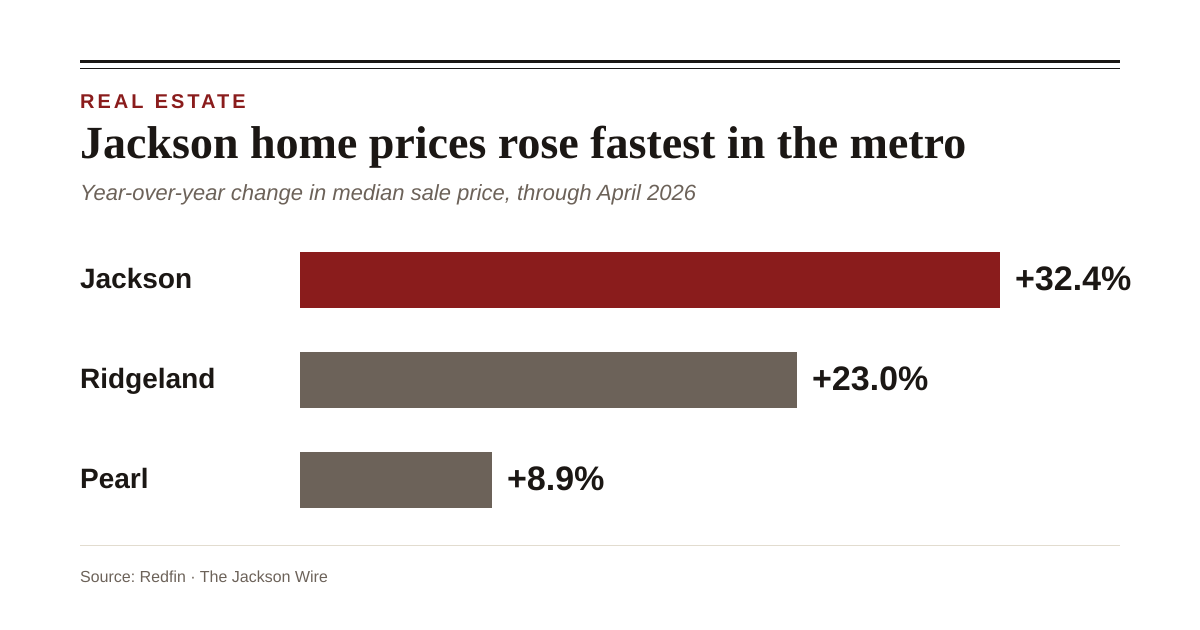
Something is shifting in Jackson's housing market, and it's showing up in the data.
Home prices in the city of Jackson rose 32.4 percent over the past year, the largest jump in the metro area, according to Redfin. The median sale price climbed to $144,000, with Ridgeland up 23 percent and Pearl up 8.9 percent over the same period. Over the three months ending April 2026, Jackson prices were up 25.5 percent compared with the same stretch a year earlier, and homes are moving faster. The typical Jackson home now sells in 44 days. A year ago, it took 60.
For agents on the ground, the numbers match what they're seeing in the field.
“There's been this resurgence in Jackson,” said Janelle Hederman of Nix-Tann Associates. “I really feel like the last 12 to 18 months, we are seeing families come back to Jackson.”
Her colleague Jamil Jackson, also with Nix-Tann, points to a stack of changes happening at once. “The improvements in infrastructure, the changes in city government and ratings for the schools have improved. It's a collection of improvements increasing values.”
That collection is more than talk. Jackson's water system reached Safe Drinking Water Act compliance by the middle of 2025 after a decade of failures, leak repairs, and federal oversight. The city closed out 2025 with 75 homicides, down 32 percent from 111 the year before. That's the fourth straight year of declining homicide numbers and the lowest total since 2017. Mayor John Horhn, sworn in last July after defeating two-term incumbent Chokwe Antar Lumumba in a landslide runoff, has built bridges with state lawmakers and the business community that the previous administration could not. Jackson Public Schools has held its C accountability rating and cleared most of its outstanding accreditation concerns. Downtown, the $29 million reconstruction of State Street is closing in on completion this summer.
And the gains aren't just landing in the usual upscale corners of the city. Hederman noted that South and West Jackson residents “are trying really hard to take care of their neighborhoods. You've got great things happening in Presidential Hills, Norwood.” Buyers are looking at parts of town that for years didn't show up on appreciation maps at all.
A word of honesty on the headline number. The 32.4 percent figure is a change in the median sale price, which means it captures the prices of homes that actually changed hands this year. Other indexes that try to control for which homes sold, like the FHFA repeat-sales index, show the Jackson metro up closer to 3 to 5 percent over the year. The truth is probably somewhere in the middle. Some of the surge reflects more renovated, higher-value homes coming to market, and some of it reflects genuine, broad-based recovery. Both can be true at once.
For sellers, the math is plain. Homes are moving faster, and asking prices are landing. For buyers, the window of bargain-bin Jackson real estate is closing on the better-located properties. And for a city that spent the better part of a decade in the national news for everything that was broken, the most striking number may be the one no spreadsheet captures. People are choosing to come back.
The trend is still young. Population data still shows Jackson losing residents overall, water rates just went up 12 percent to cover the system's operating shortfall, and the city's challenges have not vanished. But for the first time in years, the price signal is pointing up rather than down.
For a market that has been written off more than once, that signal matters.
---
[The Jackson Wire](https://www.thejacksonwire.com/) · [Read on the web](https://www.thejacksonwire.com/article/jackson-home-prices-top-metro)
---
# Plea Deadline May 29th: Will Banks Plead?
> An analysis: of the three men headed to trial in Jackson's biggest corruption case, Aaron Banks has always been the quiet one — and the quiet may be calculated.
*Politics · By Jackson Wire Staff · May 25, 2026*

Of the three men headed to trial in Jackson's biggest corruption case, Aaron Banks has always been the quiet one. The former city councilman has said almost nothing in public — "I have nothing to say," he told one reporter — while District Attorney Jody Owens calls the case an "assassination" of his character and the former mayor argues constitutional theory in the press.
But quiet may be the smartest move in the room. And it makes Banks the man to watch as the May 29 plea deadline closes in.
Here's why. Banks faces the fewest counts of the three. He's accused of accepting the smallest amount — roughly $10,000, plus a protective detail and a job offer for his daughter. Two of his co-conspirators, Angelique Lee and Marve' Smith, already pleaded guilty and are sitting unsentenced, the classic sign of cooperators waiting to testify. The math for Banks is simple and brutal: a single-count plea caps his exposure at five years, while a trial loss alongside the man prosecutors call the scheme's "lynchpin" could be far worse.
There's also a wrinkle in his favor. Banks asked the judge to sever his trial from Owens's — to not be tried beside a man caught on tape talking about "cleaning" money and keeping a "bag of information" on the council. The judge said no. So unless Banks pleads, he sits at the same table as the loudest defendant in Mississippi, while a jury hears weeks of recordings that mostly aren't his. The defense does have a real argument that could tempt Banks to roll the dice: the city never actually held the vote he supposedly sold. The council doesn't vote on the kind of application the developers submitted. No vote, the defense says, means no bribe — just a promise about something that was never going to happen.
So the calculation comes down to nerve. Plead now, take the cap, and try for the lightest sentence of anyone charged. Or bet that a jury sees a quiet councilman who got swept up in someone else's scheme.
May 29 is the tell. If Banks is going to fold, he'll do it before he ever sees that courtroom.
---
[The Jackson Wire](https://www.thejacksonwire.com/) · [Read on the web](https://www.thejacksonwire.com/article/plea-deadline-may-29-will-banks-plead)
---
# State Street Group Bets on the Office-to-Apartment Playbook Again, This Time in Northeast Jackson
> A quiet office building on Ridgewood Road is becoming luxury lofts. The developer has done this before, and the math is the reason.
*Commercial Real Estate · By Jackson Wire Staff · May 25, 2026*

There's a “Coming Soon” sign up at 2625 Ridgewood Road in Northeast Jackson, where a modest Class B office building called Eastover Commons is being reborn as The Lofts at Eastover. The pitch on the sign is simple: “New, Luxury Style Lofts.” The strategy behind it is more interesting than the marketing.
The developer is State Street Group, the Jackson firm founded in 1971 by J. Kane Ditto, the former two-term mayor of Jackson, who remains the company's principal. Day-to-day operations run through president Justin Peterson. Grant Ethridge Construction, out of Lafayette, is the general contractor, and Ridgeland's Dean Architecture is handling design. The building is being converted into roughly 15 loft-style apartments, one and two bedrooms, ranging from about 530 to 1,190 square feet, with asking rents listed between $1,321 and $2,630 a month.
What makes this worth a commercial real estate reader's attention isn't that it's an office conversion. It's that it isn't being driven by office distress.
The national story everyone knows is empty towers and gutted downtowns, conversions born of desperation. That isn't what's happening here. The I-55 and Lakeland corridor where this building sits has an office vacancy rate around 10.7 percent, one of the tightest submarkets in the metro. This building wasn't bleeding tenants. State Street simply ran the numbers and saw that apartment rents on this corridor, $1,300 to $2,600 a door, clear the economics of small office suites that once rented for a few hundred dollars a month. When multifamily rents have climbed more than 20 percent since 2020 and office rents have barely moved, the better use of an aging office asset becomes obvious. This is optimization, not triage.
And State Street has run this exact play before. In 2018, the firm converted upstairs office space along Lakeland Drive into a dozen units it called The Quarter Lofts. In 2024, it took over Walthall Lofts and The Courthouse downtown, leasing a large block of those units to Jackson State for student housing. The Lofts at Eastover is the same template at a familiar scale: take a tired commercial building in a good location, reposition it as residential, keep it in-house to manage. For a firm that owns more than 35 assets and 2.3 million square feet, adaptive reuse isn't an experiment. It's a line of business.
The location does the selling. The site sits a block off Lakeland, less than a mile from I-55, and within easy reach of UMMC, St. Dominic and Baptist, a built-in renter base of medical workers, plus the restaurants and walkability of nearby Fondren. The “Eastover” name borrows shine from the upscale enclave and the larger District at Eastover development nearby, though this is a separate, smaller project.
For the broader market, the signal is the takeaway. If a developer is converting office to residential in a 10-percent-vacancy submarket, it says the rent gap between the two uses has gotten wide enough that conversion pays even where office isn't failing. Watch whether State Street announces a second phase or a downtown conversion next. If it does, this stops being a one-off and becomes a pipeline.
The Lofts at Eastover is taking applications now.
---
_Reporting note: Unit count and rents reflect current leasing listings (Apartments.com, RentCafe) and on-site signage; State Street Group has not issued a press release on the project and no figures are independently confirmed by the developer. J. Kane Ditto is the founder and principal of the developer, not the personal developer of the building, and is distinct from his son Raymond Ditto, who runs the unrelated Ditto Residential in Washington, D.C. This project is also separate from the “District Lofts at Eastover” at the larger District at Eastover development._
---
[The Jackson Wire](https://www.thejacksonwire.com/) · [Read on the web](https://www.thejacksonwire.com/article/lofts-at-eastover-office-conversion)
---
# The Lot
> An essay: for twenty years Jackson couldn't give away a downtown lot — and when investors finally arrived with a private jet and a yacht, they turned out to be the FBI.
*Politics · By Jackson Wire Staff · May 25, 2026*
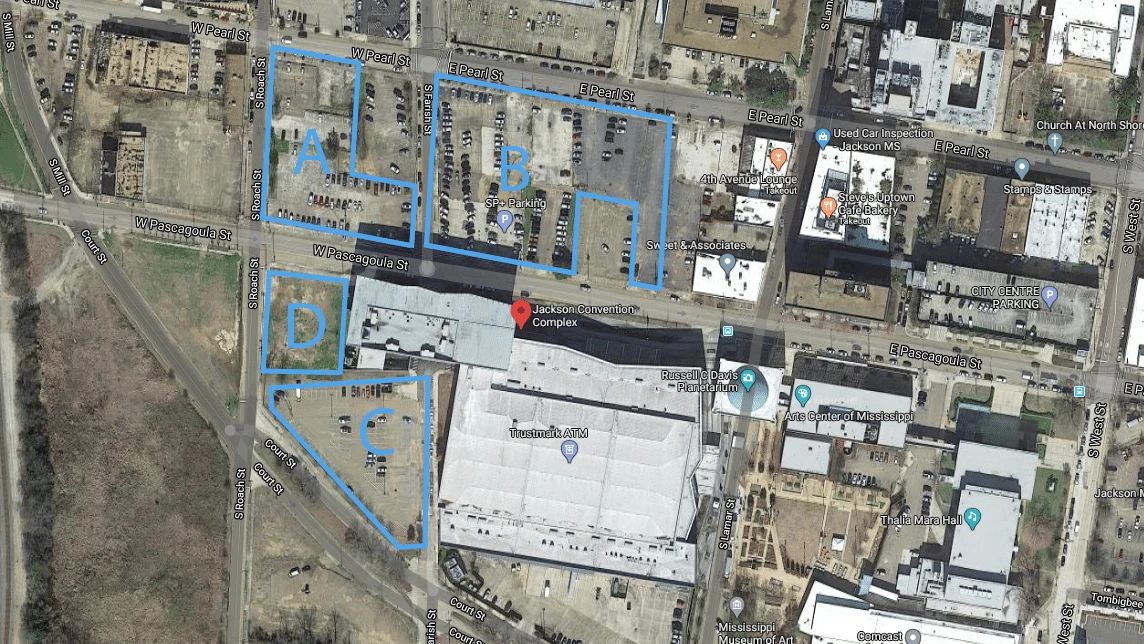
For twenty years, the City of Jackson could not give away a parking lot.
It sits downtown, across from the convention center — a flat, hopeful rectangle of nothing that generations of city officials have dreamed of turning into a hotel. They issued the paperwork. They held the meetings. They waited. And year after year, the developers of America looked at Jackson, Mississippi, and looked away. Not one serious bid. Not once. The lot stayed a lot.
Then, in 2023, the perfect developers finally arrived. They had money to burn and grand plans for the convention-center hotel the city had been begging for. They flew the right people to Nashville on a private jet. They hosted them on a yacht in Fort Lauderdale. They were everything Jackson had been waiting two decades to see.
They were the FBI.
What unfolded next is now the largest public-corruption case in modern Mississippi history — Hinds County District Attorney Jody Owens, then-Mayor Chokwe Antar Lumumba, and Councilman Aaron Banks, charged in a bribery scheme built around that empty downtown lot. There are recordings. There is cash, including bills the FBI later found stuffed inside a hollowed-out copy of the U.S. Constitution. There is talk, captured on tape, of "cleaning" money and a "bag of information" on the city council. It is, by any measure, an ugly story, and a jury will weigh it starting July 13.
But here is the strange, almost literary heart of the case, the part that should make you sit up: the thing the city could never develop in real life, it could not quite manage to be bribed over either.
The government's whole trap depended on a vote — the kind of formal council approval that turns a campaign check into a federal crime. But somewhere in the machinery, worn down by a decade of soliciting proposals that drew no response, the city switched the type of paperwork it was using. The new version never goes before the council at all. There was, the defense argues, no vote to sell. The single "official act" the mayor allegedly performed for his money was a phone call nudging a deadline two weeks earlier on a calendar — a deadline that locked nobody out, that the city employee who carried it out said raised no red flags.
The FBI spent over a million dollars, two years, and a yacht to catch a crime built on a hotel that was never going to be built, on land that has defeated everyone who ever touched it.
The judge has ruled the case will go to a jury — these are questions for twelve citizens, not for him to dismiss. The government's evidence is real and, in places, damning. The men may well be convicted. This is not a story about innocence.
It's a story about a city. About what it does to a place when nothing gets built, when the only outside investor who ever showed real interest in twenty years turned out to be a federal agent wearing a wire. About a downtown lot so cursed that even the corruption attached to it may have been, in the end, a fiction.
The trial starts in July. Whatever the verdict, the lot will still be there.
Empty.
---
[The Jackson Wire](https://www.thejacksonwire.com/) · [Read on the web](https://www.thejacksonwire.com/article/the-lot)
---
# The Mayor Who Made One Phone Call
> For readers who want to understand Chokwe Antar Lumumba's case: of the three men charged, his alleged crime is the thinnest — and his defense the most purely legal.
*Politics · By Jackson Wire Staff · May 25, 2026*
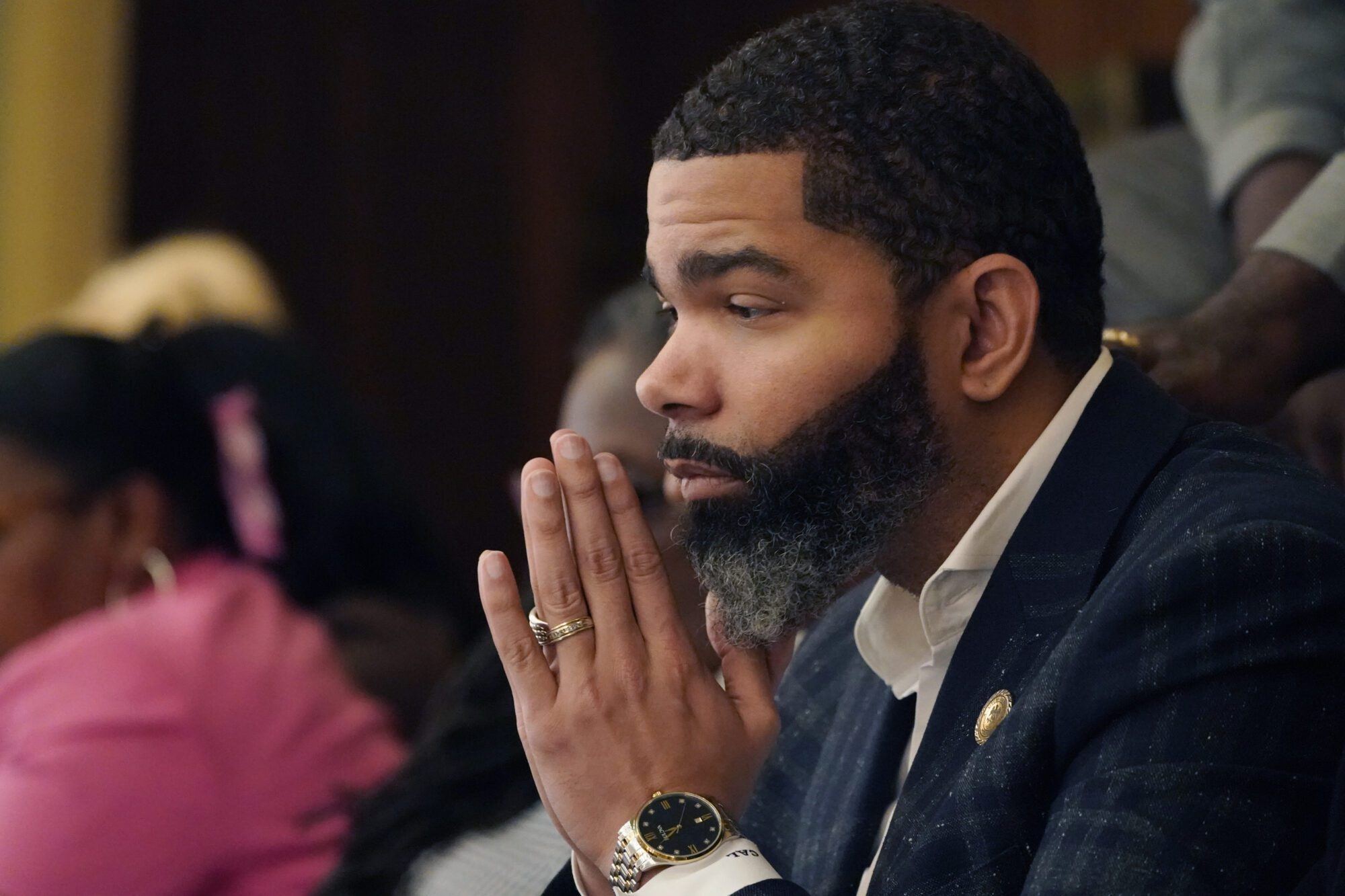
He was supposed to be the future. Chokwe Antar Lumumba inherited not just a name but a movement — his father had been Jackson's mayor before him, a civil-rights radical turned city executive, and the son carried that legacy into office promising to make Jackson "the most radical city on the planet." Now he's a former mayor, beaten badly at the ballot box while under federal indictment, waiting for a July trial that will decide whether he's also a felon.
But here's what makes Lumumba's case genuinely different from his co-defendants', and worth understanding on its own terms: of the three men charged, his alleged crime is the thinnest. And his defense is the most purely legal.
Strip away the yacht and the cash and the cigar-bar theatrics, and the government's case against Lumumba comes down to a single act. One phone call. In April 2024, he told a city employee to move a submission deadline forward by two weeks — from April 30 to April 16. For that, prosecutors say, he took $50,000, routed through campaign checks so it would look like it came from inside Mississippi.
Lumumba doesn't deny the call. He admits he made it. His entire defense is that the call wasn't a crime.
This is where his case turns on a 2016 Supreme Court decision called McDonnell — the case that overturned the bribery conviction of Virginia's governor. The Court ruled there that not everything a politician does for a donor is an "official act." Setting up a meeting, making a call, hosting an event — those ordinary courtesies of political life don't automatically become federal felonies just because money changed hands somewhere. There has to be a real exercise of government power: a vote, a hearing, a formal decision.
Lumumba's argument is that moving a deadline is exactly the kind of ministerial errand McDonnell says is not a crime. The employee who carried out the change later said it didn't strike him as unusual. No developer was shut out. The deadline could have been any date on the calendar. Where, his lawyers ask, is the formal exercise of governmental power in nudging a date two weeks?
The government's answer is that you can't look at one phone call in isolation — that the call was one move in a larger agreement, and that Lumumba's real value was his power to "do damage" to the project if he wanted, to make life difficult for developers who didn't pay. The bribe, prosecutors say, bought his cooperation across the whole scheme, not just the calendar.
The judge sided with the government on a crucial technical point in May. He ruled that the specific bribery statute used here doesn't even require an "official act" in the strict McDonnell sense — only a corrupt deal in exchange for influence. But he also left the hardest question unanswered, handing it to the jury and to a fight over how they'll be instructed: what, exactly, did Lumumba have to agree to do for that $50,000 to be a crime? That instruction may matter more to his fate than any witness.
There's a human layer underneath the law, too. Lumumba asked to be tried separately from Owens — he didn't want to sit beside a man recorded talking about "cleaning" money and keeping dirt on the city council, didn't want that spectacle bleeding onto him in front of a jury. The judge said no. So the quietest defense in the case will be heard in the same room as the loudest, and Lumumba will have to hope twelve jurors can keep the two men separate in their minds.
The political verdict is already in. Jackson voters threw him out in 2025 by a landslide, ending a family dynasty on a wave of scandal. What's left is the legal one. And it rests on a question that sounds almost too small to carry a man's freedom:
Is moving a deadline a crime?
In July, a jury will answer.
---
[The Jackson Wire](https://www.thejacksonwire.com/) · [Read on the web](https://www.thejacksonwire.com/article/the-mayor-who-made-one-phone-call)
---
# Judge Lets Owens Take His Fight to a Jury
> Why the defense sees an opening: the judge denied the motion to dismiss, but kept Owens's entrapment defense alive and left the central legal question for the jury.
*Politics · By Jackson Wire Staff · May 25, 2026*
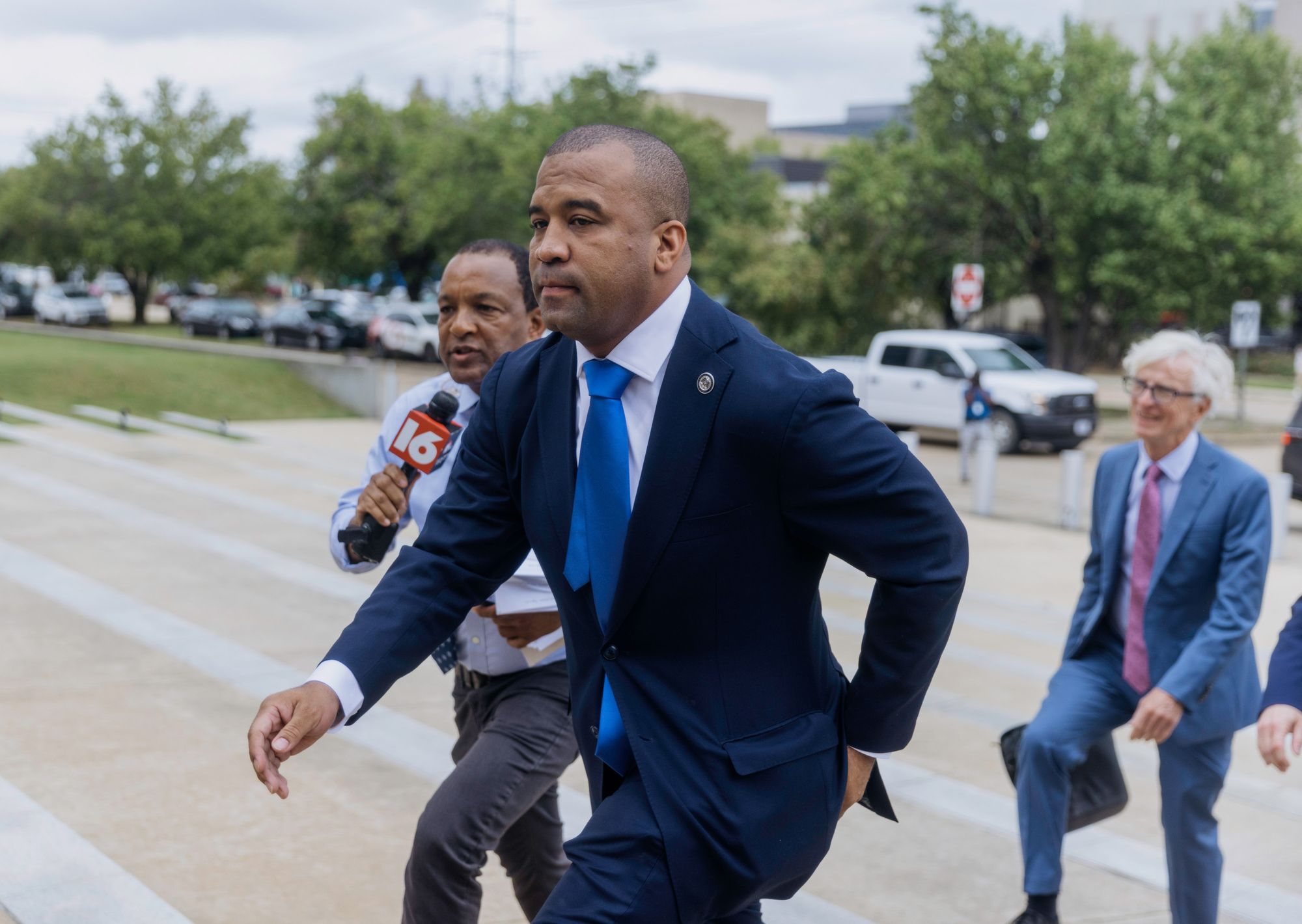
A federal judge would not throw out the corruption case against Hinds County District Attorney Jody Owens this week. But read the order closely and the defense may have come out better than the headlines suggest.
It is true that Judge Daniel P. Jordan III denied the motion to dismiss. That was always the likely result. Federal judges rarely toss a case before trial. They leave the big questions for a jury. But what a judge says while denying a motion can matter more than the denial itself. And here, Jordan said two things the defense wanted to hear.
First, he refused to block Owens from arguing entrapment at trial. Prosecutors asked him to take that defense off the table. He said no. "The Court will not prevent him from attempting to prove his theory of the case," he wrote. So a jury will get to hear Owens's main argument. That argument is simple. The FBI did not catch a crime. It built one. Agents flew him on private jets, pushed him at every step, and spent more than a million dollars chasing a development deal that was never real.
Second, Jordan left the most important legal question in the case wide open. To convict, the government has to prove a corrupt deal, a this for that exchange. But Jordan said how that has to be explained to the jury is not settled yet. The two sides, he wrote, will have to sort it out when the jury instructions are written. In plain words, the fight over what prosecutors actually have to prove is not over. It is just moving to the stage where it may count the most.
That matters because the defense's best argument lives right in that gap. Owens's lawyers say the one official act at the center of the case, a phone call moving a paperwork deadline, is not the kind of serious government action the bribery laws were meant to punish. Jordan ruled that this is a question for the jury, not a reason to dismiss. But a question for the jury is a long way from case closed. It means twelve people from Jackson, not a prosecutor, will decide it.
None of this makes the path easy. The government has a lot of evidence, and Owens still goes to trial in July. But the defense filed a bold, heavy challenge, and this ruling kept its best tools instead of taking them away. Owens did not get the case dismissed. He got something his lawyers may value almost as much. He gets to make his full case to a jury, and the rules of that fight are still up for grabs.
The trial begins July 13.
---
[The Jackson Wire](https://www.thejacksonwire.com/) · [Read on the web](https://www.thejacksonwire.com/article/judge-lets-owens-take-his-fight-to-a-jury)
---
# One Investor Just Bought the Heart of Downtown Jackson, and He's Just Getting Started
> In barely a year, New Jersey tech founder Kumar Bhavanasi has quietly bought five of downtown's most important buildings — and he's planning to spend more than $100 million bringing them back to life.
*Commercial Real Estate · By Jackson Wire Staff · May 25, 2026*
Something big is happening in downtown Jackson, and it has a name: Kumar Bhavanasi.
In barely a year, this New Jersey tech founder has quietly bought up five of the most important buildings in the city's business district. The Regions Building. The Pinnacle. The Deposit Guaranty Building. The Electric Building. And now the old Marriott Hotel. Put them together and Bhavanasi owns the spine of downtown Jackson.
His Jackson story started by accident. He first rolled through town in 2019 to look at a shopping center and fell in love with the skyline. "Wow, beautiful downtown," he remembers thinking. A few years later, a broker called him about the Deposit Guaranty Building while he was on vacation in Italy. He bought it almost sight unseen. Then he kept going.
The Marriott was the one that nearly got away. He bid in an online auction last December and lost. But when the winning bid fell through, he jumped back in and closed the deal in January 2026. "It was so attractive that I could not pass it up," he said.
Now he's swinging big. Bhavanasi plans to pour more than $100 million into these buildings. The Deposit Guaranty Building is set to become up to 200 apartments with shops on the ground floor, maybe even a small grocery store. The Marriott will be gutted to the studs and reopened as a full hotel. He's bringing the kind of energy downtown hasn't felt in years.
And it's already working. In February 2026, the law firm Cosmich Simmons & Brown moved nearly 50 employees into the Pinnacle Building, his first major tenant. People who'll buy lunch, grab coffee, and bring life back to the streets.
"I knew it was going to work," Bhavanasi said. "But when you get your first lease, you know it's working."
Downtown Jackson is waking up. And the best part? This is only the beginning.
---
[The Jackson Wire](https://www.thejacksonwire.com/) · [Read on the web](https://www.thejacksonwire.com/article/one-investor-bought-the-heart-of-downtown-jackson)
---
# Data Centers Are Coming to Metro Jackson, and the Debate Is Heating Up
> A New Jersey firm wants to rezone 190 acres for what looks like a data center, just as the City Council weighs a moratorium — part of a boom that's made Mississippi one of the country's hottest markets.
*Commercial Real Estate · By Jackson Wire Staff · May 25, 2026*

The race to build data centers in Mississippi has officially reached Jackson's front door, and not everyone is rolling out the welcome mat.
Just one day after the Jackson City Council tabled a temporary ban on data centers, WLBT learned that a rezoning request tied to one is headed to the Planning Board on May 27. A New Jersey real estate firm, Saxum Investment Company, wants to rezone roughly 190 acres along Forest Avenue, near I-220 and Medgar Evers Boulevard, for heavy industrial use.
Here's the twist: the application never actually says "data center." But almost everyone seems to know that's the plan. "When you read that application it doesn't say data center," said Ward Two Councilwoman Tina Clay, who worries about the impact on the nearby Ashley Acres subdivision. "But that's what it is. We all know that."
So why all the buzz over a building full of servers? Money, for one. The company's attorney told the council a new data center could pump tens of millions of dollars in fresh property taxes into the city and school district over the next decade. But Council President Brian Grizzell, who authored the proposed moratorium, has concerns about what these power-hungry, water-thirsty facilities could do to Jackson's already strained water and sewer systems. "All money is not good money," he told the council.
Whatever Jackson decides, it's not happening in a vacuum. Mississippi has quietly become one of the hottest data center markets in the country. Amazon alone now plans to invest a staggering $25 billion across the state, with projects in Madison County, Ridgeland, Warren County, and a $1 billion build in Hinds County at the old Delphi plant. Just down the road in Clinton, Amazon is putting up a $750 million data center on the former Milwaukee Tool site, a deal the mayor called the biggest economic development project in the city and county's history.
The pitch is hard to ignore: billions in investment, thousands of high-paying jobs, and a serious tech footprint for a state that's used to being overlooked. The catch is that all those servers need enormous amounts of power and water, and cities are now wrestling with whether the payoff is worth the strain.
For Jackson, that decision is coming fast. The Planning Board meets May 27, and if it approves the rezoning, the matter heads to the council in June for a final vote.
The bottom line? The data center boom that's been sweeping Mississippi is now knocking on Jackson's door, and the next few weeks will tell us whether the city says come on in, or not so fast.
---
[The Jackson Wire](https://www.thejacksonwire.com/) · [Read on the web](https://www.thejacksonwire.com/article/data-centers-coming-to-metro-jackson)
---
# One Courtroom, Three Defendants, and a Trial That Isn't What It Looks Like
> As the Jackson corruption case heads toward trial, here's what the headlines won't tell you about how it will actually unfold.
*Politics · By Jackson Wire Staff · May 25, 2026*
This summer, a federal jury in Jackson is set to hear one of the most closely watched public corruption cases this city has seen in years. Former Hinds County District Attorney Jody Owens, former Mayor Chokwe Antar Lumumba, and former City Councilman Aaron Banks are charged together in a single indictment. Most people assume that means one trial, one jury, and one verdict, guilty or not guilty all the way around.
It is almost never that simple. Understanding why is worth a few minutes, because what happens in that courtroom will say something about how the justice system treats all of us, not just the powerful.
Start with a basic fact most people don't know. Federal prosecutors strongly prefer to try co-defendants together, and the law presumes they should. Joint trials save money, spare witnesses from testifying twice, and prevent different juries from reaching contradictory results. But there is a strategic edge too. When jurors hear the entire alleged scheme in one sitting, every meeting, every dollar, every text message, the conduct can feel bigger and more coordinated than the evidence against any one person might show on its own.
Defense lawyers have a word for that effect. They call it spillover, and it is the central risk of a joint trial. A defendant can be judged not only by what the government proves against him, but by the mood the evidence against everyone else creates in the room. That is why defense attorneys routinely ask the judge to sever the case, meaning they want each client tried separately. It is also why those requests usually fail. Courts trust juries to keep each defendant's evidence in its own box. In this case, the judge denied severance, so all three men are currently set to be tried together.
Now picture the room. On one side sits a single prosecution team telling one clean story. On the other sit three separate defendants, each with his own lawyers and his own theory, and those theories do not have to agree. Often they don't. Every objection and every cross-examination by one defense team ripples onto the other two. A point that helps one defendant can quietly damage another.
Even jury selection reflects the strain. In a federal felony trial, the defense as a group typically gets ten peremptory strikes, which is the power to remove a potential juror without giving a reason. The phrase that matters is as a group. Three defendants often must share strikes that a single defendant would have had to himself, which forces their lawyers to negotiate over which jurors to cut. The juror one defendant fears may be the very juror another wants to keep.
Then there are the cooperators. Two people originally charged in this matter have already pleaded guilty and now await sentencing. That is one of the most common turns in federal practice, and it is rarely an accident of timing. A defendant who cooperates usually does so before sentencing, because the most valuable thing he can give the government is testimony, and that testimony can shorten his own punishment. For the defendants still standing trial, a former co-defendant on the witness stand is both a danger and an opening. A danger, because an insider's account is persuasive. An opening, because that witness can be questioned about the deal he made and the powerful incentive he has to tell prosecutors what they want to hear. Jurors are allowed to weigh that, and good lawyers make sure they do.
All of this points to the part the headlines tend to miss. Because a joint trial puts three people, with three different levels of alleged involvement, in front of the same twelve jurors, the ending is rarely all or nothing. A jury can convict one defendant and acquit another. It can convict on some charges and reject others. It can even fail to agree at all about one person while reaching a verdict on the rest. Each defendant is judged separately, on each count, even though they shared a courtroom, a judge, and a jury.
None of this is about whether these particular men are guilty. That is for the jury, and every one of them is presumed innocent until the government proves otherwise beyond a reasonable doubt. It is about recognizing that the pretrial motions, the jury math, and the cooperation deals are not lawyer's trivia. They are the architecture that decides what a jury is ever allowed to see, and in the end what justice in this case will look like.
When the verdict comes, it may not be a single word. Pay attention to the pieces, because that is where the real story usually lives.
---
[The Jackson Wire](https://www.thejacksonwire.com/) · [Read on the web](https://www.thejacksonwire.com/article/one-courtroom-three-defendants)
---
# The Jackson Bribery Case: A Timeline
> An updated chronology of United States v. Owens — from the FBI's 2022 tip through the July 13 trial date, with the jury and venue fight in focus.
*Politics · By Jackson Wire Staff · May 25, 2026*
United States v. Jody E. Owens II, et al. — No. 3:24-cr-103-DPJ-LGI (S.D. Miss.). Updated through May 25, 2026.
Highlighted entries mark jury and venue developments. Trial is set to begin July 13, 2026. All three defendants have pleaded not guilty and are presumed innocent unless and until proven guilty beyond a reasonable doubt.
## Timeline
### 2022–2024 · Investigation, Sting, Indictment
- **May 2022** — FBI receives the tip that launches the Jackson public-corruption probe.
- **Aug–Sept 2022** — Source reporting references Owens and the cigar shop; Owens added as a "subject" (Sept. 12 email). Sept. 2: Capitol Police gun-pointing incident.
- **Dec 2022** — FBI confidential sources begin operating in Jackson as fake developers.
- **July 26, 2023** — First government contact with Owens at the cigar bar (defense's key predisposition date).
- **Aug 14, 2023** — Meeting where the defense says Owens showed reluctance.
- **Oct 2023** — Nashville trip (private jet); Owens allegedly becomes a target. Oct. 16: indictment's claimed "predisposed" date.
- **Nov 2023** — Owens reelected; designated a subject of the investigation.
- **Dec 2023** — First Florida yacht trip; $125,000 cash.
- **Jan–April 2024** — Payments around Banks and Lee; the "War Room"; RFQ deadline moved (Lumumba call, April 12); 2nd Florida trip, five $10K checks to Lumumba.
- **May 22, 2024** — Search warrants; hollow-Constitution cash recovered; Owens interview (false-statement count).
- **Aug 14, 2024** — Angelique Lee resigns and pleads guilty.
- **Oct 17, 2024** — Sherik Marve' Smith pleads guilty.
- **Oct 31 / Nov 7, 2024** — Grand jury indicts; indictment unsealed; all three plead not guilty.
### 2025 · Scheduling and the Election
- **Feb 19, 2025** — Smith's first sentencing date; later continued (cooperation posture).
- **March 4, 2025** — Mayfield sentenced (24 months).
- **March 7, 2025** — Trial set for July 13, 2026. DOJ estimates 1–2 days for jury selection; Jordan corrects him, citing the 2009 Frank Melton trial (a full week; ~90% of pool had seen coverage).
- **April 22, 2025** — Lumumba loses the runoff to John Horhn (~75–25); leaves office July 1.
### 2026 · The Pretrial Run-Up
- **Jan 12, 2026** — Owens files 68-page motion to dismiss with ~50 FBI exhibits (entrapment / outrageous conduct).
- **Jan 13–15, 2026** — Government emergency seal; temporary seal granted; Owens contests it.
- **Feb 11, 2026** — Status conference: Jordan says jury selection "could take a while"; signals reluctance to move to Gulfport.
- **Feb 17, 2026** — Jordan formally seals filings pending redaction review.
- **Feb 2026** — Government moves to transfer venue to Gulfport OR draw a district-wide venire (sealed; AUSA Purdie).
- **March 11, 2026** — Lumumba files his own motion to dismiss (McDonnell "no official act").
- **March 15, 2026** — Banks moves to sever.
- **March 25, 2026** — Owens opposes transfer: "forum shopping" brief (Jackson 82% Black vs. Gulfport ~38%).
- **April 1, 2026** — Status conference: Jordan — "I am not moving this trial to Gulfport." Adopts a questionnaire-first plan; district-wide venire as backup. Sets discovery deadlines.
- **Early May 2026** — Court mails the Frank Melton-style juror questionnaire to the Northern Division pool.
- **May 11, 2026** — New protective order restricting discovery to defense teams; return/destruction post-trial.
- **May 14, 2026** — Omnibus order: denies all dismissal and severance motions; PRESERVES entrapment for the jury; holds §666 needs no "official act" but still requires quid pro quo (jury-instruction fight); defers jury-taint to selection.
- **May 15, 2026** — Venue briefing and questionnaire unsealed and reported.
- **May 19, 2026** — Owens's "forum shopping" response published.
### The Road Ahead
- **May 29, 2026** — Plea-change deadline.
- **June 8, 2026** — Parties meet to identify jurors to strike (lawyers' work session, NOT in-court voir dire).
- **June 9, 2026** — Strike lists due to the court.
- **June 15, 2026** — Final supplemental briefing on the transfer / venire question due.
- **June 9 – July 1** — Watch for Jordan's written ruling on the venire: stand pat, enlarge the Northern Division pool, or go district-wide.
- **July 13, 2026** — Trial begins; in-court voir dire starts this day (projected ~1 week, within a ~6-week trial).
---
_Correction from earlier drafts: in-court jury selection begins July 13, 2026, not June 8 — June 8 is the lawyers' strike-list meeting on questionnaire results. Compiled from public court filings and Mississippi news reporting (WLBT, WLOX, Mississippi Today, WJTV, Magnolia Tribune). Dates involving sealed filings reflect news accounts of unsealed versions; some exact dates are approximate. Informal analysis, not legal advice._
---
[The Jackson Wire](https://www.thejacksonwire.com/) · [Read on the web](https://www.thejacksonwire.com/article/the-jackson-bribery-case-a-timeline)
---
# Republicans Built Bennie Thompson's "Super-Democratic" District. Now They Want to Burn It Down.
> How Mississippi already mastered the gerrymander everyone's suddenly talking about.
*Politics · By Jackson Wire Staff · May 25, 2026*
The country is having a loud new argument about gerrymandering. The Supreme Court reshaped voting-rights law this spring, Louisiana lost a majority-Black district, and politicians from Washington to Baton Rouge are treating racial redistricting like some shocking frontier being crossed for the first time.
In Mississippi, the reaction is drier.
"Being it the country now gets to know what it's like living in the state of Mississippi," says Rep. Robert Johnson, the Democratic leader in the state House, from Natchez. "This old gerrymandering thing that everybody's excited about, what they're gonna do in Louisiana? We've already done it. We just call it Tuesday."
It's a good line because it's true, and because it cuts against the story both parties prefer to tell. To understand why, you have to start with a fact that flips the usual assumption on its head.
The one Black district was never a gift. It was a remedy.
The instinct is to look at Mississippi's 2nd Congressional District, the majority-Black seat that runs through the Delta and has elected Bennie Thompson since 1993, and assume it was drawn to hand Democrats a safe seat. The history says the opposite.
The Delta, home to the largest Black population in the state, was a single congressional district from 1882 all the way through the maps of 1932, 1952, and 1962. Then in 1966, immediately after the Voting Rights Act passed, the Legislature deliberately split the Delta across three districts at once, producing a white voting-age majority in all five of Mississippi's districts. That was the original gerrymander, and it ran the other direction from what most people assume. The goal was to crack Black voters apart so they could not elect anyone.
That split held for nearly twenty years. It was undone only by lawsuit. In Jordan v. Winter (1984), following a Justice Department objection under the Voting Rights Act, a federal court ruled that fracturing the Black population diluted its voting strength illegally and ordered a new map with one Black-majority district. In 1986 Mike Espy won it, becoming the first Black congressman from Mississippi since Reconstruction. Thompson followed him.
So when Mississippi officials describe the 2nd as a district "drawn to protect Bennie Thompson," they are telling the end of the story and skipping the beginning. It was drawn to remedy nearly a century of vote dilution, by federal courts, because the state would not do it on its own.
Here's the part the outrage leaves out.
Johnson's deeper point is that Republicans don't actually mind the packed Black district. They have quietly relied on it.
"This is some capital-H hypocrisy, some of this outcry about Bennie's super-Democratic district," Johnson says. "It's that way because Republicans wanted it. To protect all the other seats."
The math explains the move. Mississippi is about 40 percent Black, the highest share of any state, and that vote is overwhelmingly Democratic. Concentrate as much of it as possible into one district and you get a single overwhelmingly Democratic seat, and three comfortably Republican ones. Spread it out, and you risk creating two competitive districts instead of one safe Democratic one. Johnson is blunt about the consequence: if cracking the 2nd actually helped Republicans, they would already have done it.
"If there was any chance of getting rid of a Democratic congressional seat, we'd be doing it, trust me," he says, describing the Republican calculation. "You couldn't do that without ending up with at least two competitive districts."
He points back to the 2022 redistricting fight, when he says House Democrats wanted to anchor the 2nd in the Delta and add all of Hinds and Madison counties, and Republicans, including Republican congressional candidates, declined. The packed map served the majority. Until, suddenly, a new legal weapon made unpacking it look attractive.
The weapon is Callais.
On April 29, 2026, the Supreme Court decided Louisiana v. Callais 6-3, striking down Louisiana's second majority-Black district as an unconstitutional racial gerrymander. The Court did not formally erase Section 2 of the Voting Rights Act, the provision that bars vote dilution. But it heightened what plaintiffs must prove, pushing back toward a requirement of intentional discrimination rather than the "results" test Congress deliberately wrote into the law in 1982. In dissent, Justice Kagan warned the ruling leaves Section 2 "all but a dead letter."
That doctrinal shift matters more than it sounds. Congress restored the results test in 1982 precisely because an earlier decision, Mobile v. Bolden, had demanded proof of intent, a bar so high it was nearly impossible to clear. Callais swings the law back toward that bar. And it gave Mississippi Republicans the opening they had not previously had a reason to use.
The reaction was immediate. State Auditor Shad White, eyeing a 2027 run for governor, posted that Mississippi "might no longer have a district drawn to protect Bennie Thompson." A state senator said it was time to "erase" the district. Gov. Tate Reeves declared Thompson's "reign of terror on MS-2 is over." The president has pushed Mississippi to redraw its maps as part of a national effort to flip Democratic seats.
The irony Johnson is pointing at sits right there in the open.
Mississippi is the Blackest state in the country, 38 percent by population. It has four House seats. One is held by a Black representative. Both of its U.S. senators are white Republicans. The move now on the table is to eliminate that one district, in that state, by spreading its Black voters thin enough across white-majority districts that they cannot decide an outcome anywhere.
What has stayed constant across sixty years, from the 1966 split to Jordan v. Winter to the post-Callais scramble, is not the law. The law has lurched back and forth. What has stayed constant is the instinct of the state's leadership about how Black voting strength should be arranged. Only the tools have changed.
"We just call it Tuesday," Johnson says.
A special session on the maps has not been formally scheduled. But in Mississippi, the people who draw the lines have rarely waited long once the courts handed them a reason.
---
[The Jackson Wire](https://www.thejacksonwire.com/) · [Read on the web](https://www.thejacksonwire.com/article/republicans-built-bennie-thompsons-district)